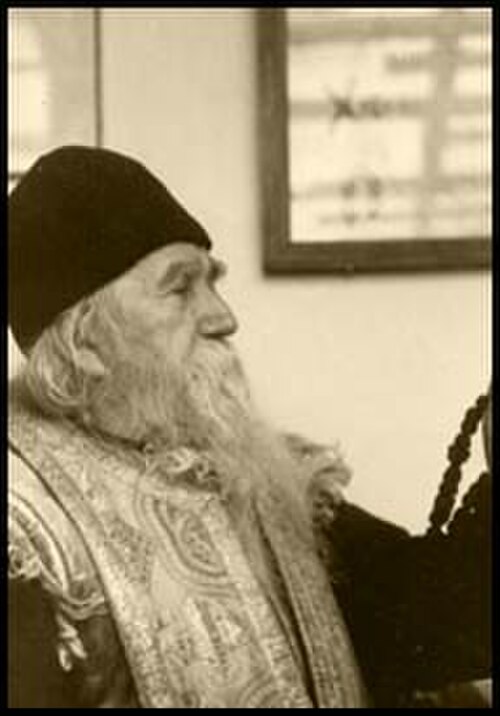
Venerable
Cleopa of Sihăstria
Archimandrite and abbot of Sihăstria
Renowned Romanian spiritual father, archimandrite and abbot of Sihăstria Monastery, 1912 to 1998.
- Feast
- December 2old style December 15
- Reposed
- 199820th century
- Place
- Sihăstria Monastery
- Order
- Venerables
Life
Saint Cleopa of Sihăstria, born Constantin Ilie, was archimandrite, abbot, and spiritual father of Sihăstria Monastery in Neamț County, one of the most beloved elders of Romanian Orthodoxy in the twentieth century. He was born in 1912 and reposed in 1998, after nearly seven decades of monastic life. The Church honours him for his humility and meekness, his zeal in preaching the true faith, and the patience with which he bore communist persecution.
Childhood and apprenticeship
Constantin Ilie was born on 10 April 1912 in the village of Sulița in Botoșani County, to a devout peasant family. He was the fifth of the ten children of Alexandru Ilie. He attended the primary school in his native village and spent much of his boyhood tending the family's sheep.
A decisive influence on him was the schemamonk Paisie Olaru, a hermit at Cozancea Hermitage and the family's spiritual father. For three years young Constantin was his disciple. The bond between them lasted all their lives, and today the Church commemorates them together.
Monk of Sihăstria
In December 1929, with his elder brother Vasile, he came to Sihăstria Hermitage. Some sources say other brothers came with them. The two were formally received into the community on 12 December 1932, the feast of Saint Spyridon.
For many years his obedience was to shepherd the hermitage's flock. Watching the sheep in the surrounding mountains, he prayed, kept silence, and read a great deal. In this way he came to know by heart large parts of the Holy Scriptures, the lives of the saints, and the writings of the Fathers, as well as the decrees of the councils, akathists, and canons.
In 1935 he was called up for military service in Botoșani, and in 1936 he returned to the hermitage. On 2 August 1937 he was tonsured a monk and received the name Cleopa.
Abbot of the hermitage
In June 1942, because Abbot Ioanichie Moroi was gravely ill, the monk Cleopa, not yet ordained, was named deputy abbot. On 27 December 1944 he was ordained a hierodeacon, and on 23 January 1945 a hieromonk, by Bishop Galaction Cordun, then abbot of Neamț Monastery. Soon afterwards he was formally appointed abbot of Sihăstria.
In those years he built new cells and a winter church, restored the old buildings, and made several missionary journeys. The community grew considerably. In 1947 the hermitage was raised to the rank of a monastery, and Father Cleopa was made an archimandrite with the approval of Patriarch Nicodim Munteanu.
Persecution and the mountains
That same year communist rule was established in Romania and the struggle against the faith began. Father Cleopa's sermons strengthened the faith of the people, and the authorities began to watch him. According to some sources, in 1948 he was arrested and held for several days without food or water. That year, sought by the Securitate, he withdrew for six months into the forests around the monastery, living in a hut and celebrating the Liturgy on a tree stump.
On 30 August 1949, by decision of Patriarch Justinian Marina, he was appointed abbot of Slatina Monastery in Suceava County, where he moved with thirty monks from Sihăstria. There he built up a community of more than eighty. Old and young, peasants and educated people, the sick and the healthy came to him for counsel, and with the bishop's blessing he also cared spiritually for other monasteries in the region.
Between 1952 and 1954 he was again pursued by the Securitate and withdrew into the Stânișoara Mountains together with Hieromonk Arsenie Papacioc. He lived there in great hardship, among wild animals, with little food and a makeshift shelter. After two years he was brought back to the monastery on Patriarch Justinian's orders.
In October 1954 he wrote to the community at Vladimirești, defending the canons and dogmas of the Church against errors that had arisen there.
The third withdrawal
In 1956 Father Cleopa returned to Sihăstria, the monastery of his tonsure. A new persecution soon began: under the decree of 1959, thousands of monastics, men under fifty-five and women under fifty, were forced out of the monasteries. In the spring of 1959 he withdrew for the third time into the Neamț Mountains, where he stayed for five years.
These desert years were for him years of prayer and writing. In 1961 and 1962 he composed his fifty homilies for monks, later printed by the Metropolis of Moldavia and Suceava and translated into Greek in Thessaloniki. Of his life in the mountains he later said that he had lived like a king, though he had suffered hunger and cold.
Spiritual father of Sihăstria
In the autumn of 1964 he returned to Sihăstria as spiritual father of the whole community. For thirty-four years he guided monks and laypeople without pause. Simple people came to his cell, and so did politicians and businessmen, whom he received side by side without distinction.
He preached meekness, repentance, frequent confession and Communion, prayer, and mercy to the poor. He urged the faithful to know the Holy Scriptures and Holy Tradition well so as to stand firm in the true faith. Many sick people for whom there was no hope received healing through his prayers.
He spoke of himself as a worthless man and constantly made little of his deeds and sufferings. Yet his words, full of quotations from Scripture and the Fathers, reached the hearts of ordinary people. He often spoke of the beauty of the created world and of man's duty to care for nature as the work of God.
His writings
From 1965 he began writing sermons, counsels, and letters for monks and laypeople, some apologetic, against the sects spreading in the country, others for children. His published books include "On the Orthodox Faith" (1981), reissued as "Guide to the Orthodox Faith", "Sermons on the Great Feasts and the Saints of the Year" (1986), "Sermons for the Sundays of the Year" (1990), "The Value of the Soul" (1991), "Ascent to the Resurrection" (1992), and "On Dreams and Visions" (1993).
His conversations were also included in the "Spiritual Conversations" volumes of Archimandrite Ioanichie Bălan, who also wrote his life. Together with Father Paisie Olaru he composed akathists. His writings have been translated into many languages, and several volumes of his teachings have appeared in Serbia.
Last years and repose
In the final period of his life his day was divided into three parts: prayer with a little rest, reading the Fathers and writing, and receiving disciples and pilgrims. In his last twenty years he prayed fourteen or fifteen hours a day and added three or four hundred prostrations to his rule.
The arrests and years in the wilderness had marked his health, and from 1985 serious illnesses beset him. In his final months he often said that he would soon go to God, and the day before his death he told a disciple that on the morrow he would pass into the other world. He reposed on 2 December 1998 at Sihăstria, and thousands of faithful came to his funeral.
Disciples and legacy
Father Cleopa was a steadfast defender of the traditional Orthodox way of life and had a deep influence on the Romanian Orthodox Church after 1989. Among his disciples were His Beatitude Daniel, Patriarch of Romania, and several bishops. His meekness, joined to a deep knowledge of the faith, made him a symbol of the church revival that followed the fall of communism.
Glorification and veneration
On 12 July 2024 the Holy Synod of the Romanian Orthodox Church decided to number him among the saints, together with his spiritual father, Saint Paisie of Sihăstria, and other spiritual fathers and confessors. The canonisation was proclaimed on 4 February 2025 in the National Cathedral in Bucharest in the presence of the whole Synod. On 7 August 2025, at Sihăstria, more than twenty thousand pilgrims and twenty-four hierarchs took part in the local proclamation of the canonisation of Saints Cleopa and Paisie.
Saint Cleopa is commemorated on 2 December, together with Saint Paisie. His grave lies in the cemetery of Sihăstria Monastery, where pilgrims come without ceasing. The troparion calls the two saints morning stars of Moldavia and pillars of humility.
Commemorated the same day December 2
 HabakkukProphet · The ProphetDec 2
 Stefan Uroš VRight-Believing · Tsar of the SerbsDec 2
 Chromatius of AquileiaSaint · Bishop of AquileiaDec 2
 BibianaMartyrDec 2
 Jovan BrankovićRight-Believing · Despot of SerbiaDec 2
 NonnusSaint · Bishop of EdessaDec 2
 Mirope of ChiosMartyrDec 2
 Ise of TsilkaniVenerable · One of the Syrian FathersDec 2
 Danact KalashnikovVenerable Martyr · HieromonkDec 2
- Avitianus of RouenSaint · Bishop of RouenDec 2
- Tadec of LandevennecHieromartyr · Hieromonk of LandevennecDec 2
- Herman of PechengaVenerable Martyr · Monk of PechengaDec 2