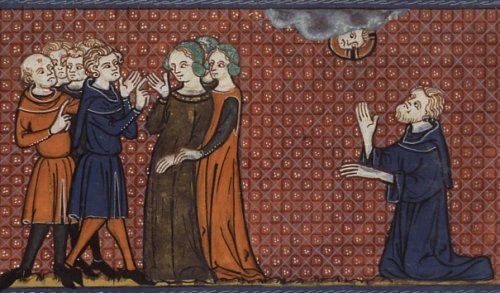
Saint
Nonnus
Bishop of Edessa
Egyptian monk turned bishop in Syria, through whom Saint Pelagia the harlot was converted.
- Feast
- December 2old style December 15
- Reposed
- 4715th century
- Place
- Antioch
- Order
- Hierarchs
Life
Saint Nonnus (Nonnos) is regarded as an Egyptian monk from Tabennisi who became a bishop in Syria and through whom Saint Pelagia the fallen woman was brought to Christ. He is a saint whose life is known mostly from legend, of the fourth or fifth century; the Serbian and English sources give his commemoration on 10 November, while our record gives 2 December. The Serbian source says he died in 471, as bishop of Edessa; the English source points out that his historicity is uncertain.
The story
The Life of Saint Pelagia, attributed to James, deacon of the church of Heliopolis (today Baalbek), says that Nonnus was a "perfect monk" from Tabennisi in Egypt who, "by reason of his virtuous life", became bishop at Heliopolis, converting "all its inhabitants" and baptizing Arabs (according to the Serbian source thirty thousand). The monks of Ramsgate place him at Edessa. The Serbian source adds that he was elected bishop of Edessa in 448 and then moved to Heliopolis, and after the death of Bishop Ibas he returned to Edessa, where he remained until his death.
While Nonnus was addressing a council at Antioch, the most famous courtesan of the city, Margarita ("Pearl"), passed by. Observing her beauty, Nonnus rebuked the members of the assembly for taking less care of their souls than she did of her body. She came to his sermon the next Sunday, and his sermon on hell moved her to repent. She wrote him a letter and was allowed to see him, with other witnesses; convinced of her sincerity, he received her confession and baptized her by her birth name, Pelagia. After being pursued for a few days by the devil, she gave the property of her former occupation to the Church and lived with the deaconess Romana, then left for Jerusalem, where she disguised herself as a male hermit under the name Pelagius. The story significantly omits dates and, on eight occasions, the name of the archbishop under whom Nonnus served.
What scholars say
The historical Pelagia, mentioned by Saint Ambrose and in two sermons of Saint John Chrysostom, was a virgin of Antioch who killed herself to escape dishonour in the Diocletian persecution; Marina, the Latin equivalent of "Pelagius", was another bride who disguised herself as a monk to escape an unwanted marriage. Parts of these stories seem to have been combined with apocryphal accounts of Mary Magdalene, biblical accounts of Solomon and the Queen of Sheba and of Jesus and various women of the New Testament, and even with Greek myths about Aphrodite, to make the story of the repentant courtesan. The mention of a meeting of the bishops of Syria does not help with dating, since in antiquity there were more than thirty synods at Antioch. Apart from copies of the Life of Pelagia, no source lists a Nonnus as bishop of Heliopolis; his story is sometimes confused with that of Nonnus, bishop of Edessa in Mesopotamia, present at Chalcedon in 451, and this one in turn with the contemporary poet Nonnus of Panopolis, which is probably a mistake. Another Nonnus at Chalcedon was the bishop of Zerabenna, in Arabia.
Commemorated the same day December 2
 HabakkukProphet · The ProphetDec 2
 Stefan Uroš VRight-Believing · Tsar of the SerbsDec 2
 Chromatius of AquileiaSaint · Bishop of AquileiaDec 2
 BibianaMartyrDec 2
 Jovan BrankovićRight-Believing · Despot of SerbiaDec 2
 Cleopa of SihăstriaVenerable · Archimandrite and abbot of SihăstriaDec 2
 Mirope of ChiosMartyrDec 2
 Ise of TsilkaniVenerable · One of the Syrian FathersDec 2
 Danact KalashnikovVenerable Martyr · HieromonkDec 2
- Avitianus of RouenSaint · Bishop of RouenDec 2
- Tadec of LandevennecHieromartyr · Hieromonk of LandevennecDec 2
- Herman of PechengaVenerable Martyr · Monk of PechengaDec 2