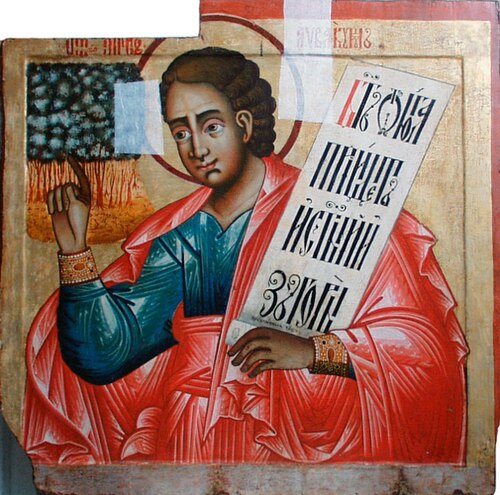
Prophet
Habakkuk
The Prophet
One of the twelve minor prophets, whose prayer and oracles are recorded in his book.
- Feast
- December 2old style December 15
- Era
- 6th century BC
- Place
- Judea
- Order
- Prophets
Life
The Holy Prophet Habakkuk is the eighth of the twelve minor prophets of the Old Testament. His oracles and prayer are written in the book that bears his name, and the Orthodox Church commemorates him on 2 December. He is honoured by Jews, Christians and, in their own way, Muslims.
His name and time
Almost nothing is known of Habakkuk beyond what can be drawn from his book. It names neither his city, nor his parents, nor his tribe, only that he is the prophet. The name is written in Hebrew Havaqquq, in the Septuagint Ambakoum, from which our Avacum, and the Latins wrote it Habacuc. It is usually interpreted as embrace, one who embraces.
Because the book speaks of the rise of the Chaldeans, Habakkuk is usually placed at the end of the seventh century before Christ, around 612, a contemporary of Jeremiah and Zephaniah, and he seems to have worked at Jerusalem. Some scholars bring him down to the time of King Jehoiakim, around 599 and 598. The Orthodox synaxarion says that he was of the tribe of Simeon and prophesied around 650, while the Septuagint, in the Codex Chisianus of Daniel, calls him the son of Jesus of the tribe of Levi.
The book
The book has three short chapters. Habakkuk is the prophet who dares to question God: how long shall I cry and You do not hear, why do You let injustice and violence happen? The Lord answers that He is raising up the Chaldeans, a fierce enemy, as a punishment for the sins of the people. The prophet wonders how God can allow the oppression of the more righteous by the more wicked. The answer is: the righteous shall live by his faith (Habakkuk 2:4). This word is taken up in the New Testament, in the epistles to the Romans, the Galatians and the Hebrews. The second chapter contains five woes against the oppressors, and the third is a prayer in the form of a song.
The prayer begins with the words: O Lord, I have heard Your report and was afraid. The prophet recalls the deeds of God of old, His coming from Teman and the trembling of the earth, and closes with unshaken faith: even if the fig tree does not blossom and there is no fruit on the vines, he will rejoice in the Lord and be glad in God his Saviour.
In the hymns of the Church
The prayer of the third chapter stands in the Orthodox Church as the fourth biblical ode, sung at Matins and underlying the fourth ode of the canons. The holy Fathers saw in the announcement that the Lord comes from Teman a foretelling of the Incarnation. The Greek translation of the Septuagint has in the second verse the words: in the midst of two living creatures You shall be made known. Church interpretation understands them as the two Testaments, as the two natures of Christ, or as the animals of the manger of the Nativity. According to Doxologia, Habakkuk prophesied also of the return of the people from Babylon, of the birth of the Lord Christ and of the end of the old law, and the OCA adds that he foresaw the devastation of the temple in Jerusalem and the Babylonian captivity.
Habakkuk and Daniel
The Book of Daniel, in the added part called Bel and the Dragon, tells that Habakkuk had prepared food for the reapers and was met by an angel of the Lord, who commanded him to bring it to Daniel, in the lions' den at Babylon. Habakkuk answered that he had never seen Babylon and did not know the den. The angel then took him by the crown of his head and carried him with the power of the Spirit to Daniel, then brought him back to his place (Daniel 14:33 to 39).
According to the Lives of the Prophets and Church tradition, during the war with the Babylonians Habakkuk withdrew far away, and after the war ended he returned to the land. He died at a great age.
His relics
The historian Sozomen tells that in the time of Emperor Theodosius the Younger (408 to 450) the relics of Habakkuk were found near Beit Guvrin, then Eleutheropolis, at the place called Cela, when God revealed in a dream to Bishop Zebennus where they lay. They were found together with the relics of the Prophet Micah, commemorated on 14 August. Other traditions point to another burial place: a Jewish one, in Upper Galilee, from the twelfth century, and a Persian one, in the city of Tuyserkan. Veneration at the tomb in Iran is made by Muslims and Jews.
Veneration
The Orthodox Church commemorates the Holy Prophet Habakkuk on 2 December. In art he is often shown aged, with a long beard, or carried by the angel to Daniel. In the West he is kept on 15 January. His veneration is among the oldest: a fifth century mosaic at the church of Hosios David in Thessaloniki depicts him.
Commemorated the same day December 2
 Stefan Uroš VRight-Believing · Tsar of the SerbsDec 2
 Chromatius of AquileiaSaint · Bishop of AquileiaDec 2
 BibianaMartyrDec 2
 Jovan BrankovićRight-Believing · Despot of SerbiaDec 2
 NonnusSaint · Bishop of EdessaDec 2
 Cleopa of SihăstriaVenerable · Archimandrite and abbot of SihăstriaDec 2
 Mirope of ChiosMartyrDec 2
 Ise of TsilkaniVenerable · One of the Syrian FathersDec 2
 Danact KalashnikovVenerable Martyr · HieromonkDec 2
- Avitianus of RouenSaint · Bishop of RouenDec 2
- Tadec of LandevennecHieromartyr · Hieromonk of LandevennecDec 2
- Herman of PechengaVenerable Martyr · Monk of PechengaDec 2