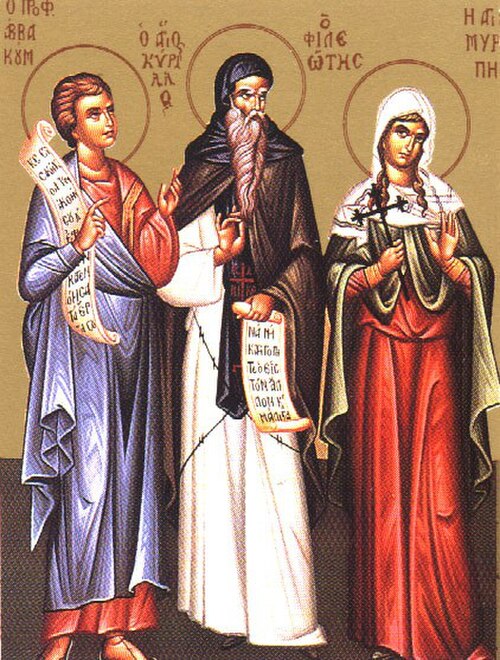
Martyr
Mirope of Chios
Virgin born at Ephesus, raised in the faith by her mother, martyred on Chios about 251.
- Feast
- December 2old style December 15
- Reposed
- 3003rd century
- Place
- Chios
- Order
- Martyrs
Life
Saint Mirope of Chios, a martyr, was born at Ephesus in the third century and put to death on the island of Chios about 251, in the persecution of Decius. She is remembered on 2 December, and among Catholics on 13 July. One Greek source wrongly gives the year 351 for her death.
Life
She was born at Ephesus to Christian parents and was baptized after the death of her father, whom she lost young. She was brought up by her mother in the faith of Christ. She often went with her mother to the tomb of Saint Hermione, the daughter of the Apostle Philip (remembered on 4 September), took holy myrrh from it and cared for the sick with it. For this she was called Mirope.
In the time of the emperor Decius, in the persecution of the Christians, she moved with her mother to the island of Chios, where they spent their time in fasting and prayer.
Martyrdom
About 251, by order of the governor of the island, the soldier Isidore (remembered on 14 May), a man of great faith and piety, was killed. Mirope, together with Ammonius, took his body in secret and buried it, probably in the town of Chora on Chios. The soldiers who had been ordered not to let Christians take the body were condemned to death. Full of pity for them, Mirope told them first, then the governor, that she had taken the body. At the trial she confessed the faith of Christ. According to one source, the commander Numerius ordered her to be beaten without mercy. Another source says she was beaten with rods and thrown into prison, where she died in torments.
According to the Russian and Greek sources, at night, as she prayed, a light shone in the prison, and Isidore appeared to her, surrounded by angels, and she gave up her soul to the Lord. The dungeon was filled with fragrance. A pagan guard, astonished at what he had seen, told a priest and himself received death for Christ. In the fifth century Saint Marcian built a church on that spot, which has survived to this day.
Commemorated the same day December 2
 HabakkukProphet · The ProphetDec 2
 Stefan Uroš VRight-Believing · Tsar of the SerbsDec 2
 Chromatius of AquileiaSaint · Bishop of AquileiaDec 2
 BibianaMartyrDec 2
 Jovan BrankovićRight-Believing · Despot of SerbiaDec 2
 NonnusSaint · Bishop of EdessaDec 2
 Cleopa of SihăstriaVenerable · Archimandrite and abbot of SihăstriaDec 2
 Ise of TsilkaniVenerable · One of the Syrian FathersDec 2
 Danact KalashnikovVenerable Martyr · HieromonkDec 2
- Avitianus of RouenSaint · Bishop of RouenDec 2
- Tadec of LandevennecHieromartyr · Hieromonk of LandevennecDec 2
- Herman of PechengaVenerable Martyr · Monk of PechengaDec 2