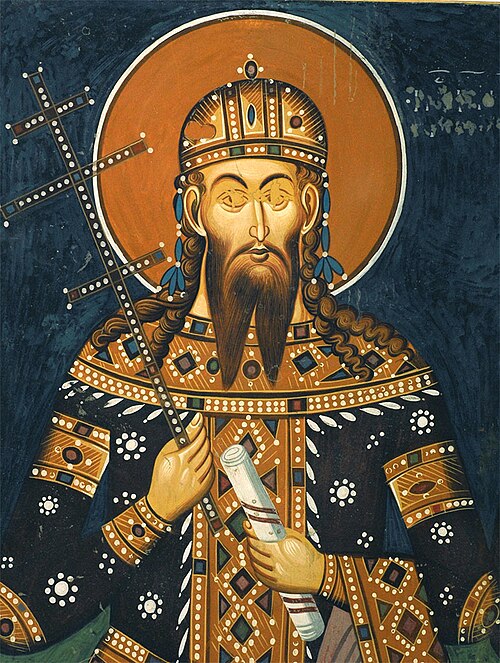
Right-Believing
Stefan Uroš V
Tsar of the Serbs
Second tsar of the Serbs, known in tradition as Uroš the Weak, who died in 1371.
- Feast
- December 2old style December 15
- Reposed
- 137114th century
Life
Saint Stefan Uroš V, the right-believing tsar, was the second tsar of the Serbs, between 1355 and 1371, the last ruler of the Nemanjić line, known in the tradition of the people as Uroš the Weak. He fell asleep in December 1371. He is venerated as a saint by the Serbian Orthodox Church, for his gentleness and humility.
Youth
Uroš was born in 1336, the only son of Stefan Uroš IV Dušan and Helena of Bulgaria, sister of Tsar Ivan Alexander. He was crowned king, as heir and co-ruler, in 1346, when his father, Dušan, was crowned emperor. When he succeeded alone to the throne, in 1355, after Dušan’s death, he was no longer a child, but he remained very dependent on his mother and on the people of the court.
His reign
Dušan’s empire soon began to fall apart. The tsardom broke up into a series of principalities, some of which no longer acknowledged his rule even in name. In the spring of 1356, Nikephoros Orsini took control of Thessaly and drove from Aetolia and Acarnania the despot Simeon Uroš, the young tsar’s uncle. Simeon withdrew to Epirus and western Macedonia, took Kostur and proclaimed himself tsar, wishing to rule beside Uroš or in his place. The claim was not accepted by all; the state council held at Skopje did not accept it, and Uroš showed himself more active, issuing several charters. In 1358 Simeon attacked the Scutari region, but was defeated; in 1359 he regained Epirus and Thessaly, where he ruled with the title “emperor of the Serbs and Greeks”.
A victory
In 1356 Matthew Kantakouzenos, a pretender to the Byzantine throne, gathered an army of five thousand Turks and marched on the city of Serres, the capital of Jovan Uglješa, where Uroš’s mother ruled. The tsar decided to raise an army to defend her; in 1357 the Turks attacked, and the Serbian army, under Vojihna of Drama, came to her aid and defeated them. Matthew was captured and held hostage until the Byzantine emperor John V ransomed him.
The breakup of the land
In the following years his mother, Helena, began to rule alone, in alliance with Jovan Uglješa, and so did the families Dejanović and Balšić and Nikola Altomanović. By 1365 the most powerful Serbian nobleman became Uglješa’s brother, Vukašin Mrnjavčević, who was crowned king and co-ruler with Uroš; in 1369, since Uroš had no children, he decided that his eldest son, Marko, should be his successor. Towards the end of the reign the tsar truly ruled only the lands between the Šar mountains and the Danube. The monastery of Matejče is his foundation.
Repose
Uroš died childless, in December 1371, after a great part of the Serbian nobility had been destroyed by the Turks in the battle of the Maritsa, in the same year. The cause of his death, at a still young age, is not known. According to a tradition, he was treacherously killed by Vukašin while hunting in the region of Kosovo, and his body was laid secretly, by night, in a tomb beside the church of the Dormition of the Mother of God, near the fortress of Petrič. His body is now kept in the monastery of Jazak, on the Fruška Gora mountain. His exceptional gentleness and tolerance were, it is said, the reason he was called “weak” and the reason he was numbered among the saints two hundred and eleven years after his death. With him the Nemanjić dynasty and the Serbian tsardom came to an end.
Commemorated the same day December 2
 HabakkukProphet · The ProphetDec 2
 Chromatius of AquileiaSaint · Bishop of AquileiaDec 2
 BibianaMartyrDec 2
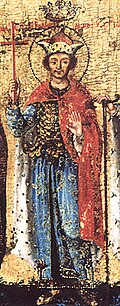 Jovan BrankovićRight-Believing · Despot of SerbiaDec 2
 NonnusSaint · Bishop of EdessaDec 2
 Cleopa of SihăstriaVenerable · Archimandrite and abbot of SihăstriaDec 2
 Mirope of ChiosMartyrDec 2
 Ise of TsilkaniVenerable · One of the Syrian FathersDec 2
 Danact KalashnikovVenerable Martyr · HieromonkDec 2
- Avitianus of RouenSaint · Bishop of RouenDec 2
- Tadec of LandevennecHieromartyr · Hieromonk of LandevennecDec 2
- Herman of PechengaVenerable Martyr · Monk of PechengaDec 2