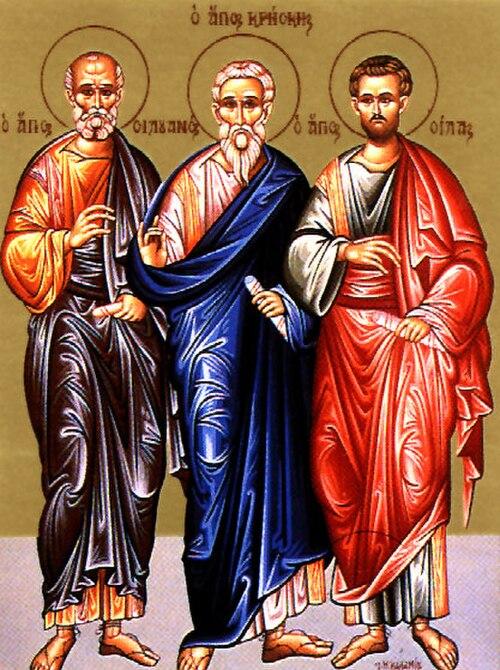
Apostle
Crescens
Missionary in Galatia
One of the Seventy Apostles, missionary in Galatia and companion of the Apostle Paul.
Life
Saint Crescens the Apostle (Greek Κρήσκης, Latin Crescens) was one of the Seventy Apostles, a disciple and fellow worker of Saint Paul, and a preacher of the Gospel in Galatia. His name comes from the Latin crescere and means increasing. The Church remembers him for his apostolic labours and, according to tradition, for a martyr's death.
In the New Testament Crescens is mentioned only once in Scripture, in the Second Epistle to Timothy. Paul, writing from Rome during his second imprisonment, urges Timothy to come to him quickly, because Demas has forsaken him, loving the present world, and gone to Thessalonica, Crescens to Galatia and Titus to Dalmatia, and only Luke is with him. Commentators rank Crescens with Titus and not with Demas, so that his departure is understood as a missionary journey and not a desertion.
Galatia or Gaul In New Testament times the name Galatia could mean either the Roman province in Asia Minor, where Paul had laboured greatly, or Gaul. Some early manuscripts, Sinaiticus and Ephraemi, read Gaul at this place, but the great majority read Galatia, and the other two regions named lie likewise to the east of Rome. Some early writers, among them Epiphanius, Blessed Theodoret and Eusebius, understood that Crescens was sent to Gaul. The tradition of the Church, following Paul's words, holds that he left Rome on the apostle's commission to preach in Galatia, where he later became bishop; he is even thought to have been a Galatian by birth, who became Paul's disciple there.
Bishop and martyr The earliest tradition, in the Apostolic Constitutions (book VII), shows him as bishop of the Churches in Galatia, and the Synaxarion calls him bishop of Chalcedon in Galatia. According to the same sources he received the crown of martyrdom in the reign of the Emperor Trajan. Later traditions connect him with Vienne in Gaul and with Mainz on the Rhine, but the Churches of Gaul keep no early record of him as their founder. The tie with Vienne seems to have arisen from confusing him with a bishop of that city of the same name who lived in the third century, and his name in the list of the bishops of Mainz is regarded as a later addition. Another source, Pseudo-Dorotheus, numbers him among the Seventy.
Veneration The Orthodox Church commemorates him on 30 July (12 August on the new calendar) and on 4 January (17 January), the day of the Synaxis of the Seventy Apostles. The Roman Catholic Church keeps his feast on 27 June, following the Roman Martyrology, which however lacks support in older martyrologies.
Commemorated the same day July 30
 ValentineHieromartyr · of TerniJul 30
 AlexeiPassion-Bearer · Tsarevich of RussiaJul 30
 Peter ChrysologusSaint · Bishop of RavennaJul 30
 Epenetus of CarthageApostle · Bishop of CarthageJul 30
 Abdon and SennenHoly MartyrsJul 30
 Silvanus of the SeventyApostle · Bishop of ThessalonicaJul 30
 Herman of SolovkiVenerable · Co-founder of Solovki MonasteryJul 30
 Tsotne DadianiConfessor · Georgian noblemanJul 30
 John the WarriorMartyr · Byzantine soldierJul 30
 SilvanMartyr · Martyr honored at DubrovnikJul 30
 Valentine of InteramnaHieromartyr · Bishop of Interamna (Terni)Jul 30
 Anatoly of OptinaVenerable · Hieroschemamonk of OptinaJul 30