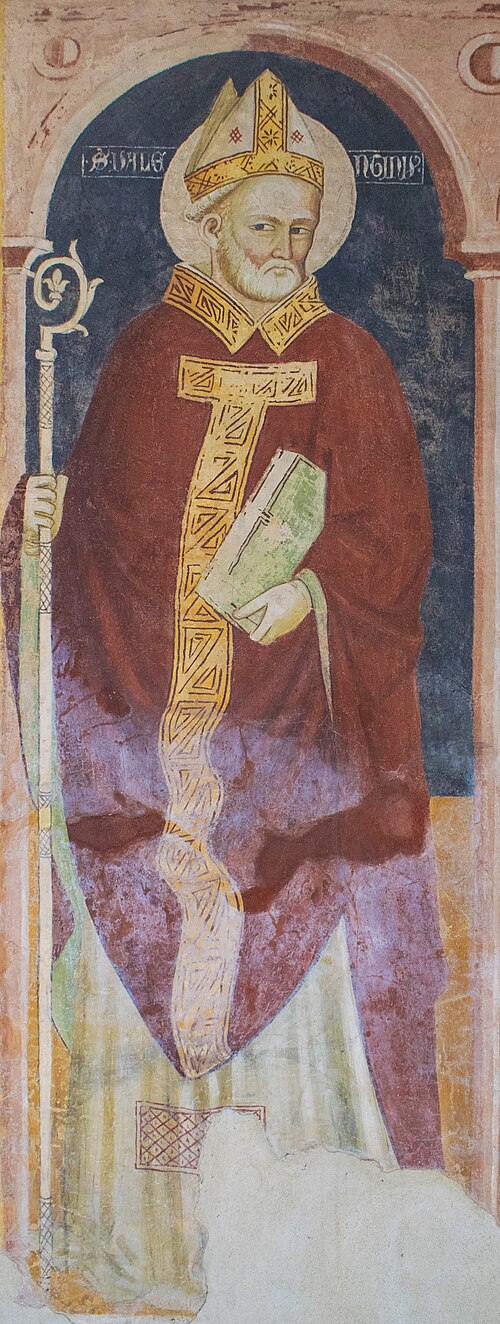
Hieromartyr
Valentine
of Terni
Roman Christian of the third century, killed for his faith, honored on February 14 in the West and July 6 in the East.
Life
Valentine was a servant of the Church, priest or bishop, in the Roman Empire of the third century, who cared for persecuted Christians and received the crown of martyrdom on the Via Flaminia near Rome on 14 February. He is the patron of the city of Terni, of those who suffer from epilepsy and of beekeepers. At least two saints named Valentine appear in the early martyrologies, and their lives blend together.
One name, two or more saints
The early martyrologies mention a priest of Rome and a bishop of Interamna, today Terni, both buried on the Via Flaminia. Very little is known of their lives, and scholars cannot say for certain whether there were two persons or two accounts of the same one. According to a common hagiography, Valentine, under house arrest with the judge Asterius, healed the judge's blind daughter by praying and laying his hands on her eyes. The judge broke his idols, fasted three days and was baptised with his household, and Valentine was arrested again for continuing to preach. Brought before the emperor Claudius II Gothicus, he refused to renounce Christ and was condemned to be beaten with clubs and beheaded. According to the diocese of Terni, he died in Rome on 14 February 269; other sources say 273.
The Orthodox synaxarion says of the bishop of Interamna in Umbria that he had received from God the gift of healing and, by healing the infirmities and diseases of people through prayer, turned unbelievers from the worship of idols to God.
A later legend, which arose in the Middle Ages in France and England, says that the emperor Claudius forbade soldiers to marry and that Valentine secretly married couples and was therefore condemned. This story has no support in the early sources. Nor is any link between the saint and the pagan Lupercalia or the god Cupid proved; the picture of Valentine as patron of lovers became established only around 1400.
Relics and veneration
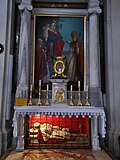
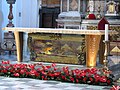
His body was buried on the Via Flaminia, and his memory has been kept on 14 February since at least the eighth century. It is said that a basilica was built over his grave, which long remained a place of pilgrimage, until the relics were moved to the church of Santa Prassede in the time of Pope Nicholas IV. His skull, crowned with flowers, is kept in the basilica of Santa Maria in Cosmedin in Rome, and other relics are in the Carmelite church on Whitefriar Street in Dublin.
The Orthodox Church commemorates the priest Valentine of Rome on 6 July, and the Holy Hieromartyr Valentine, bishop of Interamna (Umbria), on 30 July. The West commemorates him on 14 February, a day that since the Middle Ages has also been tied to the tradition of courtly love.
Commemorated the same day July 30
 AlexeiPassion-Bearer · Tsarevich of RussiaJul 30
 Peter ChrysologusSaint · Bishop of RavennaJul 30
 Epenetus of CarthageApostle · Bishop of CarthageJul 30
 Abdon and SennenHoly MartyrsJul 30
 CrescensApostle · Missionary in GalatiaJul 30
- Silvanus of the SeventyApostle · Bishop of ThessalonicaJul 30
 Herman of SolovkiVenerable · Co-founder of Solovki MonasteryJul 30
 Tsotne DadianiConfessor · Georgian noblemanJul 30
 John the WarriorMartyr · Byzantine soldierJul 30
 SilvanMartyr · Martyr honored at DubrovnikJul 30
 Valentine of InteramnaHieromartyr · Bishop of Interamna (Terni)Jul 30
 Anatoly of OptinaVenerable · Hieroschemamonk of OptinaJul 30