Confessor
Tsotne Dadiani
Georgian nobleman
Georgian nobleman of the House of Dadiani, a political figure under Mongol rule, who survived arrest after the plot of 1246.
- Feast
- July 30old style August 12
- Reposed
- 126013th century
- Place
- Kingdom of Georgia
- Order
- Confessors
Life
Saint Tsotne Dadiani was a Georgian nobleman of the House of Dadiani, lord (mtavari) of Odishi (Mingrelia), one of the leading political figures of Georgia in the time of Mongol ascendancy. The Georgian Orthodox Church numbered him among the saints on 26 October 1999 and remembers him on 30 July. His story, told in the medieval Georgian annals, in which he chose to share the fate of his fellow conspirators and moved the Mongols to mercy, made him a beloved historical figure.
Family and sources
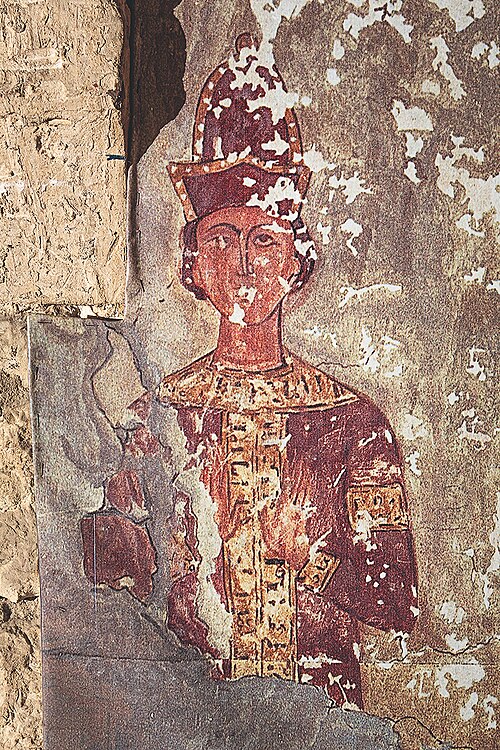
Tsotne came of the noble Dadiani family, which held Odishi, latter-day Mingrelia, in western Georgia. The principal source on his life is the anonymous Chronicle of a Hundred Years, of the early fourteenth century, which relates the history of Georgia from about 1213 to about 1320. Scholars identify him with several persons known from medieval sources: the boy-nobleman Tsotne, shown with his father Shergil Dadiani and mother Nateli in a fresco in the Dadiani chapel at the Khobi monastery; Tsotne Dadiani, “Lord High Steward” (mandaturtukhutsesi) and “Duke of Dukes” (eristavt-eristavi), mentioned in a document from the Monastery of the Cross in Jerusalem; and Dadian-Bediani, son of Juansher. The same inscriptions show him married to Khuashak, daughter of Bega, eristavi of Kartli, with sons George, Ioane and Erashahr. His brother was Vardan III.
Political career
His career unfolded in the time of the decline of Georgia as a major regional power in the face of the Khwarazmian and Mongol invasions. Around 1228 Tsotne was among the commanders of the large army summoned by Queen Rusudan to free Georgia from the Khwarazmian troops of Jalal al-Din Mangburni. In the battle of Bolnisi, on the way to Tbilisi, the Georgian army was defeated and Tbilisi again fell to Jalal al-Din. After Rusudan's death the throne of Georgia was disputed between her son David and his namesake cousin, a natural son of her brother and predecessor, King George IV. Tsotne Dadiani was among the supporters of David, son of Rusudan. In the interregnum (1245-1250), with the two Davids absent at the court of the Great Khan in Karakorum, the Mongols divided the kingdom into eight districts (tumens), each governed by a leading Georgian noble; Tsotne shared the governorship of western Georgia with Kakhaber, eristavi of Racha.
The Kokhtastavi conspiracy and his sacrifice
Around 1246 Tsotne joined other Georgian nobles in a secret meeting at the castle of Kokhtastavi in Javakheti to discuss the overthrow of Mongol rule. The Mongols soon learned of the meeting and rounded up those present, who, having no troops with them, surrendered without resistance. The only ones to escape were Tsotne and the eristavi of Racha, who had left earlier to raise troops in their remote provinces. The arrested nobles, brought to Shirakavan before the noyan Chormaqan, insisted that they had no intention of rebelling but had merely met to arrange the levying of tribute. The noyan did not believe it and had them stripped, bound hand and foot and left to suffer under the scorching sun; according to Prince Vakhushti, their bodies were smeared with honey to attract insects.
Meanwhile Tsotne Dadiani arrived with his army at the appointed rendezvous at Rkinis-Juari, between Samtskhe and Gado. Hearing what had happened, he sent his army home and, with two servants, set out for Shirakavan (in other sources, for Ani). Seeing the prisoners, Dadiani took off his clothes and joined them, although Odishi was not under Mongol rule and he was in no danger. Under interrogation he maintained that the Georgians had no design to revolt and demanded to be executed if that was the punishment of the others. The impressed noyan took his self-sacrifice as proof of the Georgians' innocence and set them free.
Later years
After David's return to Georgia in 1250 and his accession to rule in Imereti, the western half of the kingdom, Dadiani stood by his side. He brought relative order and stability to his fiefdom of Odishi. After the death of his brother Vardan, in 1250, he became full ruler of Odishi. He died around 1260 and was succeeded by his eldest son, George I. He was first married to Khuashak, then to Marikha, daughter of the lord of Tbeli and Gereti, without children. He is the hero of the third part of Grigol Abashidze's “Historical Chronicle of the Thirteenth Century,” “Tsotne, or the Fall and Rise of the Georgians” (1982).
Commemorated the same day July 30
 ValentineHieromartyr · of TerniJul 30
 AlexeiPassion-Bearer · Tsarevich of RussiaJul 30
 Peter ChrysologusSaint · Bishop of RavennaJul 30
 Epenetus of CarthageApostle · Bishop of CarthageJul 30
 Abdon and SennenHoly MartyrsJul 30
 CrescensApostle · Missionary in GalatiaJul 30
- Silvanus of the SeventyApostle · Bishop of ThessalonicaJul 30
 Herman of SolovkiVenerable · Co-founder of Solovki MonasteryJul 30
 John the WarriorMartyr · Byzantine soldierJul 30
 SilvanMartyr · Martyr honored at DubrovnikJul 30
 Valentine of InteramnaHieromartyr · Bishop of Interamna (Terni)Jul 30
 Anatoly of OptinaVenerable · Hieroschemamonk of OptinaJul 30