Martyr
John the Warrior
Byzantine soldier
Soldier of the 4th century, venerated as a saint and martyr in the Orthodox and Catholic Churches.
Life
Saint John the Warrior (John the Soldier), the Martyr, was a soldier of the fourth century, in the time of Emperor Julian the Apostate, who secretly helped persecuted Christians and all those in need. The Orthodox Church commemorates him on 30 July (12 August New Style), and the Catholic Church on 29 July. He is venerated as a helper in need and a refuge for those in prison. According to Russian and Ukrainian tradition he was of Slavic origin.
Life
In the time of the persecution, John served in the army of Emperor Julian the Apostate (361 to 363) and was forced to take part in the persecution like the other soldiers, but instead of killing them he helped the Christians: he warned them when a roundup was coming so that they could hide, and for those caught he found means to escape; he visited fellow believers in prison. He was merciful not only to Christians but to all in trouble and need: he visited the sick and comforted the grieving. Learning of the help he gave to Christians, the emperor ordered him thrown into prison, where the martyr awaited the sentence. But in 363 the emperor died in battle with the Persians, and John was released, and then devoted the rest of his days to serving those around him, living in holiness and purity.
The exact date of his death is not known; he fell asleep in great old age. According to tradition, his grave had been forgotten, and the saint appeared to a pious woman and showed her the place of his rest; the relics were found and moved to the church of the Holy Apostle John the Theologian in Constantinople, and the Lord gave them healing power. The wronged and grieving receive comfort through his prayers.
Veneration
In Russian tradition, John the Warrior is venerated as a great helper in troubles and straits. His veneration was very widespread in Ukraine, where he was called in the vernacular "Anika the Warrior" and is said to begin in the time of Kyivan Rus, though until the sixteenth century the cult was not wide. In the "Tale of the Saints" a special prayer was made to him for the recovery of stolen things and runaway servants. The Prologue says of him that he "better restrains a servant from flight, gives notice of theft and makes the exposure clear". In the Saint Sophia cathedral at Kyiv there is a wonder-working icon of him, with prayer and kontakion. The prayer begins: "O great protector and saint of Christ, John the Warrior, have mercy on your servant in needs, sorrows and every misfortune, keep him from all evil, shield him from the man who wrongs him, for to you such a gift has been given by God." The kontakion says: "O great and all-merciful sufferer John, wonderful and awesome warrior of the heavenly King. Receive the prayer of your servant and deliver me from present need, from the cunning man, from unjust plunder and from future torment, I who cry to you with faith: Alleluia." People also pray to him for those in prison and for those who have gone missing, in the hope that they will return. It was believed that he keeps servants and slaves from running away; his day was the first on which the autumn sowing could begin; and he was asked also for a good partner for married life.
The troparion says: "A faithful servant and warrior of the all-good God and Sovereign you were shown to be, John the wonderworker; for having suffered manfully for the faith and ended your course blessedly, you behold the Creator, the Lord, more brightly in the heavens; receiving from Him the gift of miracles, you help suffering people in all troubles, strengthen soldiers in battle, deliver them from capture by enemies, from wounds, sudden deaths and cruel misfortunes."
Iconography
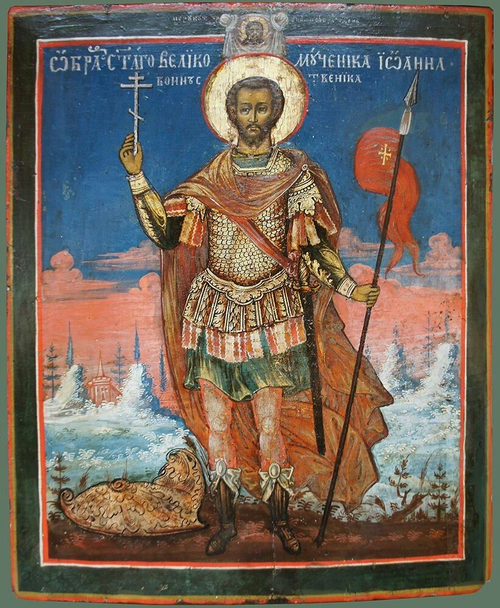
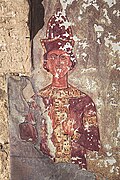
He is depicted with uncovered head, dark hair and beard, dressed in a shirt, trousers, boots, scale armour (a sign that he was a horseman) and a cloak. His three attributes are the cross (faith carried through all trials), the spear (strength given by God for the war against sin and unbelief) and the shield (the Lord's protection from every misfortune). The oldest surviving image on the territory of ancient Rus is the fresco in the church of the Saviour at Nereditsa near Novgorod. Many churches in Russia and Ukraine bear his name, among them the one in Moscow on Yakimanka.
Commemorated the same day July 30
 ValentineHieromartyr · of TerniJul 30
 AlexeiPassion-Bearer · Tsarevich of RussiaJul 30
 Peter ChrysologusSaint · Bishop of RavennaJul 30
 Epenetus of CarthageApostle · Bishop of CarthageJul 30
 Abdon and SennenHoly MartyrsJul 30
 CrescensApostle · Missionary in GalatiaJul 30
- Silvanus of the SeventyApostle · Bishop of ThessalonicaJul 30
 Herman of SolovkiVenerable · Co-founder of Solovki MonasteryJul 30
 Tsotne DadianiConfessor · Georgian noblemanJul 30
 SilvanMartyr · Martyr honored at DubrovnikJul 30
 Valentine of InteramnaHieromartyr · Bishop of Interamna (Terni)Jul 30
 Anatoly of OptinaVenerable · Hieroschemamonk of OptinaJul 30