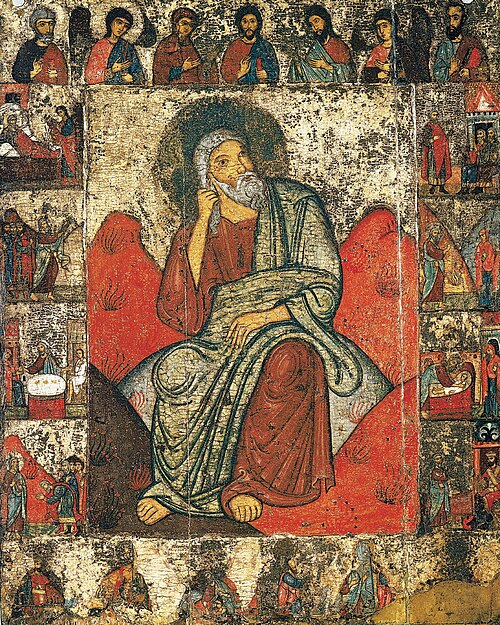
Prophet
Elijah
The Tishbite
Prophet of Israel in the time of King Ahab, taken up to heaven in a chariot of fire.
Life
The Holy Prophet Elijah the Tishbite is one of the greatest prophets of Israel. He lived in the ninth century before Christ, in the time of King Ahab, and fought with a zeal of fire against the worship of idols. Scripture says that he did not die, but was taken up to heaven in a chariot of fire. The Books of Kings speak of him, and the New Testament mentions him several times.
Beginnings
Elijah came from Tishbe in the land of Gilead, the son of Sobach. The Greek synaxarion tells that at his birth his father had a vision: two men in white garments named him Elijah, wrapped him in fire and gave him a flame to eat. The priests in Jerusalem explained that his son would be a prophet and would judge Israel with the sword and with fire. The same source says that he exercised his prophetic ministry for twenty-five years, in the days of King Ahab, who reigned between 873 and 854 before Christ.
Ahab and his wife Jezebel, a foreigner, brought the worship of Baal into Israel and persecuted the prophets of the Lord. Elijah confronted them and prayed that rain should not fall. The drought lasted three and a half years.
The drought and the widow of Zarephath
At God's command Elijah hid by the brook Cherith, beyond the Jordan, where ravens brought him bread in the morning and meat in the evening. When the brook dried up, God sent him to Zarephath of Sidon, to a poor widow. She received him with hospitality, and the flour in her jar and the oil in her jug did not fail until the end of the drought. When the widow's son died, Elijah prayed and raised him.
On Mount Carmel
At the king's summons the prophets of Baal gathered on Mount Carmel before all the people. Elijah asked them how long they would limp between two opinions. The prophets of the idol cried out all day, but no voice was heard. Elijah rebuilt the altar of the Lord with twelve stones, for the twelve tribes of Israel, dug a trench around it, and had the sacrifice drenched three times with water. He prayed, and fire from heaven consumed the offering. The people fell on their faces, and the false prophets were destroyed.
Elijah also rebuked Ahab's wickedness in the case of the vineyard of Naboth of Jezreel, taken by murder, and foretold the king's end. On another occasion the messengers of Ahaziah, Ahab's son, were consumed by fire from heaven, until the captain of the third company begged for mercy and Elijah went with him.
At Horeb
Jezebel pursued him, and Elijah fled and journeyed forty days and forty nights to Mount Horeb, where Moses had received the tablets of the Law. In a cave God told him to go out and stand before Him. A mighty wind passed, then an earthquake, then a fire, but the Lord was not in them, but in a still, small voice. From there He sent him to anoint Hazael king over Aram, Jehu king over Israel, and Elisha as prophet in his place.
Taken up to heaven
Elisha and the sons of the prophets knew beforehand that Elijah would be taken. By the Jordan, Elijah struck the water with his mantle and it divided, and he and Elisha crossed on dry ground. Then a chariot of fire with horses of fire appeared, and Elijah was lifted up in a whirlwind. His mantle fell, and Elisha took it up. Eight or ten years after his ascension, Elijah sent a letter to King Jehoram of Judah, foretelling his death because he had turned away from the worship of the true God (2 Chronicles 21:12).
Elijah in the New Testament and veneration
Zacharias said that John the Baptist would come "in the spirit and power of Elijah", and Christ said of John, "he is Elijah who was to come". At the Transfiguration the disciples saw Moses and Elijah on Tabor speaking with Christ.
The Church celebrates him on 20 July. He is regarded in Orthodoxy as a model of the contemplative life and is also commemorated on the Sunday of the Holy Fathers before the Nativity of the Lord. Popular devotion connects him with rain and thunder. In Romania more than one hundred and twenty thousand people bear the name Ilie, the prophet is patron of the Romanian Air Force, and in villages he is known as patron of beekeepers, who used to harvest honey on his day, a work called "retezatul stupilor".
Commemorated the same day July 20
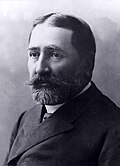 Ilia ChavchavadzeMartyr · Georgian writer and public figureJul 20
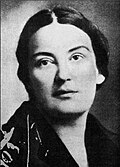 Maria of ParisVenerable Martyr · Nun and member of the ResistanceJul 20
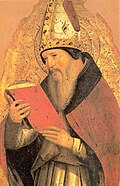 Aurelius of CarthageSaint · Bishop of CarthageJul 20
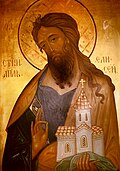 Elisaeus of Caucasian AlbaniaSaint · First bishop of Caucasian AlbaniaJul 20
- Flavian II of AntiochSaint · Patriarch of AntiochJul 20
 Dimitri KlepininHieromartyr · Russian priest of ParisJul 20
 Lucanus of SabionaSaint · Bishop of SabionaJul 20
 Alexis of UgineRighteous · Priest at Ugine, FranceJul 20
- Yuri SkobtsovMartyr · SubdeaconJul 20
 John Steblin-KamenskyHieromartyr · ArchpriestJul 20
 Theodore AbrosimovVenerable Martyr · Novice of PechengaJul 20
- Alexander ArkhangelskyHieromartyrJul 20