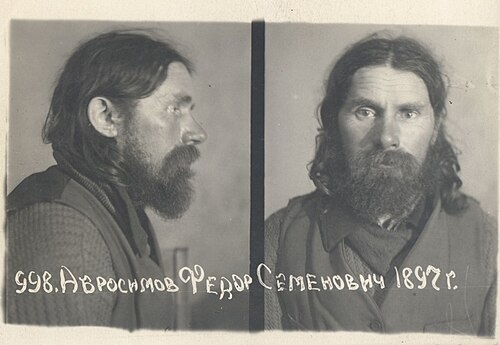
Venerable Martyr
Theodore Abrosimov
Novice of Pechenga
Novice of the Trifon Pechenga Monastery who died of exhaustion in a camp in 1941; glorified in 2003.
Life
Venerable Martyr Theodore Abrosimov (Fyodor Semyonovich Abrosimov) was a novice of the Saint Tryphon monastery at Pechenga, a soldier in the First World War, condemned and sent to the Ukhta-Izhma camp, where he died of exhaustion. He was born on 20 February 1897 in the village of Chavanga, on the shore of the White Sea, in the Kola district, in the family of a Pomor fisherman. He was numbered among the new martyrs and confessors of Russia on 30 July 2003, as a venerable martyr. Our calendar gives him 20 July and 6 July, 2 August being the day of his death by one source.
Youth
His mother kept the household. He learned to read and write at the village school, where he finished three classes. From sixteen (1913) he was a novice at the Tryphon-Pechenga monastery. At eighteen (1915) he was called into the army, did his training and at the beginning of 1916 was assigned as a private soldier to the sapper battalion. In the second half of 1916 he was sent to the Western front, in the direction of Minsk, to take part in the First World War. In the spring of 1918 he was demobilized and went to Arkhangelsk, where he worked as a hired sailor on a tugboat. When White officers made a coup in August 1918 and took the city, he stayed and continued working on the tug. In the Whites' mobilization he was called into the army's mounted transport, to care for the horses. In 1919 he fell ill, was demobilized and went to the Kola Peninsula, to Kharlovka, where he took treatment until October 1919.
At Pechenga
Then, through Murmansk, he came to Petsamo, to the Tryphon-Pechenga monastery, and began to work at the power station. When the North was freed from the Entente and the White Army, the Petsamo region remained Finnish territory. All the novices and monks received Finnish residence permits. Fyodor Abrosimov was master electro-mechanic of the monastery's power station, which supplied current not only to the monastery but to the nearby settlements. For this he received a salary from the Finnish ministry, and from the head of the local police he received instructions on when to switch the light on and off and when to make various repairs.
At the beginning of the Soviet-Finnish Winter War, in December 1939, the Red Army occupied the monastery grounds and the first arrested was the abbot Paisius (Ryabov), shot a year later. Fyodor Abrosimov was arrested and deported with the brethren of the monastery near Lovozero, to the construction of the Alluaivstroy combine, for "assistance to the White Finnish authorities". After the conclusion of the Moscow peace, in March 1940, the Pechenga region with the monastery was returned to Finland and some of the brethren returned to the monastery, but Fyodor decided to stay in the USSR. In 1940 he settled at the 80th kilometre of the Pulozero-Lovozero road and worked at timber felling and the sawmill.
Arrest and death
On 2 June 1940 he was arrested for "espionage, ties with White and English officers, ties with the Finnish security police" and imprisoned at Monchegorsk, then at Murmansk. In June and July 1940 interrogations took place. The last was on 25 July. Even at the night interrogations, Fyodor Abrosimov denounced no one and did not admit guilt of espionage. His answers did not change, marked by firm consistency and confidence in his own rightness. On 19 August 1940 he was sentenced by the Special Council of the NKVD, under article 58-6, to eight years in camps and sent to the Ukhta-Izhma camp, in the Komi Republic. On 14 October 1940 he arrived at the camp. On 2 August 1941 Fyodor Abrosimov died of exhaustion at the central sanitary settlement of the camp. The official diagnosis was chronic enteritis and ulcerative colitis. According to other data he died on 14 October 1940.
The conclusion of the Prosecutor's Office of the Russian Federation of 1992 states that Abrosimov was a citizen of Finland and, under article 4 of the Criminal Code of the RSFSR, could not be held liable, since all the acts charged to him were committed on the territory of a foreign state and did not constitute the elements of any crime.
Commemorated the same day July 20
 ElijahProphet · The TishbiteJul 20
 Ilia ChavchavadzeMartyr · Georgian writer and public figureJul 20
 Maria of ParisVenerable Martyr · Nun and member of the ResistanceJul 20
 Aurelius of CarthageSaint · Bishop of CarthageJul 20
 Elisaeus of Caucasian AlbaniaSaint · First bishop of Caucasian AlbaniaJul 20
- Flavian II of AntiochSaint · Patriarch of AntiochJul 20
 Dimitri KlepininHieromartyr · Russian priest of ParisJul 20
 Lucanus of SabionaSaint · Bishop of SabionaJul 20
 Alexis of UgineRighteous · Priest at Ugine, FranceJul 20
- Yuri SkobtsovMartyr · SubdeaconJul 20
 John Steblin-KamenskyHieromartyr · ArchpriestJul 20
- Alexander ArkhangelskyHieromartyrJul 20