Saint
Lucanus of Sabiona
Bishop of Sabiona
Bishop of the 5th century associated with the Dolomites and the Tyrol; commemorated on July 20.
Life
Saint Lucanus of Sabiona, also called Lucanus of Säben or San Lugano, was, according to tradition, bishop of Sabiona (today Säben, above the town of Klausen in South Tyrol) in the first half of the fifth century. His name is linked with the Dolomites and the Tyrol. Little is known of him outside the region in which he laboured and much of what is said is legend. He is commemorated on 20 July and invoked against the illness called dropsy.
What tradition says
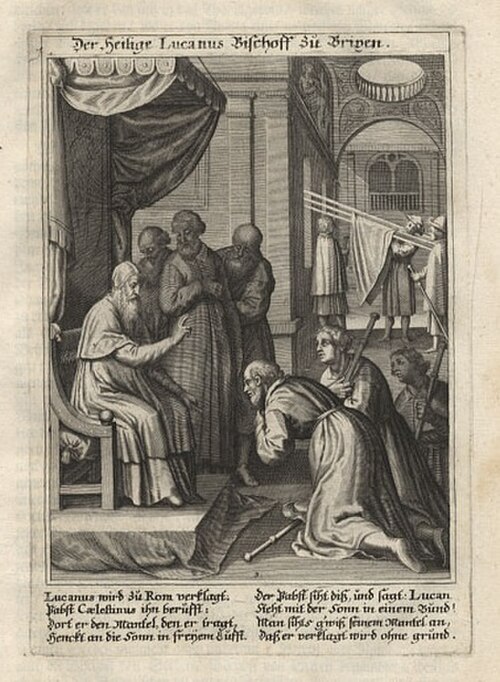
Lucanus is regarded as bishop of Sabiona, from where the bishops moved to Brixen only in the tenth century. He was later called, wrongly, bishop of Brixen. According to tradition, in a time of famine he allowed in his diocese, during the forty-day Lenten fast, the use of milk, butter and cheese when they could be obtained. For this his enemies denounced him in 424 to Pope Celestine I, who summoned him to Rome. Lucanus set out, though old, accompanied by a single servant. On the way a bear killed and ate his horse. Lucanus commanded the bear in the name of God to take the horse's place, put saddle and bridle on it and rode it to Rome.
Stopping for the night at an inn in Spoleto, he learned that the innkeeper's wife lay in bed sick with dropsy, and he healed her by praying beside her bed. He went on to Rome and commanded a flock of partridges to fly ahead of him to the pope, as a gift, since he had nothing suitable to offer. When he arrived in Rome for the audience, he wanted to take off his cloak, wet with rain, but found nowhere to hang it and threw it over a ray of sunshine, which held it. When the pope saw that Lucanus was in the grace of God, he declared him innocent and let him return home with his blessing and rich gifts.
On his return his enemies drove him out of Säben again, and he took refuge in the valley of Agordo, in the province of Belluno today, in Italy. There a woman named Avatia gave him food, who is also venerated as a saint by the church in the valley. He became known through his many miracles and fell asleep there on 20 July. His head was kept at Agordo, and his body in a marble coffin in Belluno Cathedral. At the beginning of the sixteenth century the public notary of Belluno, Peter Paul von Diolaitis, compiled a life of the saint, without giving the sources.
Veneration
According to Carl Pfaundler's book of 1843, at Brixen up to the early seventeenth century little or nothing was known of Lucanus, the old lists of bishops and other liturgical books of the region not mentioning him. Only after Bishop Hieronymus Otto Agricola reprinted the Brixen breviary of 1604 was Lucanus counted, from 1621, among the patron saints of Brixen Cathedral and officially venerated there. Earlier, for a long time, he had been venerated in the church of Belluno as bishop of Säben.
Veneration grew after 1658, when Anton von Crosini, bishop of Brixen, sent Canon Johann Andreas von Rossi to Belluno to bring parts of the saint's relics. With the agreement of the Doge and the High Council of Venice and of the administrator and members of the council of Belluno, von Rossi took a shoulder-blade and a rib, with which he returned to Brixen on 3 October 1658. The relics were placed first in the Capuchin church of Brixen, then on the following Sunday, 6 October, solemnly moved to their resting-place in Brixen Cathedral. The feast was set for 20 July, but only for the town of Brixen, not for the whole diocese. On this day the relics are publicly venerated each year, sometimes carried in procession with those of the other saints of the cathedral. In 1814 the relics of Lucanus were put in new reliquaries, in the same form as those of the other patron saints of the diocese, Ingenuin, Albuin and Hartmann. His bones remain today in Belluno Cathedral and at Brixen. His memory is kept on 20 July and 27 July.
Patronage and image
Lucanus is invoked as protector against dropsy. The settlement of San Lugano in South Tyrol bears his name, and a parish church is dedicated to him there. In the diocese of Belluno-Feltre there are at least two churches dedicated to him, San Lucano or San Lugano. The San Lugano Pass in the Alps, leading from the Adige valley into the Fleimstal, and a valley near Agordo bear his name, since he is thought to have stopped there both before and after his flight. He is shown with a mitre and with his cloak hanging on a sunbeam. He is also shown riding a bear, a motif found in the lives of Saints Romedius and Corbinian, who laboured in nearby regions.
The saint is not to be confused with the French Saint Lucanus of Loigny in Beauce, who lived also in the fifth century but died a martyr, beheaded, and is commemorated on 30 October. His relics are in the cathedral of Notre-Dame in Paris. The name of the town of Lugano, in Ticino, Switzerland, does not come from this saint.
Commemorated the same day July 20
 ElijahProphet · The TishbiteJul 20
 Ilia ChavchavadzeMartyr · Georgian writer and public figureJul 20
 Maria of ParisVenerable Martyr · Nun and member of the ResistanceJul 20
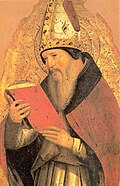 Aurelius of CarthageSaint · Bishop of CarthageJul 20
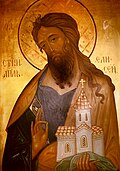 Elisaeus of Caucasian AlbaniaSaint · First bishop of Caucasian AlbaniaJul 20
- Flavian II of AntiochSaint · Patriarch of AntiochJul 20
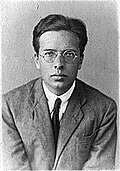 Dimitri KlepininHieromartyr · Russian priest of ParisJul 20
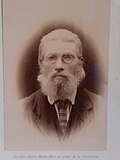 Alexis of UgineRighteous · Priest at Ugine, FranceJul 20
- Yuri SkobtsovMartyr · SubdeaconJul 20
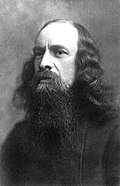 John Steblin-KamenskyHieromartyr · ArchpriestJul 20
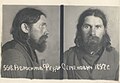 Theodore AbrosimovVenerable Martyr · Novice of PechengaJul 20
- Alexander ArkhangelskyHieromartyrJul 20