Martyr
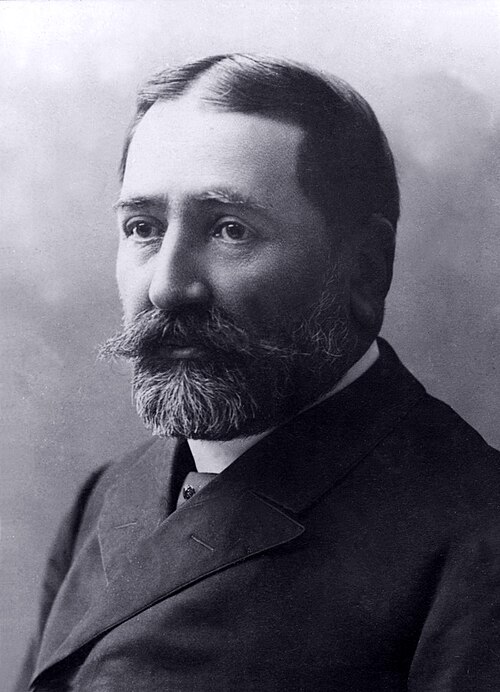
Ilia Chavchavadze
Georgian writer and public figure
Georgian poet and thinker who led the nation's revival, killed in 1907 and canonized by the Georgian Church.
Life
Saint Ilia Chavchavadze, called Ilia the Righteous, was a Georgian poet, writer, publicist and public figure, the leader of the national revival of Georgia in the second half of the nineteenth century, under tsarist rule. He was killed in 1907, and in 1987 the Holy Synod of the Orthodox Church of Georgia numbered him among the saints. The Georgians call him the father of the nation, and the Orthodox Church in America also commemorates him as a martyr.
Childhood and studies
He was born on 27 October 1837 (8 November new style) in Kvareli, in the region of Kakheti, into a family of princes of the Kvareli branch of the Chavchavadze line. He was orphaned early: his mother, Mariam, died in 1848, when he was ten, and his father, Grigol, in 1852. The children were raised by their aunt Makrine. He received his first teaching at home, from his mother, who taught him reading, prayer and the law of God, and then from Archdeacon Nikoloz Sepashvili of Kvareli. He wrote his first verses at eleven.
At Tbilisi he attended a boarding school and the gymnasium, and in 1857 he enrolled in the law faculty of the University of Saint Petersburg. He read widely, spent long hours in the city's archives searching for old Georgian texts and was among the best students. A diploma did not attract him, however: in his fourth year, in 1861, during the student unrest, he left the university and returned home. He was convinced that a nation that forgets its history is "like a beggar who knows neither where he comes from nor where he is going".
The writer and publicist
Ilia belonged to the group called the Tergdaleulebi, "those who drank the waters of the Terek", the young Georgians schooled in Russia who brought home the modern ideas of Europe. Among his best known works are the story "Is a Man a Man?", "A Beggar's Story", "Letters of a Traveler", the poem "The Apparition" and the poem "The Hermit". His maxim, "Language, Fatherland, Faith", became the motto of the Georgian nation.
In 1863 he founded the review Sakartvelos Moambe, which lasted only a year but had a great effect on the Georgian literary language. In the same year he married Olga Guramishvili. Later he worked as a mediator and justice of the peace, helped carry out the peasant reform and, from 1877, edited the newspaper Iveria, which for nearly thirty years remained one of the most influential publications in Georgia.
His work for the nation
Ilia headed the Noble Land Bank at Tbilisi, used to help peasants buy back their land, and helped found an agrarian bank. In 1879 he founded the Society for the Spreading of Literacy among Georgians, which he led from 1885. Schools, textbooks, support for museums and for theatre in the Georgian language followed, as well as a collection of Georgian manuscripts and antiquities and the gathering of folklore.
He defended the Georgian language against Russification in the schools and unceasingly demanded the renewal of the autocephaly of the Church of Georgia, abolished by Russia in 1811. It was regained in March 1917, ten years after his death. After the revolution of 1905 he was elected a representative of the Georgian nobility to the State Council of the empire. He was a sharp critic of the Bolsheviks and through his great popularity kept many peasants away from radical socialism.
The murder
On 30 August 1907 (12 September new style) Ilia and his wife, Olga, set out by carriage from Tbilisi for their estate at Saguramo. Near Tsitsamuri, close to Mtskheta, they were stopped by a band of armed men, who shot Ilia and struck Olga with a rifle butt. Who planned the murder is still debated: the tsarist inquiry blamed a revolutionary group, and later Soviet inquiries suspected the tsarist police.
The killers were caught and sentenced to death, but Olga asked for their pardon. She said that Ilia would have done the same, since he regarded them as unhappy brothers gone astray. Ilia himself had written, in his poem "Prayer", the Lord's words from the Cross: "Forgive them, Lord, for they know not what they do." All classes of Georgian society mourned his death as a national tragedy. Thousands followed the coffin from Saguramo to Tbilisi, and Akaki Tsereteli said at the funeral that his sacrifice was an example for future generations. He was buried in the Pantheon on Mount Mtatsminda, where his wife was later laid beside him.
Canonization and veneration
In 1987 the Holy Synod of the Orthodox Church of Georgia weighed his life and deeds before God and his country and numbered him among the saints, with the name Ilia the Righteous. The Church of Georgia commemorates him on 20 July old style, that is, 2 August on the civil calendar of Churches that keep the old style (in the Romanian Orthodox Church the date would be 20 July). The place of his death near Saguramo is marked with an obelisk, and his house at Tsitsamuri and his tomb in the Mtatsminda Pantheon are places of pilgrimage.
Commemorated the same day July 20
 ElijahProphet · The TishbiteJul 20
 Maria of ParisVenerable Martyr · Nun and member of the ResistanceJul 20
 Aurelius of CarthageSaint · Bishop of CarthageJul 20
 Elisaeus of Caucasian AlbaniaSaint · First bishop of Caucasian AlbaniaJul 20
- Flavian II of AntiochSaint · Patriarch of AntiochJul 20
 Dimitri KlepininHieromartyr · Russian priest of ParisJul 20
 Lucanus of SabionaSaint · Bishop of SabionaJul 20
 Alexis of UgineRighteous · Priest at Ugine, FranceJul 20
- Yuri SkobtsovMartyr · SubdeaconJul 20
 John Steblin-KamenskyHieromartyr · ArchpriestJul 20
 Theodore AbrosimovVenerable Martyr · Novice of PechengaJul 20
- Alexander ArkhangelskyHieromartyrJul 20