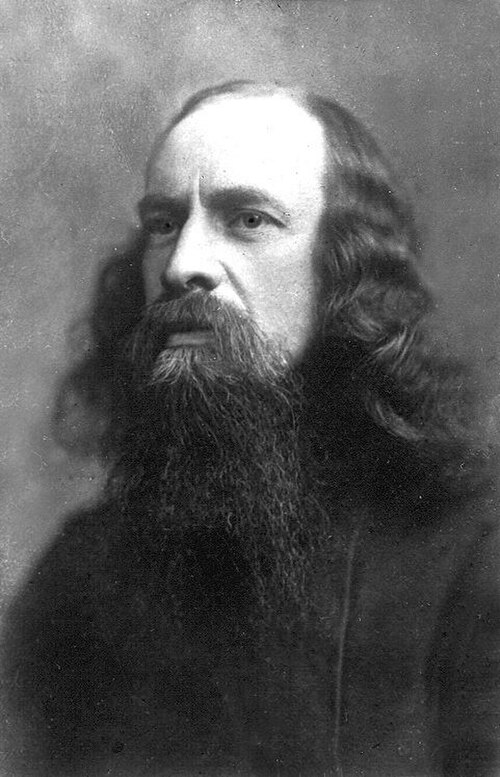
Hieromartyr
John Steblin-Kamensky
Archpriest
Archpriest born in Saint Petersburg, who died near Voronezh on 2 August 1930; canonized in 2000.
Life
Saint John Steblin-Kamensky (1887-1930), hieromartyr, was an archpriest, a former naval officer, a man of the Josephite movement at Voronezh, shot near Voronezh on 2 August 1930 with nine other pastors and believers. He was glorified by the Russian Orthodox Church in the year 2000.
Family and naval career
He was born on 26 October 1887 in Saint Petersburg. His grandfather, Egor Pavlovich, was a privy councillor and governor of Vilna, his father, Egor Egorovich, a privy councillor, director of the chancery of the Ministry of the Navy, senator and chairman of the Russian Society of Maritime Law; his mother, Olga Alexandrovna, was the daughter of Vice Admiral Alexander Zhandr. He graduated from the Naval Corps in Saint Petersburg in 1908, with the Admiral Nakhimov prize, was assigned to the cruiser Bogatyr, sailed two years abroad and received an Italian silver medal for help given after the earthquake in Sicily and Calabria. He was lieutenant from 1912, a company commander on the cruiser Admiral Makarov and taught at the Naval Corps. He took part in the First World War, with the orders of Saint Stanislaus and Saint Anna. In June 1917 he left the fleet for reasons of health, when the Baltic fleet was disintegrating. In 1919-1921 he was assistant director of the lighthouses of the Baltic fleet and, at the same time, psalm-reader at the Holy Trinity church in Petrograd.
Priest at Petrograd and Solovki
In 1920 he was ordained deacon (celibate) for the Holy Trinity church. He was soon arrested and spent some time in prison. In 1923 he was ordained priest, raised to archpriest and appointed rector of the church. In 1924 he was arrested again, accused of gathering around him believers who met not only in the church but in apartments, where they read akathists and Holy Scripture. In September 1924 he was sentenced to three years of camp, served at Solovki, where he behaved independently, always in priestly dress, and went to the services. From Solovki he wrote to his parishioners, among other things, that although moral cold still reigns in the history of mankind, the work of divine building is being accomplished, the Sun of Righteousness warms unswervingly all that is called to life, and the peace given by love, not by agreement, is unconquerable.
Voronezh and martyrdom
In 1927 he was released from the camp, but was not allowed to return to Leningrad and was sent into administrative exile at Voronezh. From November 1927 he was priest at the church of the former Protection of the Mother of God Convent, then rector, and quickly gained great authority. With his help a permanent collection of aid was organized for Archbishop Peter (Zverev) and the other Christians imprisoned at Solovki. He was an opponent of Metropolitan Sergius's declaration, joined the Josephite movement, was one of its leaders in the Voronezh diocese and signed Bishop Alexis (Buy)'s appeal of 9 January 1928 to Metropolitan Sergius. After the bishop's arrest he was dean of the diocese.
On 19 May 1929 he was arrested, accused of undermining the authority of Soviet power. At interrogation he behaved with dignity and declared himself loyal to the power, but he did not sympathize with measures against religion; he knew no weapon other than the cross, he said, and thought the only right way was to act in a pacifying manner. He was sentenced to three years at Solovki. In May 1930 he was taken to the prison at Voronezh, accused of spreading monarchist church leaflets and brochures and anti-Soviet rumours. He did not admit guilt and slandered no one, though another priest in the same case gave testimony that suited the authorities. He was sentenced to death by a collegium of the OGPU, and the sentence was carried out on 2 August 1930 in the surroundings of Voronezh.
Shot with him were Archimandrite Tikhon Krechkov, abbot of the Akatov Monastery, the hieromonks George Pozharov and Cosmas Vyaznikov, the priests Alexander Arkhangelsky, Sergius Gortinsky, George Nikitin and Theodore Yakovlev, and the peasants Pyotr Vyaznikov and Euthymius Grebenshchikov. All were glorified by the Jubilee Council of Bishops in the year 2000.
Commemorated the same day July 20
 ElijahProphet · The TishbiteJul 20
 Ilia ChavchavadzeMartyr · Georgian writer and public figureJul 20
 Maria of ParisVenerable Martyr · Nun and member of the ResistanceJul 20
 Aurelius of CarthageSaint · Bishop of CarthageJul 20
 Elisaeus of Caucasian AlbaniaSaint · First bishop of Caucasian AlbaniaJul 20
- Flavian II of AntiochSaint · Patriarch of AntiochJul 20
 Dimitri KlepininHieromartyr · Russian priest of ParisJul 20
 Lucanus of SabionaSaint · Bishop of SabionaJul 20
 Alexis of UgineRighteous · Priest at Ugine, FranceJul 20
- Yuri SkobtsovMartyr · SubdeaconJul 20
 Theodore AbrosimovVenerable Martyr · Novice of PechengaJul 20
- Alexander ArkhangelskyHieromartyrJul 20