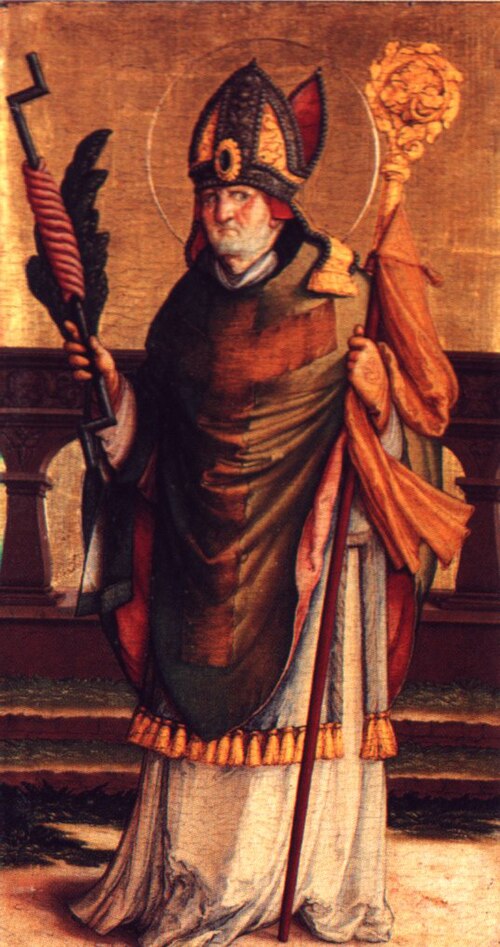
Hieromartyr
Erasmus of Formia
Bishop of Formia
Bishop and martyr around the year 303, patron of sailors.
Life
Saint Erasmus, hieromartyr, also called Elmo or Ermo, was bishop of Formia in Italy and received the martyr’s crown around 303, in the persecution of Diocletian and Maximian. He is honoured as patron of sailors and of those with abdominal pain, and is one of the Fourteen Holy Helpers of the Western tradition. The Orthodox Church commemorates him on 17 May, the Catholic Church on 2 June.
The story of his life has come down in an account full of legends, which historians see as mixed up with another Erasmus, bishop of Antioch, and for which there is no historical evidence. According to this tradition, Erasmus was bishop of Formia and of all Campania. In the persecution he left his diocese for Mount Lebanon, where he hid for seven years, living on the fruits of the wild. An angel told him to return to his city.
On the way he met soldiers who questioned him; he confessed himself a Christian and was taken to trial at Antioch before Diocletian. After terrible tortures he was bound in chains and thrown into prison, from which an angel freed him. He passed through Lycia, where he raised up the son of a notable man, and many baptisms drew the attention of Maximian, whom Jacobus de Voragine calls much worse than Diocletian. Maximian ordered his arrest, and Erasmus went on confessing his faith. Enraged, the emperor had him put in a barrel full of spikes and rolled down a hill; tradition says an angel kept him alive.
According to Serbian sources, Erasmus came to Ohrid, raised up the son of a man named Anastasius and baptized many pagans, destroying idol altars. Before a bronze statue of Zeus, to which he was told to bow, he worked a wonder: a dragon came out of the idol, and the saint killed it. In these accounts he baptized thousands. An angel freed him from the prison where he had been thrown and brought him to Campania. He withdrew to a cave, where he lived in ascetic struggle until his death. Before dying he bowed three times toward the east and prayed that God would forgive the sins of all who called on his name with faith; a voice from heaven answered, “So be it, as you have prayed, my healer Erasmus.” He reposed around 303. At Ohrid a cave with a small church of Saint Erasmus still stands.
Another tradition says he was disembowelled, his intestines wound on a windlass; the story may have grown from looking at an icon showing the saint with a windlass, a sign of his protection of sailors. It is also said that Erasmus went on preaching even after a thunderbolt struck the ground beside him, so sailors in danger from storms called on him; the lights seen on ships’ masts in storms were named “Saint Elmo’s fire”.
Pope Gregory the Great wrote in the sixth century that his relics were kept in the cathedral of Formia. When old Formia was destroyed by the Saracens in 842, his veneration moved to Gaeta, where the relics were found hidden in 917 by Bishop Bono, and later Pope Paschal II consecrated the new cathedral dedicated to him. He is patron of the cities of Gaeta and Formia. In Saint Peter’s Basilica in Rome there is an altar of his, with a copy of Poussin’s “Martyrdom of Saint Erasmus”, and a skull attributed to him is venerated in Munich. He is invoked against colic, abdominal pain, intestinal ailments and the pains of childbirth.
Commemorated the same day May 4
 MonicaFool-for-Christ · Mother of Augustine of HippoMay 4
 FlorianMartyr · of LauriacumMay 4
 Godehard of HildesheimSaint · Bishop of HildesheimMay 4
 Pelagia of TarsusMartyrMay 4
 Sylvanus of GazaHieromartyr · Bishop of GazaMay 4
 Alvian of AneaHieromartyr · Bishop of AneaMay 4
 Alfanov Brothers of NovgorodHoly Venerables · Five monk brothers of NovgorodMay 4
 Trendafil KerelovNew Martyr · Priest of BatakMay 4
 Mavra of Mount CeahlăuVenerable · Schemanun of Mount CeahlăuMay 4
- New Martyrs of BatakHoly New MartyrsMay 4
- Nikephoros the SolitaryVenerable · Athonite monkMay 4
- Aedh son of BrecSaintMay 4