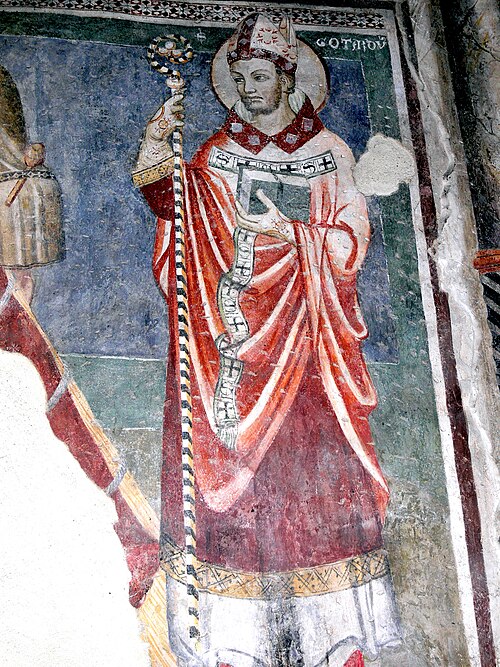
Saint
Godehard of Hildesheim
Bishop of Hildesheim
Benedictine abbot and bishop of Hildesheim, a monastic reformer, who died in 1038.
Life
Saint Godehard of Hildesheim, also called Gotthard, was a Benedictine monk, monastic reformer and bishop of Hildesheim in the first half of the eleventh century. He was born in 960 and died on 5 May 1038. He lived before the separation of the Churches, and his name is kept in calendars on 4 or 5 May. His Life was written by his disciple Wolfher.
Youth and monastic life
He was born in 960 near Niederaltaich, in the diocese of Passau, where his father Ratmund was a vassal of the canons of the abbey. He studied the humanities and theology at Niederaltaich Abbey, where he became a canon, and then served as church administrator at the court of the archbishops of Salzburg. After travelling through several countries, among them Italy, he completed his studies at the cathedral school of Passau and returned to Niederaltaich, where he was appointed provost.
When Duke Henry of Bavaria decided to turn the canons' house into a Benedictine monastery, Godehard remained there as a novice and became a monk in 990. In 993 he was ordained priest, then became prior and head of the monastic school. In 996 he was installed as abbot, in the duke's presence. He introduced the reforms of Cluny at Niederaltaich and helped renew the Rule of Saint Benedict. Under the patronage of Henry II, who became emperor, he trained abbots for the abbeys of Tegernsee, Hersfeld and Kremsmünster.
Bishop of Hildesheim
On 2 December 1022 he succeeded Bernward as bishop of Hildesheim, consecrated by Archbishop Aribo of Mainz. In fifteen years of ministry he won the respect of the clergy. He cared greatly for the education of young clerics and founded several schools; the cathedral school of Hildesheim became under him a centre of learning. He ordered the building of some thirty churches. Around 1025 he founded a monastery beside the chapel on the Zierenberg, with a church dedicated to Saint Maurice, consecrated in 1028. Though advanced in years, he vigorously defended the rights of his diocese. After a brief illness he died on 5 May 1038 at the Mauritiusstift, the hospice for travellers which he had founded.
Canonization and veneration
His successors in the see, Bertold and Bernhard I, pressed for his canonization, which took place in 1131 at a synod held at Reims, where Pope Innocent II officially numbered him among the saints. On 4 May 1132 Bernhard moved the relics from the abbey church to the cathedral at Hildesheim, and on 5 May the first feast in his honour was held. His shrine, from about 1140, is among the oldest surviving relic shrines of the Middle Ages. His veneration spread to Scandinavia, Switzerland and eastern Europe. He was invoked against fever, dropsy, children's illnesses, hail and the pains of childbirth. Niederaltaich Abbey made him patron of its grammar school, and travelling merchants chose him as patron; for that reason many churches and chapels in the Alps bear his name, as does the St Gotthard Pass.
Commemorated the same day May 4
 MonicaFool-for-Christ · Mother of Augustine of HippoMay 4
 FlorianMartyr · of LauriacumMay 4
 Erasmus of FormiaHieromartyr · Bishop of FormiaMay 4
 Pelagia of TarsusMartyrMay 4
 Sylvanus of GazaHieromartyr · Bishop of GazaMay 4
 Alvian of AneaHieromartyr · Bishop of AneaMay 4
 Alfanov Brothers of NovgorodHoly Venerables · Five monk brothers of NovgorodMay 4
 Trendafil KerelovNew Martyr · Priest of BatakMay 4
 Mavra of Mount CeahlăuVenerable · Schemanun of Mount CeahlăuMay 4
- New Martyrs of BatakHoly New MartyrsMay 4
- Nikephoros the SolitaryVenerable · Athonite monkMay 4
- Aedh son of BrecSaintMay 4