Martyr
Florian
of Lauriacum
Christian of Lauriacum in Noricum, killed for his faith around 304.
Life
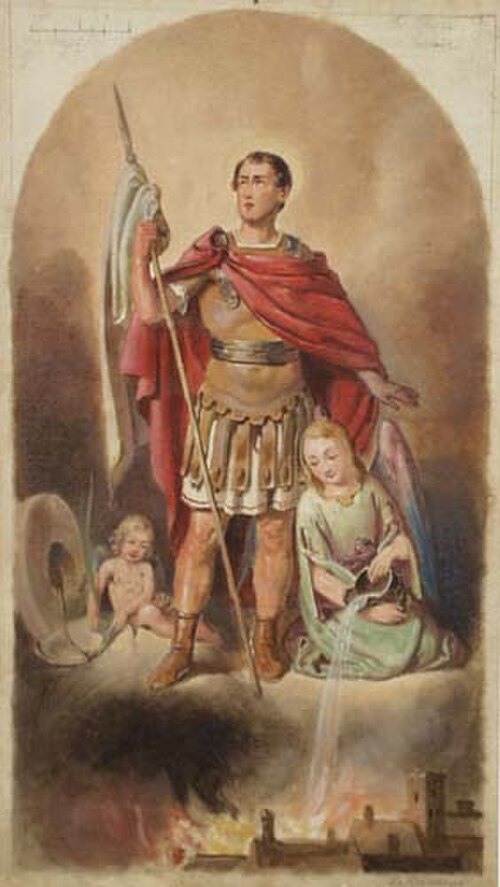
Saint Florian was a Christian of Lauriacum, in the province of Noricum, killed for his faith around 304, during the persecution of Diocletian. He is honoured above all in Central Europe, as patron of firefighters, of Poland and of Upper Austria. His feast is 4 May in the Catholic Church and 17 May in the Russian Orthodox Church.
Life
He was born around 250, according to some sources at Aelium Cetium (today Sankt Pölten), according to others at Cannabiaca (today Zeiselmauer). He joined the Roman army and rose until he became commander of the troops in Noricum. Besides his military duties he organized and led firefighting brigades, and trained an elite group of soldiers for that task alone. The emperors Diocletian and Maximian valued him for his quickness and skill in dealing with people. Florian embraced Christianity, at first in secret, then confessed his faith openly.
Martyrdom
During the persecution, word reached Rome that Florian was not enforcing the orders against Christians in his region. The emperor sent the official Aquilinus to Lauriacum. Hearing of the arrest of several Christians at Lorch, Florian went to rescue them but was seized. Aquilinus ordered him to sacrifice to the Roman gods, and he refused; his ranks and post were taken from him. According to his Life, he was beaten with rods, and his body was torn with hooks. He was sentenced to be burned at the stake. Standing on the pyre, he is said to have told the soldiers to light the fire, since in the name of the Lord he would climb onto it. The soldiers feared his words and did not burn him; they tied a millstone around his neck and threw him into the river Enns, on 4 May 304.
According to tradition, the soldier who pushed him into the river went blind on the spot. An unusual wave carried the body to a rock, and an eagle spread its wings over it to guard it. The next night Florian appeared to a pious woman, Valeria, and asked to be buried. The oxen drawing the cart with the body stopped, exhausted by thirst, and water sprang from the ground at that spot; so they reached the burial place. The spring is still called Florian’s spring. The body was buried near Lorch, then moved to where the monastery of Saint Florian, near Linz, was built.
Veneration
The people chose him as patron of firefighters, chimney sweeps, brewers, potters, smiths and other trades. He is regarded as a defender against fire, floods, lightning and drought; he is shown as a Roman soldier with a banner, pouring water from a pail onto a burning house. His veneration is very widespread in Central Europe, and in Bavaria and Austria the name Florian was given to children to place them under his protection. The Austrian town of Sankt Florian bears his name.
In 1184 Pope Lucius III sent some of his relics to Poland at the request of Prince Casimir II, and Kraków keeps portions. Florian then became patron of Poland. The Church of Saint Florian in Kraków has been especially venerated since 1528, when a fire burned the neighbourhood without touching the church. A statue of him in the Roman Catholic church of Turda, given in 1950, is a rarity in Romania and shows him putting out a fire.
Commemorated the same day May 4
 MonicaFool-for-Christ · Mother of Augustine of HippoMay 4
 Erasmus of FormiaHieromartyr · Bishop of FormiaMay 4
 Godehard of HildesheimSaint · Bishop of HildesheimMay 4
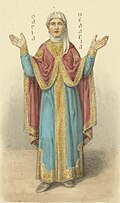 Pelagia of TarsusMartyrMay 4
 Sylvanus of GazaHieromartyr · Bishop of GazaMay 4
 Alvian of AneaHieromartyr · Bishop of AneaMay 4
 Alfanov Brothers of NovgorodHoly Venerables · Five monk brothers of NovgorodMay 4
 Trendafil KerelovNew Martyr · Priest of BatakMay 4
 Mavra of Mount CeahlăuVenerable · Schemanun of Mount CeahlăuMay 4
- New Martyrs of BatakHoly New MartyrsMay 4
- Nikephoros the SolitaryVenerable · Athonite monkMay 4
- Aedh son of BrecSaintMay 4