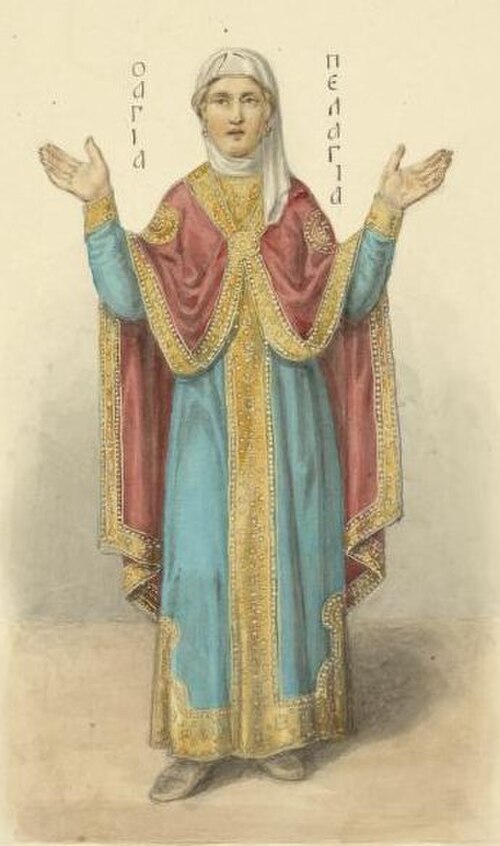
Martyr
Pelagia of Tarsus
Virgin of Tarsus in Cilicia, martyred in the early fourth century, with a life preserved in legend.
Life
Saint Pelagia the Martyr was a virgin of Tarsus in Cilicia who received the crown of martyrdom at the beginning of the fourth century, in the persecution of Diocletian. Her life has come down to us as a traditional narrative, and the Church honours her as a young woman who chose to remain Christ's despite the wish of an emperor.
According to tradition, Pelagia was born in Tarsus into a wealthy and renowned but pagan family. She was very beautiful and well brought up. Hearing from Christians about Christ and the salvation of the soul, she came to love the faith, and she was baptised by Bishop Clinon (Linus), a man known for his holiness who lived in hiding because of the persecution. She gave her costly garments and much of her wealth to the poor and told her mother that she had been baptised.
The adopted son of Diocletian, heir to the throne, fell in love with her and asked for her hand. Pelagia replied that she had pledged herself to Christ and could belong to no one else. The young man, in despair, took his own life with a sword. Pelagia's mother, fearing the emperor's anger, brought her to trial. Diocletian, struck by her beauty, asked her to renounce her faith and become his wife, promising her every earthly good. The maiden refused and confessed Christ. She was then condemned to be burned in a heated bronze bull. In the story she made the sign of the cross, prayed, and entered the glowing bull herself. One version has her taken to Rome, where the scent of myrrh is said to have filled the city; another tells that four lions were sent to devour her remains but guarded them from vultures and crows until the bishop could gather them.
Her bones were collected by Bishop Clinon and buried on a hill near the city. Later a church was built over her relics, which tradition connects with Constantine the Great.
Historians point out that Diocletian had a daughter, Valeria, but no sons, so the story is legendary in its details. It is thought, however, that a real martyr named Pelagia was honoured at Tarsus, and that her memory was embellished with time. Her feast was originally on 8 October together with the two other Pelagias of Antioch; the Orthodox Church commemorates her on 4 May and 7 October.
Commemorated the same day May 4
 MonicaFool-for-Christ · Mother of Augustine of HippoMay 4
 FlorianMartyr · of LauriacumMay 4
 Erasmus of FormiaHieromartyr · Bishop of FormiaMay 4
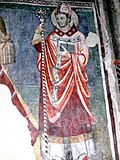 Godehard of HildesheimSaint · Bishop of HildesheimMay 4
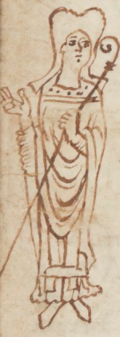 Sylvanus of GazaHieromartyr · Bishop of GazaMay 4
 Alvian of AneaHieromartyr · Bishop of AneaMay 4
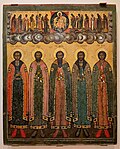 Alfanov Brothers of NovgorodHoly Venerables · Five monk brothers of NovgorodMay 4
 Trendafil KerelovNew Martyr · Priest of BatakMay 4
 Mavra of Mount CeahlăuVenerable · Schemanun of Mount CeahlăuMay 4
- New Martyrs of BatakHoly New MartyrsMay 4
- Nikephoros the SolitaryVenerable · Athonite monkMay 4
- Aedh son of BrecSaintMay 4