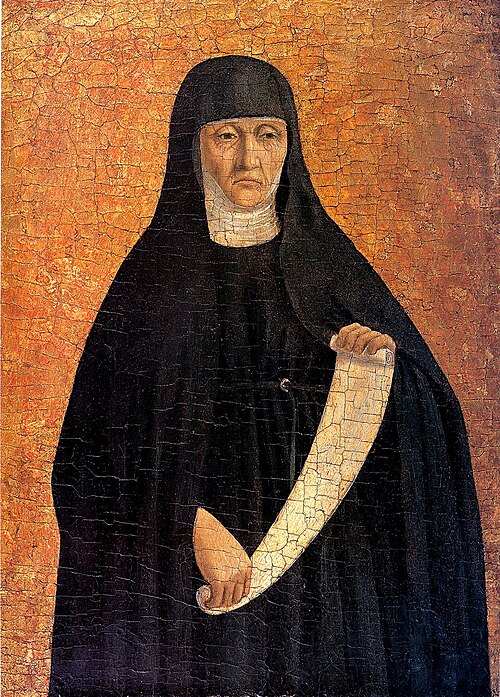
Fool-for-Christ
Monica
Mother of Augustine of Hippo
North African Christian who prayed earnestly for the conversion of her son Augustine, died at Ostia in 387.
- Feast
- May 4old style May 17
- Reposed
- 3874th century
- Place
- Ostia
- Order
- Fools-for-Christ
Life
Monica was a Christian of North Africa, the mother of Blessed Augustine, who prayed with tears for many years for her son's return to the faith. Her life is known chiefly from Augustine's Confessions, in book nine. She fell asleep in 387 at Ostia, the port of Rome. She is honoured in the Orthodox Church, on 4 May, and in the Roman Catholic Church, where she is remembered on 27 August.
Youth and marriage
She was born about 332, most probably at Thagaste (today Souk Ahras, in Algeria), in a Christian family. From her name she is believed to have been a Berber. Her parents were pious Christians, and in her father's house an old servant had a great influence on her.
She was married young to Patricius, a pagan decurion of Thagaste. He had a quick temper and dissolute habits, as, it seems, did his mother. Monica's almsgiving, deeds and prayers vexed him, but she bore with him gently, and her patience won over in the end the heart of her mother-in-law as well. In time her husband too received the faith, being baptized at the end of his life, after sixteen years of her prayers, and he fell asleep in peace in 371. Monica had three children: Augustine, Navigius and a daughter.
Prayer for Augustine
Patricius had not allowed the baptism of the children, and Monica grieved much when Augustine fell ill in childhood. Augustine lived his youth far from the faith. At Carthage he fell under the influence of the sect of the Manichaeans, and his mother, horrified, once drove him from her table. She was later reconciled with him, after a vision in which she was told to be patient and gentle. She tried to enlist the help of a bishop, but he did not wish to argue with the young man. He comforted her, however, with the words: Go on your way, the son of these tears will not perish.
Monica followed Augustine to Rome and then to Milan, where she met the bishop, Saint Ambrose. Ambrose came to value Monica and often congratulated her son on having so virtuous a mother. Through his preaching Augustine at last came to faith, after long years of resistance. He was baptized by Ambrose on the night of Pascha in 387, in the presence of his mother.
Habits of piety
In the Confessions Augustine tells of a practice of his mother: she brought to the chapels raised in memory of the saints offerings of porridge, bread, water and wine. At Milan Ambrose forbade the gift of wine, lest it be an occasion of drunkenness for those inclined to it. Monica accepted the counsel and, in place of a basket of the fruits of the earth, learned to bring to the chapels of the martyrs a heart full of purer prayers, giving the poor all she could. Augustine, Monica and their companions spent six quiet months at Cassiciacum before the baptism.
Repose at Ostia
On the way back to Africa, mother and son stopped at Civitavecchia and then at Ostia. A few days before her death they stood at a window of the house, looking out on the garden, and spoke of the eternal life of the saints, reaching in thought toward eternal Wisdom. Monica then said that she no longer found any joy in this life, because her hope was fulfilled: she had seen her son a faithful Christian.
After five days she fell ill. She died at the age of fifty-five, in 387, and was buried at Ostia. She asked those around her to remember her at the altar of the Lord, wherever they might be. Augustine's grief at his mother's death gave rise to the Confessions.
Relics and veneration
At first Monica was almost forgotten. In the sixth century her body was moved to a hidden crypt in the church of Santa Aurea at Ostia, near the tomb of Saint Aurea. Her epitaph, written by Anicius Auchenius Bassus, has survived, and the stone was rediscovered in 1945. In 1430 Pope Martin V ordered her relics to be brought to Rome, where they are kept in the church of Sant'Agostino. Many miracles are said to have happened on the way.
The Orthodox Church calls her Venerable Monica and commemorates her on 4 May. She remains the example of the faithful mother who prays for her children.
Commemorated the same day May 4
 FlorianMartyr · of LauriacumMay 4
 Erasmus of FormiaHieromartyr · Bishop of FormiaMay 4
 Godehard of HildesheimSaint · Bishop of HildesheimMay 4
 Pelagia of TarsusMartyrMay 4
 Sylvanus of GazaHieromartyr · Bishop of GazaMay 4
 Alvian of AneaHieromartyr · Bishop of AneaMay 4
 Alfanov Brothers of NovgorodHoly Venerables · Five monk brothers of NovgorodMay 4
 Trendafil KerelovNew Martyr · Priest of BatakMay 4
 Mavra of Mount CeahlăuVenerable · Schemanun of Mount CeahlăuMay 4
- New Martyrs of BatakHoly New MartyrsMay 4
- Nikephoros the SolitaryVenerable · Athonite monkMay 4
- Aedh son of BrecSaintMay 4