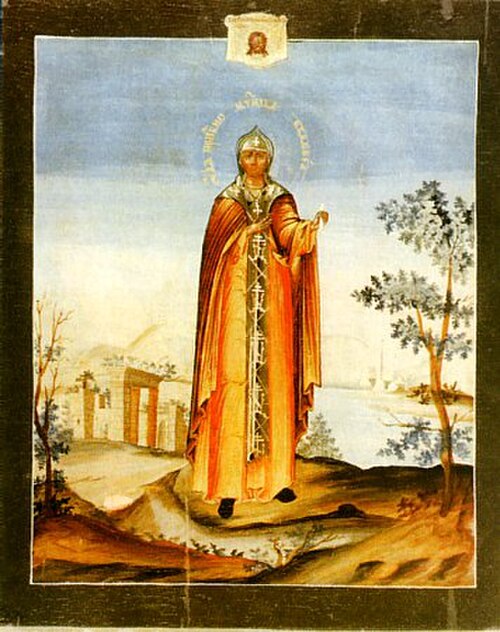
Venerable Martyr
Eudokia of Heliopolis
Samaritan woman of Heliopolis in Phoenicia, now Baalbek, a martyr put to death around 107.
Life
Saint Eudokia of Heliopolis (now Baalbek, in Lebanon), a venerable martyr, was a woman of Samaritan descent who, after a sinful life, repented, became a nun and abbess and received a martyr's death. The Church commemorates her on 1 March. She is not to be confused with other saints named Eudokia.
According to her life she was very beautiful and had gathered great wealth by her sinful life. The change came through the monk Germanus, who, coming to the city one day on business, lodged in a house next to hers. At night, according to monastic custom, he read the Psalter and a book on the Last Judgment. Eudokia, who heard him through the wall, listened attentively to the end, seized with fear, and stayed awake until morning. She sent to call the monk, and their long conversation about faith and salvation led her to a decision. Germanus told her to stay alone in her room for a week, fasting and praying. According to tradition the Archangel Michael appeared to her then and assured her of Christ's love for all people. She was baptised by Bishop Theodotus of Heliopolis, gave her property to the Church to be shared among the poor, freed her servants and slaves, and then withdrew to a women's monastery nearby. She gave herself to ascetic struggle, obedience, vigil and fasting, and soon, after the death of the abbess, she was chosen abbess. The account says that her prayer healed a persistent suitor, Philostratos, who had been struck down, and that he then became a Christian, and that she was given the gift of raising the dead.
As to the persecution, the life tells that the city governor, Vincentius, hearing that the monastery held a great treasure, sent soldiers to plunder it; for three days a divine power kept them from entering, and then a huge serpent destroyed almost the whole company. Eudokia, seeing in a vision that she would suffer for Christ, took the Holy Gifts and gave herself into the soldiers' hands. She was brought before Diogenes, who ordered her hung from a tree and scourged. The story says that a portion of the Lord's Body, which she carried, turned to fire, burned the servants and wounded the governor, and at the saint's prayer he was raised and received baptism. In the end she was beheaded with the sword. The life says she lived in the monastery for fifty-six years.
The dating is uncertain: some sources place her under Trajan, others under Hadrian (one tradition gives 1 March 107); the Bollandists consider the life legendary, with many anachronisms, and place her in the fifth century. In iconography she is shown as a martyr or alone. In Romanian folklore her name is tied to the figure of Baba Dochia, and on 1 March customs welcoming spring are kept.
Commemorated the same day March 1
 David of WalesSaint · Patron of WalesMar 1
 Suitbert of KaiserswerthVenerable · Missionary to GermanyMar 1
 Domnina of SyriaVenerable · Ascetic of CyrrhusMar 1
 Leoluca of CorleoneVenerable · Abbot in CalabriaMar 1
 Antonina of NicaeaMartyr · Martyr of NicaeaMar 1
 Basil of Pavlovsky PosadRighteous · Righteous man of Pavlovsky PosadMar 1
 Anna MakandinaVenerable Martyr · NunMar 1
 Martyrius of ZelenetsVenerable · Founder of Zelenets MonasteryMar 1
 Basil NikitskyHieromartyr · PriestMar 1
 Daria ZaitsevaVenerable Martyr · NunMar 1
 Anthony PankeevHieromartyr · Bishop of BelgorodMar 1
- Benjamin FamintsevHieromartyr · ArchpriestMar 1