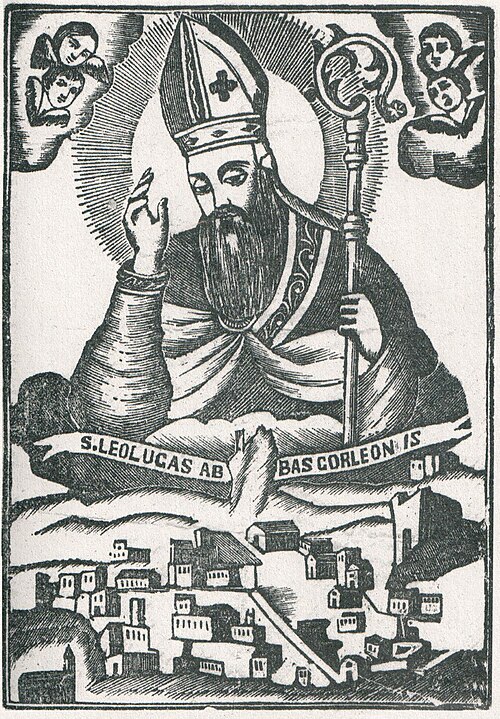
Venerable
Leoluca of Corleone
Abbot in Calabria
Abbot of the monastery on Mount Mula in Calabria, wonderworker and founder of Italo-Greek monasticism.
- Feast
- March 1old style March 14
- Reposed
- 91510th century
- Place
- Vena Inferiore
- Order
- Venerables
Life
Venerable Leoluca of Corleone (Leone Luca, Leo Luke of Corleone, Luke of Sicily) was abbot and wonderworker of the monastery on Mount Mula in Calabria and one of the founders of Italo-Greek monasticism in southern Italy, in the ninth and tenth centuries. He is venerated as a saint in both the Roman Catholic and Orthodox Churches, on 1 March, and is patron of the towns of Corleone, in Sicily, and Vibo Valentia, in Calabria. His life is known from the Life published in the seventeenth century, whose Latin manuscripts do not point to an original Greek source, though the Greek names in it suggest one.
The sources
The text of the Life of Leo Luke of Corleone was published in 1657 in the Sicilian martyrology of the Jesuit Ottavio Gaetani ("Vitae Sanctorum Siculorum"), who said he took it from three manuscripts discovered in Sicily, one at Palermo, another at Mazara and a third at Corleone. Later the Bollandists published another Life, in Latin, found in the library of Joseph Acosta. None of the Latin manuscripts refers to a Greek source, but the presence of Greek names (Leone, Theotiste, Christopher, Theodore, Euthymius) may suggest one. The Life was probably composed right after Leoluca's death in Calabria, but may have been handed down orally and then in writing, later and in another place.
In Sicily
Leoluca was born at Corleone, in Sicily, in the ninth century (between 815 and 818), on the eve of the Saracen invasion of Sicily, in a pious and well-to-do family. His parents, Leo and Theoktiste, baptized him Leo, after his father. He was orphaned young and began to manage the estate and tend the flocks as a shepherd. In the solitude of the fields he understood he had a call to monastic life, so he sold the estate, gave the money to the poor and went to the monastery of Saint Philip at Agira, in the province of Enna. It is not known how long he stayed there. Because of the Saracen raids he left for Calabria, on the abbot's advice, after making a pilgrimage to the tombs of the holy Apostles Peter and Paul in Rome. At that time many Sicilian monks were forced to move to southern Italy because of the oppression by the Arabs who ruled the island.
In Calabria
In Calabria he went to the monastery of Mula, on Mount Mula, one of the highest peaks of the Orsomarso mountains (1,935 m), near Cassano allo Ionio. A pious woman had advised him to begin his struggle not as a hermit but in a community monastery. Obeying her, he entered the community monastery of Saint Sozon on Mount Mula. There he became a monk, with the name Luke, and the brothers called him Leoluca. He excelled in virtue and obedience and stayed six years.
Then he left with the abbot of the monastery, Christopher, for the mountainous region of Merkourion, in northern Calabria, in the Pollino area of the southern Apennines, an important centre of monastic settlements, called in several Lives the "New Thebaid", on the border of Calabria and Lucania. Here they founded a new monastery, probably at Mormanno, and lived seven years in asceticism. They left again for Vena (today Avena, in Calabria), to continue the spiritual struggle another ten years. There they built another monastery, which by the time of Abbot Christopher's death had over a hundred monks. Leoluca himself lived near it, at Mormanno, in solitude. A little later, after the death of Abbot Christopher, Leoluca became abbot of the monastery on Mount Mula. According to tradition God gave him the gift of working miracles, and many faithful flocked to him to receive blessing and healing. He is believed to have healed the sick, cast out demons, raised paralytics and guided the lost toward the path of salvation. He prayed without ceasing and stayed outside in the cold up to twenty days to intensify his struggle. He was distinguished by humility, generosity and almsgiving and led a severe asceticism of unceasing prayer.
Repose and veneration
It is said he spent his last days in meditation, fasting and ecstatic raptures. In old age he called the monks and foretold his end. He entrusted the governance of the monastery to the monk Theodore and gave him as helper the priest Euthymius. Having received Holy Communion, Venerable Luke fell asleep in peace, at an age of almost a hundred (about 915), after eighty years of monastic life, and was buried in the church of the Mother of God at Monteleone Calabro (today Vibo Valentia).
News of his death reached Corleone slowly, and only in the thirteenth century is there evidence of a church dedicated to him in his birthplace. In 1420 a Brotherhood of Saint Leoluca is mentioned. His intercession is credited with saving the town of Corleone in an outbreak of plague in 1575, and he became patron of the town. In 1624 he became patron of Vibo Valentia too. The apparition of Saints Leoluca and Anthony is credited with preventing a Bourbon invasion of Corleone on 27 May 1860. At Vibo Valentia, on his feast day, 1 March, the local fire brigade pay him homage by placing a crown of flowers at the feet of his statue on the façade of the cathedral of Santa Maria Maggiore and San Leoluca, using a turntable ladder. He is invoked as protector against natural disasters.
Some historians say he was buried at Monteleone Calabro, in the church of Santa Maria Maggiore. However, the Italian paper La Sicilia reported on 10 December 2006 that Leoluca's relics had been found in the municipality of San Gregorio d'Ippona, about 2 km south-east of Vibo Valentia, in the grotto of the church of Santa Ruba, and that they were confirmed by analysis. The church of Santa Ruba was dedicated to Our Lady of Health (Madonna della Sanità), according to Professor Gregorio Vaianella.
Commemorated the same day March 1
 David of WalesSaint · Patron of WalesMar 1
 Eudokia of HeliopolisVenerable MartyrMar 1
 Suitbert of KaiserswerthVenerable · Missionary to GermanyMar 1
 Domnina of SyriaVenerable · Ascetic of CyrrhusMar 1
 Antonina of NicaeaMartyr · Martyr of NicaeaMar 1
 Basil of Pavlovsky PosadRighteous · Righteous man of Pavlovsky PosadMar 1
 Anna MakandinaVenerable Martyr · NunMar 1
 Martyrius of ZelenetsVenerable · Founder of Zelenets MonasteryMar 1
 Basil NikitskyHieromartyr · PriestMar 1
 Daria ZaitsevaVenerable Martyr · NunMar 1
 Anthony PankeevHieromartyr · Bishop of BelgorodMar 1
- Benjamin FamintsevHieromartyr · ArchpriestMar 1