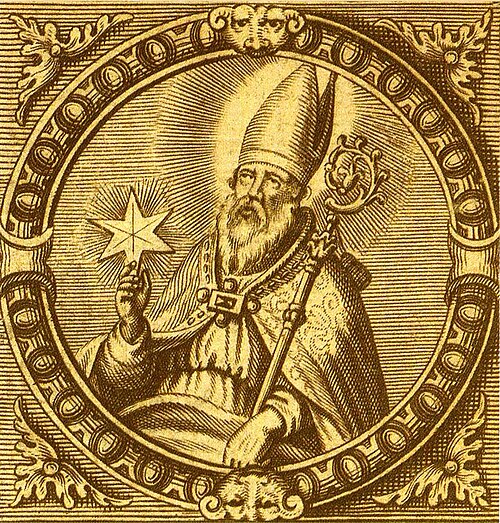
Venerable
Suitbert of Kaiserswerth
Missionary to Germany
Anglo-Saxon missionary born in Northumbria and companion of Willibrord; died at Kaiserswerth in 713.
- Feast
- March 1old style March 14
- Reposed
- 7138th century
- Place
- Kaiserswerth
- Order
- Venerables
Life
Saint Suitbert was an Anglo-Saxon missionary, born in Northumbria in the seventh century, a companion of Saint Willibrord in the mission to the Frisians, then apostle of the lands of the Lower Rhine and Westphalia. He fell asleep on 1 March 713, at Kaiserswerth, on the island of Werth. He is regarded as a patron of Germany and is invoked against sore throats. He is commemorated on 1 March, in some places on 4 September.
Beginnings
He was born in Northumbria. According to legend, his parents, Count Sigebert and Countess Bertha, had before his birth a vision: a very bright star, with two rays toward Frisia and Westphalia, came down toward their chamber, which filled with light and fragrance. A bishop told them they would have a remarkable child, who would be a light of Christianity for the Lower Rhine. This is why he is often shown with a star. He studied in Ireland, at Rathmelsigi in Leinster, with Ecgberht of Ripon. Ecgberht, full of zeal for the conversion of the Germans, had sent Wihtberht to evangelize the Frisians, but because of the opposition of the pagan king Redbad, Wihtberht returned to England. Then Ecgberht sent Willibrord with twelve companions, among whom was Suitbert. They landed in 690 near the mouth of the Rhine and went to Utrecht, which became their headquarters.
The mission
The missionaries worked with great success under the protection of Pepin of Herstal, who, having recently conquered part of Frisia, compelled Redbad to cease harassing the Christians. Suitbert laboured chiefly in North Brabant, Gelderland and Cleves. After some years he went back to England, and in 693, in Mercia, was consecrated a missionary bishop by Wilfrid of York. He returned to Frisia and fixed his see at Wijk bij Duurstede, on a branch of the Rhine. A little later, entrusting his flock of converts to Willibrord, he went north of the Rhine and the Lippe, to the Bructeri, in the district of Berg in Westphalia. The mission bore great fruit at first, but ended in failure because of the inroads of the pagan Saxons who conquered the territory, though he did Christianize the Bructeri. According to tradition, in the Haard forest south of Haltern am See, the ray of light from the star is said to have fallen, and a cross stands there, on the place of an important pagan sanctuary destroyed; the saint is said to have rested there on his journeys.
The island of Werth
Around 700 he withdrew to Werth, a small island that was an important crossing point of the Rhine, six miles from Düsseldorf. The island, with the royal estate of Rinhusen, was granted to him by Pepin of Herstal, probably at the request of his wife, Saint Plectrude. There he built a Benedictine abbey and ended his days in peace, on 1 March 713. Bede the Venerable described him as "a man of modest nature and gentle heart". He was succeeded as abbot by Saint Willeic, also born in England.
Veneration
His relics were rediscovered in 1626 at Kaiserswerth and are venerated there still. His bones have rested since 1264 in a precious shrine in the former collegiate, now parish, church of Kaiserswerth, one of the most important examples of medieval goldsmithing in the Rhine-Maas region. The old shrine is no longer carried in processions, for which a shrine of 1991 is used. Each year in May Kaiserswerth holds a festival weekend in his honour, with a shrine procession through the old town and along the Rhine. A sculpture of 1864 by Julius Bayerle shows him in a niche of a building on the Suitbertus-Stiftsplatz.
Commemorated the same day March 1
 David of WalesSaint · Patron of WalesMar 1
 Eudokia of HeliopolisVenerable MartyrMar 1
 Domnina of SyriaVenerable · Ascetic of CyrrhusMar 1
 Leoluca of CorleoneVenerable · Abbot in CalabriaMar 1
 Antonina of NicaeaMartyr · Martyr of NicaeaMar 1
 Basil of Pavlovsky PosadRighteous · Righteous man of Pavlovsky PosadMar 1
 Anna MakandinaVenerable Martyr · NunMar 1
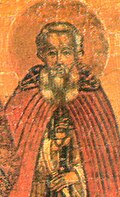 Martyrius of ZelenetsVenerable · Founder of Zelenets MonasteryMar 1
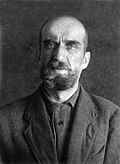 Basil NikitskyHieromartyr · PriestMar 1
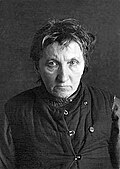 Daria ZaitsevaVenerable Martyr · NunMar 1
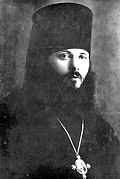 Anthony PankeevHieromartyr · Bishop of BelgorodMar 1
- Benjamin FamintsevHieromartyr · ArchpriestMar 1