Martyr
Eustathius of Vilnius
A martyr of Vilnius in Lithuania, put to death for his faith in Christ.
Life
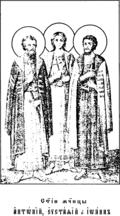
Holy Martyr Eustathius of Vilnius (Lithuania) was a martyr alongside his kinsmen, the holy Anthony and John, at the court of the Grand Prince of Lithuania Algirdas (1345 to 1377). The calendar page we rely on tells their lives together.
The brothers Anthony and John
Algirdas had accepted Christianity for worldly reasons, in order to marry the Orthodox princess Maria Yaroslavna of Vitebsk and enlarge his domains. At first he favoured the Orthodox faith: he allowed the princess's confessor, Father Nestor, to preach and allowed several churches to be built, two in Vitebsk and one in Vilnius, in the name of the Holy Martyr Paraskeva. Father Nestor brought several pagan Lithuanian courtiers to Orthodoxy, among them two brothers of local nobility, Nezhilo and Kumets, named at Baptism Anthony and John. After the death of his wife, under pressure from the pagan priests, Algirdas renounced Christianity. Anthony and John kept the Christian customs, among other things not eating meat on fast days, and the pagan priests demanded their punishment. Algirdas urged them to renounce, but the brothers did not yield, and the prince threw them into prison. A whole year they lay there. Anthony, the younger, bore it firmly, but John, the elder, weakened under the trial and secretly promised to submit if he were freed. Algirdas freed them both. John outwardly kept the pagan customs but remained a Christian in his heart. Anthony reproached him for weakness and urged him to repent and confess the name of Christ again.
At a table of the prince, to which the brothers were invited, meat was served on a fast day. John, from fear, did not refuse it, and Anthony refused and was thrown back into prison. John, feeling the weight of his sin, repented with tears, and one day before a great crowd of courtiers declared himself a Christian aloud. He was cruelly beaten and shut in the same prison. Crowds came to the prison to see the confessors, and many received Baptism. The pagan priests demanded their deaths. Anthony was executed first, hung on an oak after receiving the Holy Mysteries in the morning, and after him John, strangled and then hung on the same oak, on 24 April 1347. Their bodies were buried with honour in the church of Saint Nicholas.
Eustathius
A kinsman of theirs, Kruglets, a courtier of Algirdas, shaken by the steadfastness of the martyrs, received Baptism from Father Nestor with the name Eustathius, and began to live as a true Christian, keeping all the rules of the Church. The grand prince, who loved his young courtier, noticed one day that he had let his hair grow and asked whether he was a Christian. Eustathius confessed it openly, and the prince, enraged, tried to force him to eat meat on a Friday of the Nativity Fast. Eustathius refused and was beaten with iron rods, giving thanks to God. Then they led him out naked in a hard frost and poured icy water into his mouth, crushed the bones of his legs from the soles to the knees, tore the skin from his head along with the hair, and cut off his ears and nose. For three days he was tormented. To the Christians who wept he said that this earthly dwelling was being destroyed, but he hoped that God would give him a dwelling not made by hands in heaven.
Condemned to death, he walked to the place of execution so briskly, with his legs crushed, that the executioners could hardly keep up. On 13 December 1347 he was tortured and hung on the same oak as his kinsmen Anthony and John. His body was left near the ground for beasts and birds, but none could approach, for a pillar of cloud guarded it. After three days he was buried in the church of Saint Nicholas, beside the brothers Anthony and John. On the site of the oak a church of the Holy Trinity was later built; when the bodies were moved there, the relics were found incorrupt, and miracles and healings came from them.
Veneration
At the request of the Orthodox Lithuanians, Saint Alexis, Metropolitan of Moscow, appealed to Patriarch Philotheus of Constantinople to approve the glorification of the martyrs. As early as 1364 the patriarch sent to Saint Sergius of Radonezh a cross containing relics of Saints Anthony, John and Eustathius. Algirdas returned to the Christian faith and became a monk at the end of his life, and all twelve of his sons were Christians. By the end of the fourteenth century half the inhabitants of Vilnius confessed Orthodoxy. In 1915, at the approach of the Germans, the relics were taken to Moscow by Metropolitan Tikhon, the future patriarch, and returned in 1946 to the Holy Spirit Monastery in Vilnius. The day of their return, 13 (26) July, is celebrated there every year. Eustathius is commemorated on 27 April (new style) and on 11 July, in the Synaxis of the Saints of Belarus, on a movable day.
Commemorated the same day April 14
 Martin the ConfessorConfessor · Bishop of RomeApr 14
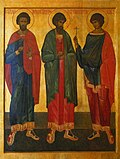 Anthony, John and Eustathius of VilniusHoly Martyrs · Martyrs of VilniusApr 14
 Dimitri KipianiSaint · Georgian statesmanApr 14
 Thomais of AlexandriaMartyr · Martyr of AlexandriaApr 14
- Lambert of LyonSaint · Bishop of LyonApr 14
 TassachSaintApr 14
 Demetrius the NeomartyrNew MartyrApr 14
- Alexander OrlovConfessor · PriestApr 14
- Abundius the SacristanSaintApr 14
 AnthonySaintApr 14
- Anthony of VilniusMartyrApr 14
- ArdalionMartyr · ActorApr 14