Venerable
Euthymius Lyubimchenko of Glinsk
A venerable monk of Glinsk, commemorated in the calendar of the Orthodox Church.
- Feast
- September 9old style September 22
- Reposed
- 186619th century
- Order
- Venerables
Life
Holy Venerable Euthymius Lyubimchenko of Glinsk, in the world Eustathius, was born in 1795 in the Zenkov district of the Poltava province, of a family of freed house serfs of a landowner, and reposed in 1866. Called by God's grace to the monastic life at the age of twenty-two, he is honoured among the venerable fathers of Glinsk.
Beginnings
From 1818 he appears in the lists of novices of the Glinsk Hermitage. At first the novice Eustathius did the hard obediences that beginners have in desert monasteries: the kitchen, the bakery and other menial labour. By his diligence and attention he soon drew the notice of the abbot and the brotherhood and was appointed cell attendant to the elder Philaret. In 1827 Eustathius, who already wore the cassock and kamilavka, was assigned the obedience of sacristan, an arrangement which, given his zeal for the church, was a true spiritual consolation.
On 20 December 1832 he was tonsured into the mantle by the builder Philaret and named Euthymius. In his old age, when he passed on to the young monks the wise teachings of the great abbot, Euthymius ended his speech with this seal: So the elder Philaret taught us.
From 1827 to 1857 he served as sacristan and was a living Typikon, a perfect knower of the order of the Church. But besides this visible service he carried a hidden and necessary inner labour for salvation: the struggle with the passions. The desires of our old man have no end, the venerable said. If you obtain one, desires flare up for another, higher; if you obtain that too, desires multiply still more for a still higher rank.
If you have received the rank of deacon, you will surely wish for that of hieromonk, then the epigonation, then some honoured office, and so our desires have no limit. So it is best to block this road from the start by cutting off the causes of seeking honours, and to replace everything by one seeking, the approach to God: by this way our soul will sooner reach the desired rest.
Hidden labour
The abbot of Glinsk, seeing the strict ascetic life of the monk Euthymius, treated him with great respect and, wishing to make him spiritual father of the younger brothers, proposed that he accept ordination. But Euthymius, guided by his humility, refused flatly, saying: Holy father, whoever has to teach others must first strive to know everything himself, and I am only beginning to learn. The free hours from the sacristan's obedience he devoted to other work: he laboured in the garden, planting trees, digging and watering, and the same inside the monastery, in the gardens around the brothers' buildings.
Of his inner and outward labours in the years of his manhood and old age we have remained in ignorance, apart from a few very small pieces of information that he told on occasion to brothers who came to him for teaching in the struggle with passions. Once, strengthening a brother in the struggle, he told him how in his youth he had fought the spirit of fornication, which attacked him fiercely; to repel its fiery arrows, he bound his naked body with a knotted cord and tightened it hard, and for a whole week he walked through the forest without food or rest, day and night without loosing the cord, crying out loudly to the Lord.
When God's help came and he felt peace in his heart and rest in his body, he wished to take off the cord, but it had sunk deep into his flesh and the skin had stuck to it; tearing it off, there was a wound along its whole length.
The tonsure of the elder Euthymius into the schema took place in the fifties, when he was retired from service; because it was done in secret, his name was not changed. For thirty years of the sacristan's obedience he was almost unceasingly in the church: at the beginning of the services he entered first, and at the end of the long desert service and all the offices he left last, so that little time remained to him for rest and food.
When from old age he could not fulfil the sacristan's obedience and was relieved, despite his weakness, he hurried to the beginning of every service and stood attentively to the end.
His end
Before his death the elder smiled brightly, and tears flowed from his eyes; one of the brothers asked him in simplicity of heart: Father, why do you weep? Are you also afraid to die? He answered: Why should I be afraid? I am going to the heavenly Father, and should I be afraid? No, brother, by the goodness of God, I am not afraid; and the tears you see are tears of joy.
For so many years my soul has longed for the Lord, and now the desired time approaches: I shall soon stand before Him whom my soul has longed for all my life, and I shall see Him; therefore the tears flow.
He was buried at the Glinsk Hermitage. He is commemorated on 22 September (new style).
Commemorated the same day September 9
 JoachimRighteous · Father of the TheotokosSep 9
 Ciarán of ClonmacnoiseVenerable · Abbot of ClonmacnoiseSep 9
 Joseph of VolotskVenerable · Abbot of Volokolamsk MonasterySep 9
 Gorgonius of NicomediaMartyr · Martyr of NicomediaSep 9
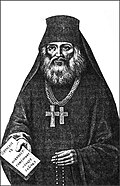 Philaret of GlinskVenerable · Abbot of Glinsk HermitageSep 9
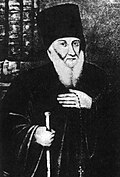 Basil KishkinVenerable · Hieromonk of PloshchanskSep 9
- Zenobius MazhugaSaint · Metropolitan of the Georgian ChurchSep 9
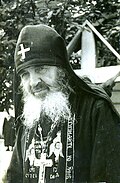 Andronik LukashVenerable · Schema-archimandrite and elderSep 9
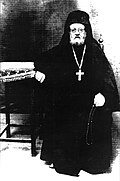 Joanicius of RakotinciVenerableSep 9
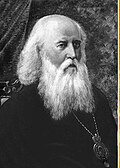 Zacharias LobovHieromartyr · Archbishop of VoronezhSep 9
- Joachim of OpochkaVenerable · Disciple of St. Euphrosynus of PskovSep 9
- Nikita of ConstantinopleFool-for-Christ · Clerk of ConstantinopleSep 9