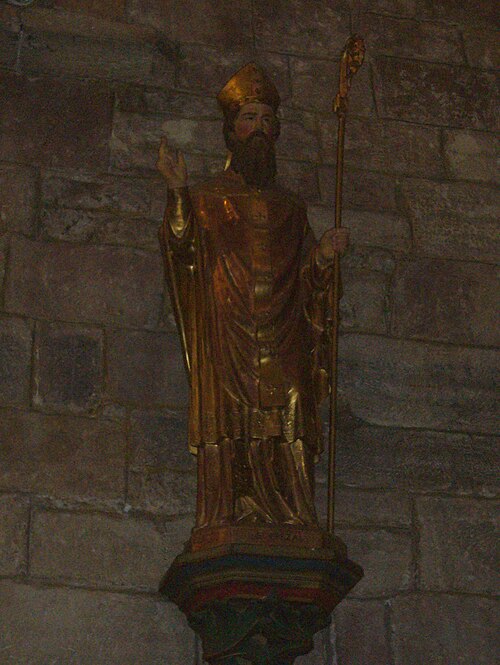
Hieromartyr
Fredardus of Mende
Bishop of Mende
Bishop of Mende in France, who reposed in 826.
- Feast
- September 4old style September 17
- Reposed
- 8269th century
- Place
- Banassac
- Order
- Martyrs
Life
Fredardus of Mende (Fredaldo, Frézal, Frézal of the Gévaudan) was bishop of the Gévaudan and is venerated as a saint in the Western Church. According to a legendary text he was killed on 4 September 826 (other sources give 828). He appears little in historical writings, took part in no council, but has a great oral tradition.
It is not known for sure whether the episcopal see of the Gévaudan was then at Mende or in another commune; Javols and Banassac may have been the seat for a time. Frézal is said to have been born around 780 in the neighborhood of the upper Lot valley, as the eldest son of William of Gellone, and is known as bishop of the Gabali in the time of Louis the Pious, son of Charlemagne, whose cousin he was. His greatest task was to rid the Gévaudan of idolatry, especially the ritual of the lake of Saint-Andéol near Bonnecombe, begun three centuries earlier by Saint Hilarius of Mende. He was the fourteenth bishop of the Gévaudan, in an office left unfilled for decades; the list of the bishops of Javols has a gap of two hundred years.
The Life of the saint tells that, having reached the age when old age was to do its work, Frézal was still robust, to the great dismay of his nephew Bucilinus, destined to succeed him in the episcopate. Bucilinus is said to have cut off his uncle's head in his own house. The legend says that the devil himself showed Bucilinus how to proceed, so as to be rid at once of uncle and nephew, whom he then strangled on leaving Frézal's house. According to the same legend, Frézal picked up his head and carried it to the place where he wanted to be buried, which indicates that the episcopal see was then not at Mende but at La Canourgue, for forty kilometers separate Mende from the spring where Saint Frézal rests. His status as a martyr has been doubted over the centuries.
His tomb is a reused Roman sarcophagus, in the chapel of Saint-Frézal of the 12th century, near La Canourgue. The fountain beside it was already known in Roman times for its healing benefits.
Commemorated the same day September 4
 MosesProphet · The LawgiverSep 4
 Joseph the All-ComelyRighteous · Son of JacobSep 4
 Boniface I of RomeSaint · Bishop of RomeSep 4
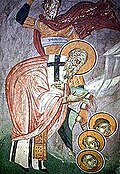 Babylas of AntiochHieromartyr · Patriarch of AntiochSep 4
 Hermione of EphesusMartyr · Martyr of EphesusSep 4
 Candida the ElderMartyr · Patron of NaplesSep 4
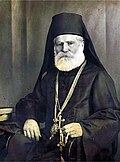 Peter ZimonjićHieromartyr · Metropolitan of Dabar and BosniaSep 4
 Theodore, Mian, Julian and KionHoly Martyrs · Martyrs of NicomediaSep 4
- Ultan of ArdbraccanSaint · Abbot-bishop of ArdbraccanSep 4
- Babylas of NicomediaMartyrSep 4
 Sergius DruzhininHieromartyr · Bishop of NarvaSep 4
 Stephen of TronošaVenerable · ArchimandriteSep 4