Venerable
Gabriel of Sedmiezerka
Schema-archimandrite
Schema-archimandrite born in 1844 in the Perm region, who lived at the Sedmiezerka Hermitage and died in Kazan in 1915.
- Feast
- October 4old style October 17
- Reposed
- 191520th century
- Order
- Venerables
Life
Venerable Gabriel (in the world Gavriil Fyodorovich Zyryanov, 1844-1915) was a Russian schema-archimandrite, confessor and spiritual father, a disciple of Elder Ambrose of Optina and abbot of the Sedmiezernaya Hermitage near Kazan. He was revered as an elder in his lifetime and was glorified in 1996. He is commemorated on 24 September.
Childhood and the call to monastic life
He was born on 14 March 1844 in the village of Frolovo, in the Irbit district of Perm province, into a well-off family of state peasants, and was baptized with the name of the Archangel Gabriel. The family attended the church of the Sign of the Mother of God in the village of Bobrovskoe. As he was often ill in childhood, his parents vowed to abstain from meat and alcohol for his recovery. At eighteen he made a pilgrimage to Saint Nicholas Monastery in Verkhoturye, to the relics of Saint Simeon of Verkhoturye, who appeared to him several times in visions and foretold that he would become a monk.
Optina and the years of apprenticeship
In 1864 (some sources say 1865) he entered Optina as a novice. In 1872 he was formally enrolled in the monastery and tonsured a rassophore. He had obediences at the bell tower, the bakery, the prosphora bakery and the abbot's kitchen, and was guided spiritually by Elders Ambrose and Hilarion. In 1874 he fell gravely ill and was healed through the prayers of the Optina elders. In the autumn of that year he visited Kiev and Moscow, and on 28 December 1874 he entered the Vysoko-Petrovsky Monastery at the invitation of Archimandrite Gregory. He was tonsured a monk on 13 August 1875 with the name Tikhon, in honour of Saint Tikhon of Zadonsk, and in 1877 he was ordained deacon.
Because of the slander and intrigues of some of the brethren, in 1880 he moved to the Epiphany Monastery in Moscow. He had a fine tenor voice and often served with Bishop Ambrose of Dmitrov, which aroused the envy of other hierodeacons. Remaining in correspondence with the Optina elders, he left Moscow on the advice of Saint Ambrose and in 1882 came to the Raifa Monastery near Kazan. There he was ordained priest on 24 April 1883. On 7 October 1883 he was appointed steward of the bishop's house in Kazan, and a month later was transferred to the Sedmiezernaya Hermitage.
Sedmiezernaya and the great schema
On 4 March 1889 he was appointed confessor and dean of the monastery. He took part in the processions with the wonderworking Smolensk icon of the Mother of God, the monastery's chief treasure. In the autumn of 1892, while pulling a monastery cart out of a ravine, he strained himself, and on the same day he suffered a severe burn of the oesophagus and stomach from vinegar essence. Expecting to die, he was tonsured into the great schema on 5 October 1892, with the blessing of Archbishop Vladimir of Kazan, with the name Gabriel.
For five years he did not rise from his bed, receiving the Holy Mysteries often. During the years of his illness he acquired the gifts of eldership and discernment. Archbishop Arseny appointed him acting superior in 1901 and then superior of the hermitage, and on 9 June 1902 he was raised to archimandrite. In that year he published in Kazan a collection, Instructions and Words, which was reissued in 2013.
As superior he showed great skill in management. Under him the monastery became not only spiritually beautiful but also a well-ordered, self-supporting community. For many years its main source of income had been the wonderworking icon, which was carried in processions through the diocese. Father Gabriel, seeing that these journeys did great spiritual harm to the monks, ordered them stopped and that the brethren live by the work of their hands. Seven or eight versts from the monastery he built a farmstead, bought new agricultural machinery and built cattle sheds with a good breed of dairy cattle, brick kilns, a smithy, a cooperage, joinery, shoemaker's and tailor's shops, and put the brethren to work, reducing the number of hired labourers.
Trials and the years at Pskov
His spiritual authority and his energetic management aroused the displeasure of some careless monks and of some people in secular circles, and several complaints against him reached the Synod. In 1908 he was accused of ruining the monastery and of belonging to the Social Democratic party. Archbishop Nicanor carried out an inspection, and on 15 May 1908 Father Gabriel and the treasurer, Hieromonk Tikhon, were removed from their posts. Archimandrite Simeon recalled that the elder nearly died from the shock. He was expelled from the monastery, lived for a time in a house built from the gifts of his admirers and then in Kazan, and was later cleared of the charges.
At the end of July 1908 he came to the Eleazar Monastery in Pskov, whose abbot was his spiritual son, Archimandrite Juvenal. A house with a church in honour of the Archangel Gabriel was built for him and consecrated on 7 August 1910. He divided his life between unceasing prayer, in which he read twelve thousand Jesus Prayers daily together with the midnight office, the kathismata, the hours, vespers and his cell rule, and the service of an elder. Crowds came to him without cease for healing of soul and body, for advice and comfort. He also guided the sisters of the Old Ascension Convent and the Saint John the Forerunner Convent in Pskov.
Repose and veneration
From 1912 his health declined. Sensing death near, he prepared a burial place at Eleazar. In the summer of 1915 the advance of German troops made him leave for Kazan, where he lived gravely ill in the home of Archimandrite Guriy, inspector of the Theological Academy. Hieromonk Jonah (Pokrovsky) gave him communion before the end. He fell asleep on 24 September 1915 and was buried in the church of Saint Euthymius the Great and Saint Tikhon of Zadonsk at the Sedmiezernaya Hermitage.
In 1928-1929 the monastery was closed and laid waste, and the grave was desecrated. His holy relics were preserved, together with the Smolensk icon, by Hieroschemamonk Seraphim (Kashurin). His first life was written by his disciple, Archimandrite Simeon (Kholmogorov). In 1981, with the blessing of Bishop Panteleimon of Kazan, his image was placed on the icon of the Synaxis of the Saints of Kazan in the Cathedral of Saint Nicholas. In 1996 the Synodal Commission for Canonization examined the materials, and on 25 December 1996 Patriarch Alexy II approved his canonization. A troparion and kontakion were composed that year, and an akathist in 1998.
From 1997 his relics were in the church of Saint John of Kronstadt of the Kazan seminary, and since 30 July 2000 they have rested in the restored Sedmiezernaya Hermitage. On 9 July 2019 the Holy Synod placed the question of his veneration throughout the whole Church on the agenda of the next Council of Bishops.
Commemorated the same day October 4
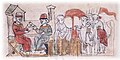 Vladimir of NovgorodRight-Believing · Prince of NovgorodOct 4
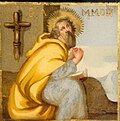 Ammon of NitriaVenerable · Founder of the Nitria communityOct 4
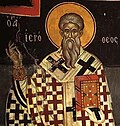 Hierotheos the ThesmotheteHieromartyr · Bishop of AthensOct 4
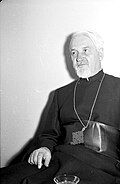 Dumitru StăniloaeConfessorOct 4
 Paul the SimpleVenerable · Disciple of Saint Anthony the GreatOct 4
- Luke ZhidiataSaint · Bishop of NovgorodOct 4
 Stefan ŠtiljanovićRight-Believing · Serbian noblemanOct 4
 Gurias of KazanSaint · First Archbishop of KazanOct 4
 Arcadius of NovgorodSaint · Bishop of NovgorodOct 4
 Eudemus I of GeorgiaHieromartyr · Catholicos-Patriarch of GeorgiaOct 4
 Gaius of CorinthApostle · of CorinthOct 4
 Helladius of KievVenerable · Recluse of the Kiev CavesOct 4