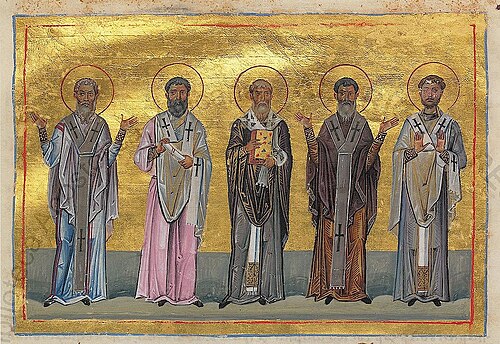
Apostle
Gaius of Ephesus
Apostle of the Seventy
One of the Seventy Apostles, bishop of Ephesus, named in Romans; commemorated on January 4.
- Feast
- November 5old style November 18
- Reposed
- 1001st century
- Place
- Ephesus
- Order
- Apostles
Life
Saint Gaius the Apostle was one of the seventy apostles, a disciple of the holy Apostle Paul and bishop of Ephesus, named in the New Testament in the Epistle to the Romans and in the First Epistle to the Corinthians. He is remembered on 5 November (old calendar), with the apostles Patrobulus, Linus, Philologus and Hermas, and on 4 January, in the synaxis of the seventy apostles.
In the New Testament
Gaius is named twice in the New Testament: in the Epistle to the Romans (16:23), where Paul says that Gaius, his host and that of the whole Church, greets them, and in the First Epistle to the Corinthians (1:14), where Paul thanks God that he baptized none of them except Crispus and Gaius. The tradition of the Church counts him a disciple of the Apostle Paul, who later became bishop at Ephesus. As is seen from the First Epistle to the Corinthians, he was a wealthy and prominent inhabitant and perhaps a proselyte, that is, a Jew of the diaspora or a pagan who had accepted the law of Moses.
During Paul's long stay at Corinth, he received him in his house and served the Apostle of the Gentiles with the virtue of hospitality, of which Paul writes to the Christians of Rome. Gaius was known for his virtuous life. Saint John Chrysostom writes in his commentary on the Epistle to the Romans that the Apostle wove him a crown, testifying to his love of strangers and gathering the whole Church in his house. And when you hear that Gaius received Paul in his house, marvel not only at his generosity, but also at his strict life, for if Gaius had not been worthy of Paul's virtues, Paul would not have gone to his house.
Bishop of Ephesus
According to the Slavonic Menaia, Gaius was bishop of Ephesus after the Apostle Timothy. The church writer Dorotheus of Tyre gives the same information. Some have suggested that he is the Gaius to whom the Third Epistle of John is addressed. Our sources speak both of a Gaius of Ephesus and a Gaius of Corinth, but they give no other sure life.
Commemorated the same day November 5
 LinusApostle · Bishop of RomeNov 5
 Hermas of PhilippopolisApostle · Bishop of PhilippopolisNov 5
 Philologus of SinopeApostle · Bishop of SinopeNov 5
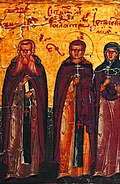 Galaktion and EpistemeHoly MartyrsNov 5
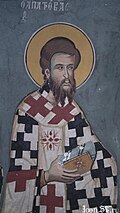 PatrobasApostle · Apostle of the SeventyNov 5
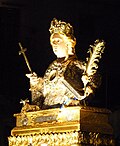 TrofimenaSaintNov 5
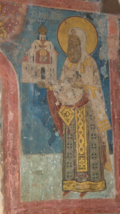 Jonah of NovgorodSaint · Archbishop of Novgorod and PskovNov 5
 Mark of EcaSaint · Bishop of EcaNov 5
- Gabriel MaslennikovHieromartyr · PriestNov 5
- AgathangelusMartyrNov 5
- Augustine and PaulinusVenerableNov 5
- AuxentiusHieromartyr · Martyr of Caesarea MaritimaNov 5