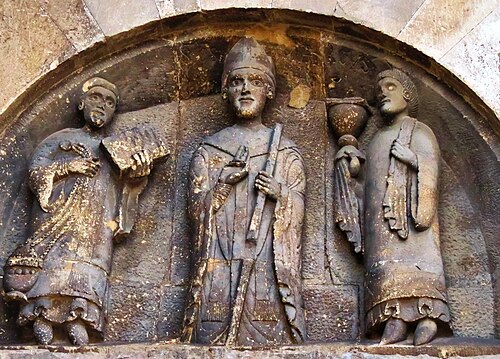
Saint
Mark of Eca
Bishop of Eca
Bishop of Eca in Apulia and confessor of the faith in the 3rd-4th centuries; commemorated June 14.
- Feast
- November 5old style November 18
- Reposed
- 3284th century
- Place
- Lucera
- Order
- Hierarchs
Life
Saint Mark of Eca was a confessor bishop of Apulia, of the third and fourth centuries (around 266 to 328), bishop of Lucera. He is commemorated on 14 June, 7 October and 5 November; 7 October is taken as the day of his repose. Our sources show no separate Orthodox glorification and present him as a saint of Italian Apulia, with local veneration.
He was born in a city of Daunia. His father, Constantine, was a rich and educated man and taught the future saint his letters. John, bishop of Troia, ordained him priest. Saint Mark soon became known for his devotion, strictness and abstinence and for his generosity to the needy. He shared his dwelling with two girls who were receiving Christian education. The life of Saint Mark aroused the envy of some fellow citizens, who sent a letter to Bishop John, accusing the saint of gluttony, magic and cohabitation with the two girls, and asked him to punish Mark, lest his conduct bring some disaster upon the city. Then the bishop sent two deacons, Vincent and Aristotle, for the saint. On their arrival Saint Mark prayed to God to help him overcome these accusations, then proposed to them to receive the Holy Mysteries, to which only Vincent agreed. Then they set out. On the journey Aristotle grew very hungry. Then Mark, seeing a doe with a fawn beside the road, prayed, and she nourished Aristotle with her milk. Satisfied, Aristotle fell at Mark's feet, begging forgiveness.
Arriving at the bishop's, the two deacons told him what had happened. John and Mark went to serve matins. During the service Mark heard a choir of angels greeting the coming of the new day and asked the bishop to pray for him until he too heard them. Convinced by this of Mark's complete innocence, the bishop asked him to stay another week. Soon Bishop John died. Both the people and the clergy demanded that Saint Mark become bishop of Lucera. He did not consider himself worthy of episcopal ministry and tried to flee, but was soon found. So he was elected and then installed by Pope Marcellinus. As bishop, Saint Mark took care to live in abstinence, in almsgiving and in helping the poor.
Above all, Mark soon became known for numerous miracles. The water that passed through his hands after the service had power to work wonders. He also healed a possessed man sent by the devil with threats. A man who suffered from a ceaseless pain in the head, which had led to blindness, received sight by the saint's prayer and laying on of hands. At another time, as he was walking through the square, a widow begged him to give back her son who had just died; convinced by the woman's insistence, Mark went to her house and, left alone in the room with the child's body, prayed to God to repeat the miracle of resurrection, performed several times through the prophets and Jesus Christ. His prayers were accepted and he was able to bring the child back to life. Struck by fever, Saint Mark died at the age of 62. After his death many clergy and inhabitants sensed a fragrance coming from his body. The day of his repose is celebrated on 7 October. By his will he was buried at Bovino, and where his body rested a church was built.
Commemorated the same day November 5
 LinusApostle · Bishop of RomeNov 5
 Gaius of EphesusApostle · Apostle of the SeventyNov 5
 Hermas of PhilippopolisApostle · Bishop of PhilippopolisNov 5
- Philologus of SinopeApostle · Bishop of SinopeNov 5
 Galaktion and EpistemeHoly MartyrsNov 5
 PatrobasApostle · Apostle of the SeventyNov 5
 TrofimenaSaintNov 5
 Jonah of NovgorodSaint · Archbishop of Novgorod and PskovNov 5
- Gabriel MaslennikovHieromartyr · PriestNov 5
- AgathangelusMartyrNov 5
- Augustine and PaulinusVenerableNov 5
- AuxentiusHieromartyr · Martyr of Caesarea MaritimaNov 5