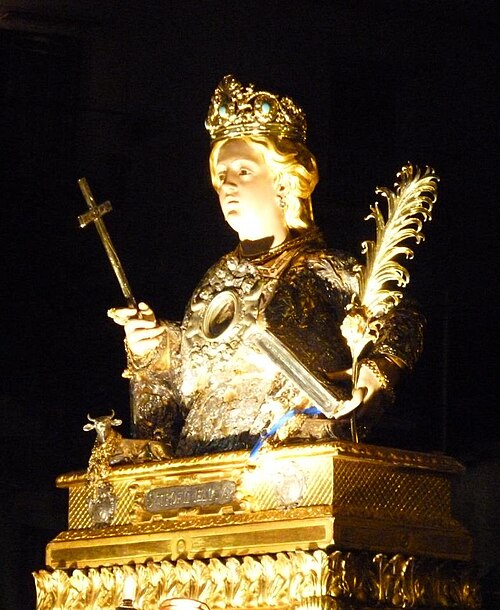
Saint
Trofimena
Virgin from Patti in Sicily, linked with Saint Febronia; her relics are venerated in the basilica at Minori.
- Feast
- November 5old style November 18
- Reposed
- 7007th century
- Place
- Patti
Life
Saint Trofimena is a virgin and martyr from Patti in Sicily, honoured above all at Minori, on the Amalfi coast of southern Italy, where her relics are kept. Her story comes down to us through legend and medieval narratives, and scholars today think her legend is mixed up with that of Saint Febronia of Nisibis. Her commemoration falls on 5 November. She is a saint of the time before the division of the Church, honoured in the West, and her feast in the town is celebrated above all on 13 July.
The legend of the martyr
Tradition says that Trofimena was tortured to death by her own father, in the town of Patti in Sicily, when she was a young girl of 12 or 13, because she wanted to receive Holy Baptism and embrace Christianity. A vision is told of an angel, who announced the young girl's dedication to Christ and the martyrdom awaiting her, and advised her not to enter the marriage her family was preparing.
After death her body was placed in an urn and given to the waves of the sea. The current carried the urn toward the shore of Salerno, in southern Italy, to the little town of Minori. The urn was found by the people of Minori, who carried it on a cart drawn by a pair of young bulls, in the presence of Peter, bishop of Amalfi (around the year 829). Where the animals stopped, a church was built in her honour. The stopping of the animals was taken as a sign.
The relics and their moves
The finding of the relics and their placing with honour in the cathedral of Minori, according to an anonymous chronicle of the ninth century, is tied to the years 838 to 839, in the time of Sicard, prince of Benevento. At the move, miracles appeared. The relics did not stay long there, however. Sicard, raising a church in his capital, resolved to obtain relics and agreed with sailors of Amalfi to bring him the relics of Saint Bartholomew from Lipari. The Amalfitans, fearing that Sicard would also take Trofimena's relics from Minori, a town that could not defend itself, carried them to their own city, Amalfi, and placed them in the cathedral.
Tradition says that Trofimena showed her displeasure at the move and warned Bishop Peter that he would die soon and that his tomb would be desecrated by wild dogs. So it happened: Sicard returned from a successful expedition against the Saracens, sent his fleet to Amalfi, took the relics and carried them first to Salerno, then to Benevento. Bishop Peter's tomb was desecrated and his remains thrown to the dogs.
The following year, 839, Sicard was killed, and two priests of Minori at once asked for the relics from Prince Radelchis and the bishop of Benevento, threatening them with the eternal enmity of the Amalfitans if they refused. Until the arrival of the relics of the Holy Apostle Andrew from Constantinople, Trofimena enjoyed great veneration throughout the Amalfi territory, because she was the only saint of whom they had real relics at hand. An agreement was reached that the body be returned, except the top of the skull. The relics were carried to Minori and, to the joy of all, on 13 July 840 were carefully hidden in the basilica.
In 987 Minori was raised to a bishopric. With time the exact place of the relics was lost. Though she bore several names (Trufumena, Trefonia, Febronia), on 21 January 1673 the Sacred Congregation of Rites in Rome decided that from then on the saint would appear in the calendar of martyrs as Trofimena. Bishop Silvestro Stano began the remodelling of the cathedral at the end of the eighteenth century, and a few years later the relics were found on the night of 27 November 1793. In 1694 the Neapolitan playwright Carmino Scassafer published a "sacred tragedy" about her life.
Veneration today
Today Saint Trofimena's relics are in the basilica of Minori. The medieval church was built around the year 700 on the foundation of an older Roman church, was remodelled in the twelfth century and then completely rebuilt in the eighteenth. In the crypt of the basilica, on the main altar, her relics have lain since 1722 in an alabaster urn made by the sculptor Gennaro Ragazzino. At Salerno there still stands an ancient church of Saint Trofimena, in which part of her relics is kept (the top of the skull). In New York, emigrants from Minori have raised a chapel in her honour and have a copy of the statue carried in procession on the feast of the patroness of Minori.
The calendars know three feasts: 5 November, the finding of the relics in the early centuries, 27 November, their finding again at the end of the eighteenth century, and 13 July, the most important, when the deliverance of Minori from Arab pirates is remembered. The town had been attacked from the sea, and, after the prayers of the inhabitants to the protector Trofimena, on a fine summer day a terrible storm rose which scattered the attackers' ships.
Trofimena and Febronia
Sometimes Trofimena is identified with Saint Febronia of Nisibis, whose name appears in the Latin translations as Phebronia, Pambronia, Sephronia, Sophronia and Trofimena. According to her Life of the sixth century, Febronia was a beautiful nun martyred in the persecution of Diocletian. Her veneration began in Syria and spread to Constantinople, southern Italy and Sicily. Her Latin life dates from the ninth century. According to scholars today, it is very likely that the legends of Febronia and Trofimena are one and the same.
Commemorated the same day November 5
 LinusApostle · Bishop of RomeNov 5
 Gaius of EphesusApostle · Apostle of the SeventyNov 5
 Hermas of PhilippopolisApostle · Bishop of PhilippopolisNov 5
- Philologus of SinopeApostle · Bishop of SinopeNov 5
 Galaktion and EpistemeHoly MartyrsNov 5
 PatrobasApostle · Apostle of the SeventyNov 5
 Jonah of NovgorodSaint · Archbishop of Novgorod and PskovNov 5
 Mark of EcaSaint · Bishop of EcaNov 5
- Gabriel MaslennikovHieromartyr · PriestNov 5
- AgathangelusMartyrNov 5
- Augustine and PaulinusVenerableNov 5
- AuxentiusHieromartyr · Martyr of Caesarea MaritimaNov 5