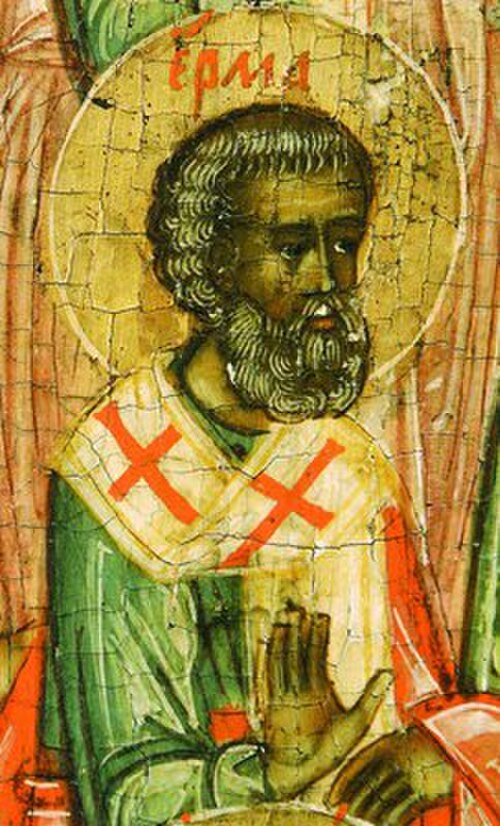
Apostle
Hermas of Philippopolis
Bishop of Philippopolis
One of the Seventy, bishop of Philippopolis in Thrace (modern Plovdiv); sometimes taken for the author of the Shepherd of Hermas.
- Feast
- November 5old style November 18
- Reposed
- 1001st century
- Place
- Plovdiv
- Order
- Apostles
Life
Saint Hermas the Apostle was one of the Seventy Apostles and, according to tradition, bishop of Philippopolis in Thrace, now Plovdiv in Bulgaria. He is named by the Apostle Paul in the Epistle to the Romans (16:14), among the brethren to whom greetings are sent. The Church remembers him on 31 May, on 5 November with the apostles Patrobas, Linus, Gaius and Philologus, and on 4 January, in the Synaxis of the Seventy.
From the fact that Paul names him and counts him among the "brethren" it is understood that he was a prominent member of the Christian community at Rome. The Greek Menaia call him bishop of Philippopolis in Thrace, while some Slavic sources mention him at Philippi. The service gives no other historical information about him. The Serbs say he was Greek by birth but lived long at Rome.
According to tradition Hermas was first wealthy, then fell into poverty because of his sins and those of his sons. Then, at prayer, there appeared to him a man in white clothes with a staff in his hand, who told him he was the angel of repentance, sent to him for the rest of his life. During that time he wrote the book The Shepherd, which Christians believed was written according to the angel's revelations. The angel is said to have given him twelve commandments: to believe in God; to live in simplicity and innocence and give alms to anyone who asks; to love truth and shun lies; to keep purity of thought; to learn patience and magnanimity; to know that beside each person stand a good spirit and an evil one; to fear God and not the devil; to do all good and refrain from every evil deed; to pray from the depth of the soul with faith that the prayer will be heard; to guard against sadness, sister of doubt and anger; to test true and false prophecies; and to guard against every evil desire. Scholars say that Hermas of Philippopolis is often identified with the author of The Shepherd, but that author was a second-generation Christian and lived somewhat later. Hermas ended his life as a martyr for the faith in Christ.
Commemorated the same day November 5
 LinusApostle · Bishop of RomeNov 5
 Gaius of EphesusApostle · Apostle of the SeventyNov 5
- Philologus of SinopeApostle · Bishop of SinopeNov 5
 Galaktion and EpistemeHoly MartyrsNov 5
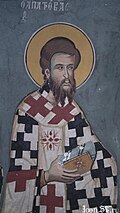 PatrobasApostle · Apostle of the SeventyNov 5
 TrofimenaSaintNov 5
 Jonah of NovgorodSaint · Archbishop of Novgorod and PskovNov 5
 Mark of EcaSaint · Bishop of EcaNov 5
- Gabriel MaslennikovHieromartyr · PriestNov 5
- AgathangelusMartyrNov 5
- Augustine and PaulinusVenerableNov 5
- AuxentiusHieromartyr · Martyr of Caesarea MaritimaNov 5