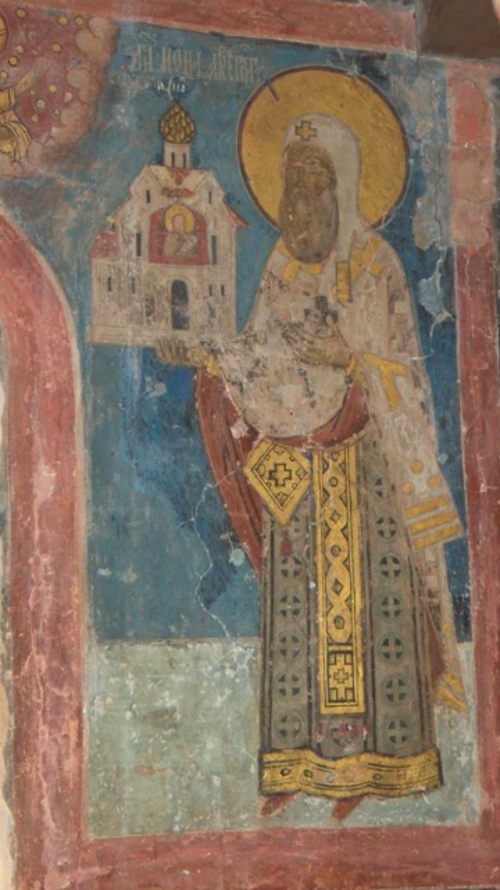
Saint
Jonah of Novgorod
Archbishop of Novgorod and Pskov
Archbishop of Novgorod and Pskov, orphaned young, who died on November 5, 1470.
- Feast
- November 5old style November 18
- Reposed
- 147015th century
- Order
- Hierarchs
Life
Saint Jonah was archbishop of Novgorod and Pskov, who died on 5 November 1470. He was canonized by the Council of Makariev in 1549 for veneration throughout the Russian Church. He is commemorated on 5 (18) November, the day of his death, on 9 (22) January, the translation of his relics in 1554, on 9 (22) March, the memory of the miracle at his relics (1670), on 10 (23) February and 4 (17) October in the Synaxis of the Hierarchs of Novgorod, and on the third Sunday after Pentecost in the Synaxis of the Saints of Novgorod.
At three he lost his mother, and at seven his father. A pious widow, Natalia Medovartseva, raised him. According to the Serbian source, already in childhood Michael of Klopsko foretold that he would be archbishop; immediately on coming of age he received the monastic habit at the Otnya monastery and took the name Jonah, leading a strict life, full of great monastic labours. He was abbot of the Otensky hermitage; according to the Serbian source, after the death of Archimandrite Chariton he was chosen abbot. From 1458, after the death of Archbishop Euthymius, he was elected in his place archbishop of Novgorod and Pskov.
He organized in Novgorod shelters for orphans and widows. To defend his flock from the claims of Moscow he went to Ivan III and persuaded him to look on Novgorod with gentle eyes. In 1466 more than 250,000 people died of plague in the Novgorod land, among them in Novgorod itself some 50,000 (including 7,650 monastics and 300 priests). According to the chronicle, Jonah stopped the disease by holding a procession to the Zverin monastery. He invited to Novgorod the Lithuanian and Kievan prince Michael Olelkovich, to organise defence against the conquest of Novgorod by Moscow. According to the Serbian source, as archbishop he built many churches and adorned others: the church of Saint Sergius of Radonezh, the church of the Three Hierarchs, the church of Saint John the Forerunner, he restored the church of the Holy Great Martyr Demetrius and built the church of Saint Symeon the God-receiver; he made a great contribution to the founding of the Solovki monastery.
He died on 5 November 1470 and was buried at the Otnya (Otensky) monastery. His relics lay, not covered with earth, in the church of the Forerunner of the Otensky hermitage. In the lives many wonderful healings at his tomb are recounted. At the beginning of the nineteenth century, after the building of the monastery's new cathedral, the saint's grave came to lie between the side chapels of the Three Hierarchs and of Jonah and was marked in 1803 with a gilded shrine and a canopy. In the Great Patriotic War the church was destroyed. The place where the relics of Saint Jonah lie under a slab is marked with a wooden cross, to which the local people go on pilgrimage on Elijah's Friday.
Commemorated the same day November 5
 LinusApostle · Bishop of RomeNov 5
 Gaius of EphesusApostle · Apostle of the SeventyNov 5
 Hermas of PhilippopolisApostle · Bishop of PhilippopolisNov 5
- Philologus of SinopeApostle · Bishop of SinopeNov 5
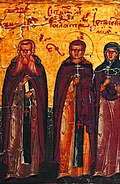 Galaktion and EpistemeHoly MartyrsNov 5
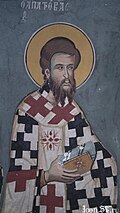 PatrobasApostle · Apostle of the SeventyNov 5
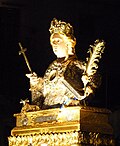 TrofimenaSaintNov 5
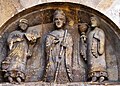 Mark of EcaSaint · Bishop of EcaNov 5
- Gabriel MaslennikovHieromartyr · PriestNov 5
- AgathangelusMartyrNov 5
- Augustine and PaulinusVenerableNov 5
- AuxentiusHieromartyr · Martyr of Caesarea MaritimaNov 5