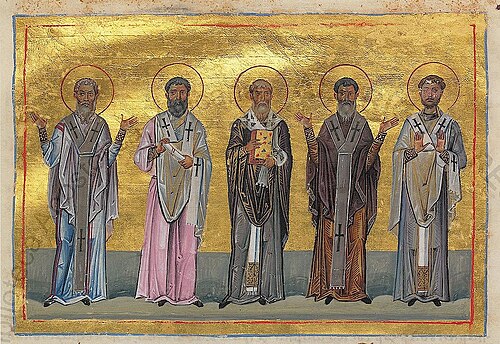
Apostle
Philologus of Sinope
Bishop of Sinope
One of the Seventy and bishop of Sinope, named by the Apostle Paul in Romans.
- Feast
- November 5old style November 18
- Era
- unknown
- Order
- Apostles
Life
Saint Philologus the Apostle was one of the Seventy Apostles and bishop of Sinope, on the Black Sea shore. He is named by the Apostle Paul in the Epistle to the Romans (16:15): "Salute Philologus, and Julia, Nereus, and his sister, and Olympas, and all the saints which are with them." The Church remembers him on 5 November, with the apostles Patrobas, Hermas, Linus and Gaius, and on 4 January, in the Synaxis of the Seventy Apostles. Catholics commemorate him on 4 November, with Crispus and Gaius.
The New Testament says nothing else about him. Who the Julia named with him was is not known; some regard her as his sister, others, like Origen, as his wife. Some manuscripts have "Julius" and then he would be a man, one of the members of the Church of Rome. Tradition numbers him among the Seventy, a disciple of the Apostle Paul. Dorotheus, Epiphanius and others regard him as disciple and companion of the Apostle Andrew, and the Acts of Andrew name him among his companions. The Greek Synaxarion says Andrew made him bishop at Sinope. The Prologue adds that he endured many misfortunes and afflictions, taught many and brought them to Christ, and after many labours gave his soul to God in peace. One source considers him the possible father of Marcion of Sinope.
According to the Roman tradition Philologus was a Roman of noble birth, son of Saint Persis, named by Paul in Romans 16:12. From youth he served in the praetorian guard, renowned for courage and beauty, and chanced to meet Aquila, whom he defended from the abuse of the pagan crowd. Julia, of unusual beauty, was his wife and a kinswoman of Persis. Through Aquila the young couple met the Apostle Paul in his first imprisonment at Rome and were baptized by him, but Philologus did not wish to leave his good post at court and remained a secret Christian. After Paul was freed and left Rome, in 64 Nero set the city on fire and blamed the Christians, and many were burned as torches in his gardens. Philologus and Julia were not among the first. After the terrible killing of the Roman Christians, Philologus resolved to declare himself a Christian; some of the brethren urged him to spare himself and his young wife, and Julia ended his hesitation, saying in a firm voice: "Where the Lord has placed us, there we must be, and not fear to confess His faith. In life and in death we are His children." Nero ordered the two spouses burned together at the stake.
Commemorated the same day November 5
 LinusApostle · Bishop of RomeNov 5
 Gaius of EphesusApostle · Apostle of the SeventyNov 5
 Hermas of PhilippopolisApostle · Bishop of PhilippopolisNov 5
 Galaktion and EpistemeHoly MartyrsNov 5
 PatrobasApostle · Apostle of the SeventyNov 5
 TrofimenaSaintNov 5
 Jonah of NovgorodSaint · Archbishop of Novgorod and PskovNov 5
 Mark of EcaSaint · Bishop of EcaNov 5
- Gabriel MaslennikovHieromartyr · PriestNov 5
- AgathangelusMartyrNov 5
- Augustine and PaulinusVenerableNov 5
- AuxentiusHieromartyr · Martyr of Caesarea MaritimaNov 5