New Martyr
George of Ephesus
New Martyr of Ephesus
A new martyr of Ephesus, who died in 1801 at New Ephesus (Kusadasi); venerated locally.
Life
George of Ephesus was a Christian born at New Ephesus (Kusadasi) who, after a fall and deep repentance, confessed Christ and was beheaded in 1801. He is honoured as a new martyr and is commemorated on 5 April. On the island of Samos he is popularly called "Saint George the Drunk". He has no known canonization.
He was born in 1756 at New Ephesus, to a father from Samos. He was married and had several children. In June 1798, while drunk, he was induced to deny his Orthodox faith and become a Muslim, though he was not circumcised. When he sobered he was ashamed of what he had done, renounced Islam and fled to Samos.
While he was away the Christians of New Ephesus received permission from Constantinople to build a church, a rare thing at that time. The local Muslims were angered and claimed that the Christians meant to kill George and bury his remains in the foundation of the church. After some time George was recognised on Samos and brought back by force. He was circumcised and made the keeper of a mosque. After ten months he found an opportunity and sailed back to Samos, and then divided his time between Samos and Patmos, weeping in repentance.
Having confessed his sin, he resolved to die for Christ. He appeared before the Turkish governor of Samos, confessed Christ and condemned Islam; he was beaten and imprisoned, but was soon released through the influence and money of leading Christians of Samos. He went back to New Ephesus, first sent his family away so that they would not suffer the vengeance of the fanatics, and for three days sat before the tree on which the new martyr Polydoros had been hanged, and then in a coffee house, waiting to be arrested. No one touched him. So he appeared alone before the judge, on Wednesday 3 April, and confessed his faith.
He was bound, imprisoned with a heavy chain around his neck and his feet in stocks, and tortured. He was told to pronounce the Muslim declaration and was offered money, but he answered that he was an Orthodox Christian and wished to die an Orthodox Christian. On Friday he was brought before the court. The mufti told him to say the declaration and live as he pleased, Turk or Orthodox, but he stood firm. Sentenced to be beheaded, he knelt at the place of execution, refused the last urging of a Muslim and bent his head with a serene face. That night a light shone over his body. The judge ordered that he be buried with Polydoros, and the Christians took hair, blood-soaked clothing and other relics, through which many healings were worked, especially of fevers and malaria.
His biographer, Saint Athanasios of Paros, tells of the healing of a man, Nicholas Karpathios, of stomach pains after he came in tears to the martyr's tomb. In 1806 the saint's skull was brought to the Monastery of Docheiariou on Athos in a silver reliquary. His service was written by Saint Nikephoros of Chios. He is honoured especially on Samos, where the first official commemoration took place on 7 May 1967 in the presence of Metropolitan Panteleimon. Since 1996 the feast has been kept on the fifth Sunday of Pascha. A part of his head is at Docheiariou, and a relic of the skull is kept in the Metropolis of Samos.
Commemorated the same day April 5
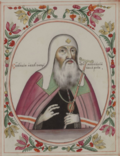 Job of MoscowSaint · First Patriarch of MoscowApr 5
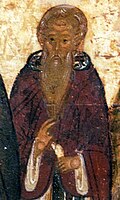 Plato of SakkoudionVenerable · Abbot of SakkoudionApr 5
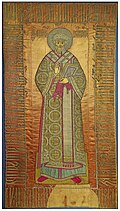 Philip I of MoscowSaint · Metropolitan of MoscowApr 5
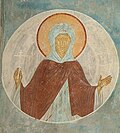 Theodora of ThessalonicaVenerable · Nun of ThessalonicaApr 5
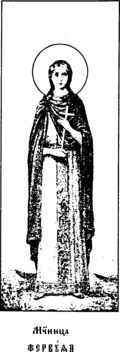 PherbuthaMartyrApr 5
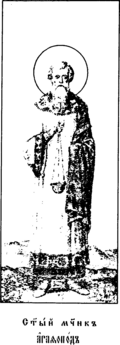 Theodulus and AgathopodesHoly Martyrs · Martyrs of ThessalonicaApr 5
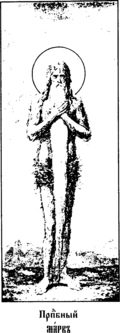 Mark of AthensVenerable · Hermit and fool for ChristApr 5
- Agathopus of ThessalonikiMartyrApr 5
 Argyre of ProusaNew MartyrApr 5
- Nicholas SimoHieromartyr · ArchpriestApr 5
 Theodulus of ThessalonikiMartyrApr 5
- AbdiesusSaintApr 5