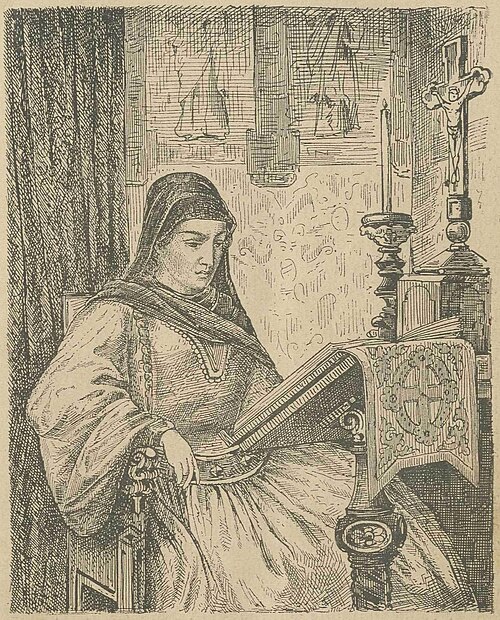
Right-Believing
Helen of Serbia
Queen of Serbia
Wife of King Stefan Uroš I of Serbia and mother of later Serbian kings, who died in 1314.
- Feast
- October 30old style November 12
- Reposed
- 131414th century
- Place
- Shkodër
Life
Saint Helen of Serbia, also called Helen of Anjou or Helen Angelina, was queen of Serbia, wife of King Stefan Uroš I and mother of the kings Stefan Dragutin and Stefan Milutin. She was born about 1236 and died on 8 February 1314, as a nun at Shkodër. The Serbian Church numbered her among the saints, as the first woman canonised by it, and commemorates her on 12 November (30 October by the old calendar).
Origin
Nothing is known with certainty of her family. Her Life, written by Archbishop Danilo II, says only that she was of a French family, of royal or imperial blood. Because King Charles I of Naples called her a relative in a letter of 1273, the idea of an origin from the house of Anjou arose, long taken up by older historians. More recent research shows a distant kinship only, and the name Anjou is perhaps a mistake for Angelina, the name of the Byzantine family of the Angeloi. According to Gordon McDaniel, she was the daughter of John Angelos, lord of Syrmia, and Matilda of Vianden, a granddaughter of the sister of Baldwin II of Constantinople. A document of 1280 calls Maria of Cayeux the sister of the queen of Serbia, which supports this link.
Queen of Serbia
Helen married King Stefan Uroš I about 1245 to 1250 and had at least four children. It is said that the king had lilacs planted in the Ibar valley so that the young woman from another land would feel at home. In 1276 conflict broke out between the king and their eldest son, Dragutin, and Uroš withdrew, dying in 1280. In the reigns of her sons, Dragutin and Milutin, Helen governed as queen mother, until 1308, the provinces of Zeta, Travunia, Plav and the Ibar region. She was a good administrator of lands with a mixed Orthodox and Catholic population.
She built many churches, Orthodox and Catholic alike, among them the Orthodox monastery of Gradac and Catholic monasteries at Bar, Ulcinj, Shkodër and Kotor, and was known for her religious tolerance. She brought influences of French Gothic into Serbian architecture. She founded the first girls' school in medieval Serbia, kept a library at court and encouraged the copying of books in monasteries. Her palace stood at Brnjaci, in present Kosovo. Helen contributed greatly to the cultural flowering of the Serbian state.
Her end and veneration
She became a nun at the church of Saint Nicholas in Shkodër, taking, according to some sources, the monastic name Elisabeth, and fell asleep there on 8 February 1314. She was buried at the monastery of Gradac, which she had built. Tradition says that after three years a monk saw her in a dream, and when her grave was opened her body was found incorrupt, after which she was numbered among the saints. Her Life was written in 1317 by Archbishop Danilo II. Her relics, says one source, are lost, while another mentions a hand kept at the monastery of Tvrdoš, in Herzegovina.
Commemorated the same day October 30
 Stefan Uroš II MilutinRight-Believing · King of SerbiaOct 30
 Justus BarsabbasApostle · Apostle of the SeventyOct 30
 Artemas of LystraApostle · Bishop of LystraOct 30
 Marcellus of TangierMartyr · Roman centurionOct 30
 Joseph I GalesiotesSaint · Patriarch of ConstantinopleOct 30
 Marcian of SyracuseHieromartyr · First Bishop of SyracuseOct 30
 Anastasia the RomanVenerable Martyr · Nun of RomeOct 30
 Germanus of CapuaSaint · Bishop of CapuaOct 30
 TertiusApostle · Apostle of the SeventyOct 30
 Varnava the New ConfessorConfessor · Bishop of HvosnoOct 30
 Felix of Massa MartanaHieromartyrOct 30
- ClopasSaint · New Testament figureOct 30