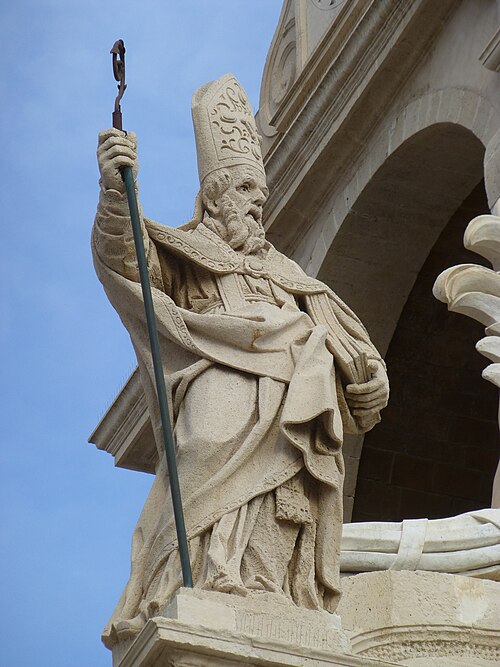
Hieromartyr
Marcian of Syracuse
First Bishop of Syracuse
Native of Antioch, by tradition a disciple of the Apostle Peter and first bishop of Syracuse; he died a martyr.
- Feast
- October 30old style November 12
- Reposed
- 681st century
- Place
- Syracuse
- Order
- Martyrs
Life
Saint Marcian the Hieromartyr is venerated as the first bishop of Syracuse in Sicily and, according to tradition, a disciple of the Apostle Peter. The Church remembers him on 30 October, in some calendars on 9 February. Much can be said of his veneration, but little is certain of his life, since the sources are late.
According to tradition he was born in Antioch of Syria in the first century, and the Apostle Peter sent him in the year 39 to preach the Gospel at Syracuse. The first Christians gathered in the cave of Pelopius, in the Acradina district. The spread of Christianity roused the displeasure of the senate and the Jews, many of whom had gone over to the new faith. In the year 68 the bishop was stoned to death. According to another tradition he was killed at Syracuse in the time of the emperors Gallienus and Valerian, between 253 and 260, nearly two hundred years later. Having come to the West, to Sicily, while the apostle was still in Antioch, he is regarded as the first bishop of the West.
The earliest reports of him are late: a Kontakion attributed to the hymnographer Gregory, from the second half of the seventh century, and an Encomium, from the end of the seventh century or the start of the eighth, in Greek, preserved in the Vatican, which uses oral tradition and a lost Passion of a disciple of the saint, Peregrinus. Because of the laudatory character of these writings it is hard to tell sure facts from fanciful ones, and many scholars place the bishop no earlier than the third century. The oldest image of him is an eighth-century fresco in the catacombs of Saint Lucy. Another depiction was found in the so-called crypt of Saint Marcian, a Byzantine basilica built over an ancient Christian complex, regarded by tradition as the saint's dwelling and then his tomb. His relics, however, are not at Syracuse but at Gaeta, where he is patron of the city together with Saint Erasmus, commemorated on 2 June, and at Messina. He is also patron of the diocese of Syracuse.
Commemorated the same day October 30
 Stefan Uroš II MilutinRight-Believing · King of SerbiaOct 30
 Helen of SerbiaRight-Believing · Queen of SerbiaOct 30
 Justus BarsabbasApostle · Apostle of the SeventyOct 30
 Artemas of LystraApostle · Bishop of LystraOct 30
 Marcellus of TangierMartyr · Roman centurionOct 30
 Joseph I GalesiotesSaint · Patriarch of ConstantinopleOct 30
 Anastasia the RomanVenerable Martyr · Nun of RomeOct 30
 Germanus of CapuaSaint · Bishop of CapuaOct 30
 TertiusApostle · Apostle of the SeventyOct 30
 Varnava the New ConfessorConfessor · Bishop of HvosnoOct 30
 Felix of Massa MartanaHieromartyrOct 30
- ClopasSaint · New Testament figureOct 30