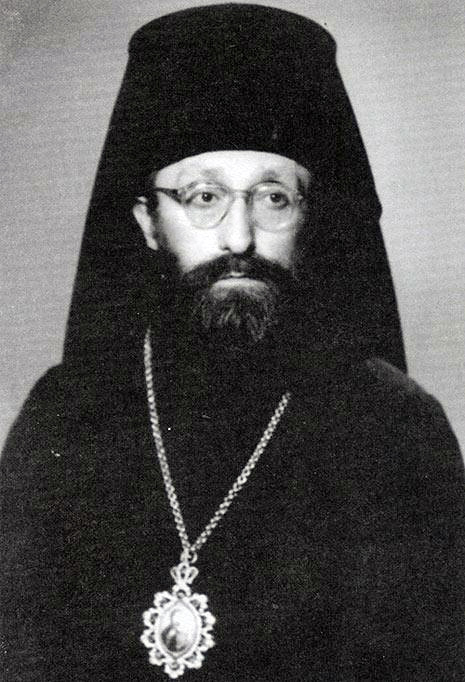
Confessor
Varnava the New Confessor
Bishop of Hvosno
Serbian bishop of Hvosno, confessor of the faith under the communist regime, died in 1964 at Beočin.
- Feast
- October 30old style November 12
- Reposed
- 196420th century
- Place
- Beočin monastery
- Order
- Confessors
Life
Saint Varnava Nastić, also called Varnava the New Confessor, was titular vicar bishop of Hvosno of the Serbian Orthodox Church, born in the United States and imprisoned by the Yugoslav communist regime for his faith and his word. Born on 31 January 1914 at Gary in Indiana, he passed to the Lord on 12 November 1964 at Beočin monastery, in unclear circumstances, perhaps poisoned. He was canonized by the Serbian Church in 2004 and 2005 as a hieroconfessor. He is commemorated on 12 November (30 October Old Style).
Childhood and school
Born Vojislav Nastić into a family of Serbian emigrants from Old Herzegovina, his parents were Atanasije and Zorka, née Laković, members of the church of Saint Sava in Gary, where he was baptized and later served as altar boy. Already at Gary he was recognized as a prodigy in reciting traditional Serbian epic poetry. At about eight, after the second class of primary school, the family returned to the homeland and settled in Sarajevo, in the Kingdom of Serbs, Croats and Slovenes, where he finished primary school and gymnasium, with good results, in 1933. Choosing his way, he went with his father to Ohrid, to Bishop Nikolaj Velimirović, to ask advice; he already had the thought of becoming a monk. His father, who supported the pious "Bogomoljci" movement, told the bishop of his son's wish, and the bishop was glad, but said that for now he should study and that he would pray that the Lord would fulfil his other wish too. Vojislav enrolled at the Faculty of Theology in Belgrade. According to his friend Archpriest Lazar Milin he had good schooling, knew solfeggio, played the cello, spoke English, French and German and loved music and sport. He graduated in 1937 with distinction and taught religion at two high schools in Sarajevo.
Monk and bishop
In 1940, at Mileševa monastery, he was tonsured a monk by Metropolitan Petar of Dabar-Bosna with the name Varnava, after the Apostle Barnabas and after Patriarch Varnava Rosić, and was ordained hierodeacon. In the Second World War he stayed in Sarajevo, during the Independent State of Croatia, and categorically refused Ante Pavelić's offer to become bishop of the so-called Croatian Orthodox Church. After the war Bishop Nektarije Krul of Zvornik and Tuzla ordained him hieromonk and protosyncellus. On 20 May 1947 the Holy Assembly of Bishops elected him vicar of the Patriarch, with the title Bishop of Hvosno, and in August 1947 he was consecrated bishop by Patriarch Gavrilo, with Bishop Nektarije and Bishop Vikentije of Zletovo and Strumica. He helped Bishop Nektarije administer the dioceses of Dabar-Bosna and Zahumlje-Herzegovina.
Arrest and prison
For his sermons against communism he drew the attention of the authorities and was arrested at the end of 1947 or the beginning of 1948; on 1 March 1948 he was sentenced to ten or eleven years of hard labour, on charges of treason, weakening the economic and military power of the country, helping terrorist bands, hostile propaganda and espionage for the Anglo-Americans. One ground was that he had taught his sister Dobrila English so that she could receive the Anglo-Americans, and another that he had taken into his house the UNRRA driver who had brought humanitarian aid to Sarajevo. Many Serbs thought he had been condemned as compensation for the arrest of the Catholic Archbishop Aloysius Stepinac. The prosecutor asked him whether he also regarded Tito as illiterate, since in the cathedral at Sarajevo he had called all unbelievers that, and he answered yes, as anyone who does not know the three letters, GOD. In his closing statement he said he was not surprised to be judged and that so many Christians had been condemned, since Turks, Germans and Ustaše had done the same to them.
He served his sentence at Zenica, in strict isolation, in a dark and damp cell of building 3/A, was shorn and shaved, put to learn locksmithing, tormented with hunger, thirst and loneliness. On Sundays and feast days he sang troparia and other hymns, which led the jailers to punish him still more severely. Among the prisoners, especially the intellectuals, he was loved. In 1949 he was moved to Sremska Mitrovica with other Serbian intellectuals, bound with wire, he himself being tied by the hand to a Catholic priest. When the train arrived, the carriage with the convicts was put on a siding and, around one at night, a locomotive struck the carriage at full speed. Of all the convicts only eleven survived; the bishop was thrown out of the window with the Catholic priest, who died on the spot, and broke both legs and an arm. People at the station ran to help, but the police stopped them. An hour later the medical team came, accompanied by a patrol of the secret police, then the doctors began operations, but the police forbade continuing care while the bishop was on the operating table. His heel was pierced with a drill to insert a metal rod. The injured were thrown into a truck on bare boards; two died on the way. After several months in the hospital he was sent to Belgrade, to the Vavedenje monastery, where he lay almost a year. The people came to him in crowds, so he was moved to Gomionica monastery near Banja Luka. In 1951 he was released conditionally, under surveillance, and the Church retired him.
Last years
In March 1954 he asked to return to episcopal service and was refused. After the end of the sentence he moved to Krušedol monastery, then to Beočin. At the monastery the head of the religious police for Serbia, Milan Vilić, often came to persuade him to change his attitude to the authorities, but in vain: the bishop remained faithful to his religious and national ideals. He died on 12 November 1964 in unclear circumstances; relatives and some clergy suspected the regime of poisoning, according to some by poison in coffee, according to Bishop Vasilije of Srem by poison placed in a tooth by a dentist. No autopsy was done. He was buried in the church of the Ascension of the Lord at Beočin monastery. His lifelong collaborator and secretary was Lazar Babić.
Canonization
On 18 May 2004 the Holy Assembly of Bishops of the Serbian Orthodox Church entered the name of Bishop Varnava of Hvosno in the diptychs and the calendar. The solemn canonization took place on 15 May 2005 during the concelebrated liturgy at Žitomislić monastery. The church of Saint Varnava of Hvosno at Vranješ bears his name. In America he is counted one of the American saints, with Alexis Toth, Alexander Hotovitzky, Herman of Alaska and Peter the Aleut.
Commemorated the same day October 30
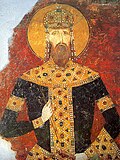 Stefan Uroš II MilutinRight-Believing · King of SerbiaOct 30
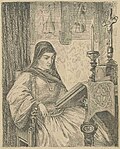 Helen of SerbiaRight-Believing · Queen of SerbiaOct 30
 Justus BarsabbasApostle · Apostle of the SeventyOct 30
 Artemas of LystraApostle · Bishop of LystraOct 30
 Marcellus of TangierMartyr · Roman centurionOct 30
 Joseph I GalesiotesSaint · Patriarch of ConstantinopleOct 30
 Marcian of SyracuseHieromartyr · First Bishop of SyracuseOct 30
 Anastasia the RomanVenerable Martyr · Nun of RomeOct 30
 Germanus of CapuaSaint · Bishop of CapuaOct 30
 TertiusApostle · Apostle of the SeventyOct 30
 Felix of Massa MartanaHieromartyrOct 30
- ClopasSaint · New Testament figureOct 30