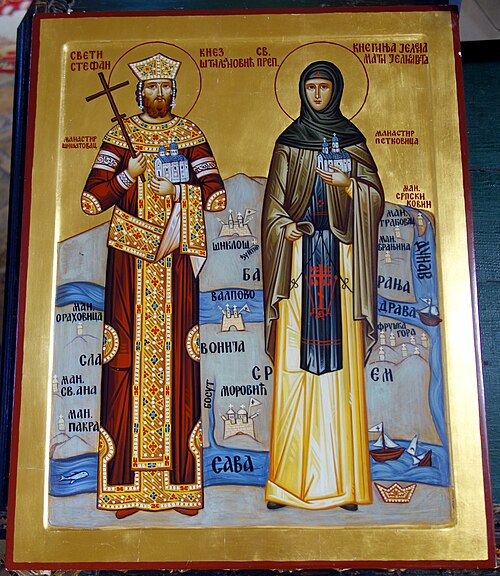
Right-Believing
Jelena Štiljanović
Serbian princess
Serbian princess also called Elisabeth, who died in 1546, venerated as a saint.
- Feast
- October 4old style October 17
- Reposed
- 154616th century
- Place
- Serbia
Life
Jelena Štiljanović, called in monastic life Jelisaveta (Elizabeth), was a Serbian princess, the wife of Prince Stefan Štiljanović, and died around 1546. She is venerated as a saint by the Serbian Church, which commemorates her on 4 October. Her husband, Stefan Štiljanović, is also venerated as a saint, together with his wife.
According to the Serbian source, she was first married to the despot of Syrmia, Jovan Branković, son of the despot Stefan Branković. When Jovan died, on 10 December 1502, his wife, the despotess Jelena, turned to Prince Stefan Štiljanović of the Serbian tribe of the Paštrovići, on the Serbian Adriatic coast, and invited him to take up, in place of her late husband, the Serbian despotic dignity in Syrmia and Slavonia. Prince Stefan accepted the call, became despot and was given to govern the place Morović in Syrmia. After the battle of Mohács in 1526, when the Turks defeated the Austro-Hungarians, they began to enter more and more often to the north, into Stefan's territory and the surroundings. Stefan distinguished himself in the battles against the Turks and soon received other lands: the places Miholjac and Glogovnica in the county of Virovitica, then the towns Novigrad and Orahovica, and then, together with his wife Jelena, he received as a gift the estate called Ešćem in Syrmia. During his life Stefan succeeded in keeping his territories from the Turks. Around 1540 he died a natural death, after which his wife and the people buried him on the hill Buntir.
After his death Jelena was no longer safe in Syrmia and withdrew from the Turks to Germany. After some time the Turks occupied these lands and found Stefan's relics. The military leader Amir, a Serb turned Turk and a distant relative of the despot Stefan, gave the relics to the Serbian monks who had come to him to ask him to give them the coffin. The monks then buried the relics in a monastery on Fruška Gora. When she learned that her husband's relics had been found, Jelena came to the monastery of Šišatovac to venerate them. There she also became a nun, with the monastic name Jelisaveta. There is also a supposition that she became a nun at the monastery of the Entry of the Mother of God into the Temple in Sremski Karlovci. She died around 1546 and was buried beside her husband at the monastery of Šišatovac. The English source adds that the founding of the Petkovica monastery, around 1522, is attributed to her generosity, a date which does not fit her becoming a nun after 1540. Other reports say that she was buried at the convent of the Blessed Virgin in Sremski Karlovci.
Commemorated the same day October 4
 Vladimir of NovgorodRight-Believing · Prince of NovgorodOct 4
 Ammon of NitriaVenerable · Founder of the Nitria communityOct 4
 Hierotheos the ThesmotheteHieromartyr · Bishop of AthensOct 4
 Dumitru StăniloaeConfessorOct 4
 Paul the SimpleVenerable · Disciple of Saint Anthony the GreatOct 4
- Luke ZhidiataSaint · Bishop of NovgorodOct 4
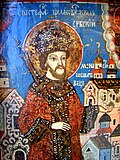 Stefan ŠtiljanovićRight-Believing · Serbian noblemanOct 4
 Gurias of KazanSaint · First Archbishop of KazanOct 4
 Arcadius of NovgorodSaint · Bishop of NovgorodOct 4
 Eudemus I of GeorgiaHieromartyr · Catholicos-Patriarch of GeorgiaOct 4
 Gaius of CorinthApostle · of CorinthOct 4
 Helladius of KievVenerable · Recluse of the Kiev CavesOct 4