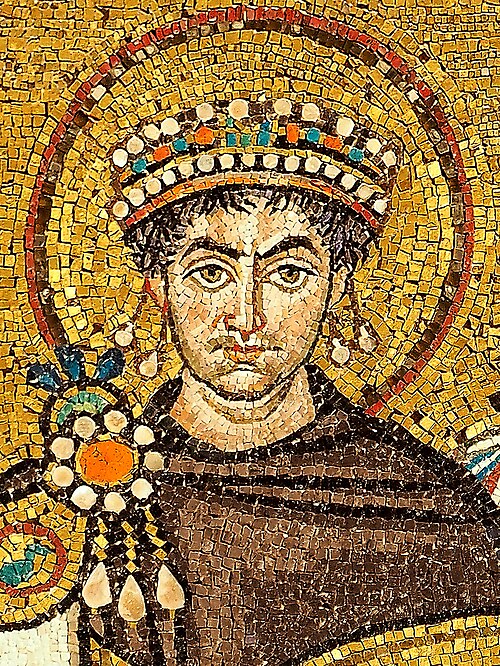
Right-Believing
Justinian the Great
Byzantine Emperor
Byzantine emperor who built Hagia Sophia and codified Roman law in the Justinian Code.
- Feast
- November 14old style November 27
- Reposed
- 5656th century
- Place
- Constantinople
Life
The right-believing Emperor Justinian the Great ruled the Roman Empire of the East from 527 to 565. The Church honours him as a right-believing emperor, builder of Hagia Sophia in Constantinople, defender of the true faith, author of the great collection of Roman law and convener of the Fifth Ecumenical Council. History also shows him as a man of his time, with harsh decisions, and the Church remembers him for his labours on behalf of the faith.
Beginnings
He was born around 482 in the village of Tauresium in the province of Dardania, near present-day Skopje, in a Latin-speaking peasant family. His uncle Justin made a career in the army and became emperor in 518. He brought Justinian to Constantinople, gave him a fine education and made him a sharer in the rule. In 527 Justinian ascended the throne. His wife, the Empress Theodora, was a close counsellor in affairs of state.
His reign was one of the most brilliant in the history of the Empire. Through his generals Belisarius and Narses he reconquered North Africa and Italy, though the victories in the West were hard and costly. The most lasting of his works remains the codification of Roman law, begun in 529: the Code, the Digest, the Institutes and the Novels make up the Corpus Juris Civilis, the foundation of civil law in Europe.
The builder
In January 532 the Nika revolt, begun by the circus factions, nearly overthrew him, and the old cathedral was burned. After the revolt was put down, the emperor rebuilt Hagia Sophia, dedicated to the Wisdom of God, to the plans of the architects Anthemius of Tralles and Isidore of Miletus. The church was consecrated at the end of 537. He also built many other churches, among them the Holy Apostles in Constantinople, Saints Sergius and Bacchus, the monastery of Saint Catherine at Sinai and numerous churches dedicated to the Mother of God. According to an old account he also founded the see of Justiniana Prima, the city he built near the place of his birth.
Defender of the faith
The emperor laboured for the unity of the Church. He issued laws on the order of the clergy and of monasteries and gave legal force to the decisions of the four ecumenical councils held until then. He tried to win back those who had not accepted the Council of Chalcedon, at times by harsh measures that history has recorded, and his dialogues with the non-Chalcedonians bore no fruit. He also fought against the Origenists, whose teaching revived Nestorian errors. In 553 he convened the Fifth Ecumenical Council at Constantinople, which condemned the teachings of Origen and confirmed the decisions of Chalcedon. Tradition attributes to him the hymn "Only-begotten Son and Word of God", sung at the Liturgy before the Little Entrance. He closed the pagan schools at Athens and sent missionaries into Asia Minor, one of whom, Bishop John of Ephesus, is said to have baptized more than seventy thousand pagans. For the newly baptized he ordered ninety churches to be built.
In his personal life Justinian was sober and given to fasting. In Great Lent he would not eat bread or drink wine. His idea of a symphony between Church and state remained a theme of Byzantine thought.
Repose and veneration
In his last years the emperor lived ever more withdrawn. After the great earthquake of 557 he laid aside his crown and gave to the poor, and in the 560s he pardoned those who had plotted to kill him. He reposed on the night of 14 November 565 at Constantinople, childless, and his nephew Justin II succeeded him. He was laid in a mausoleum built for him in the Church of the Holy Apostles, which was plundered and desecrated by the crusaders in 1204.
The Orthodox Church commemorates him on 14 November, the day of his repose, and in the Churches that use the Julian calendar the commemoration falls on 27 November. A Romanian calendar on the Doxologia website lists him on 2 August. Hagia Sophia remains the most vivid witness to his reign.
Commemorated the same day November 14
 PhilipApostle · The ApostleNov 14
 TheodoraRight-Believing · Byzantine EmpressNov 14
 Gregory PalamasSaint · Archbishop of ThessalonicaNov 14
 DubriciusSaint · Welsh bishopNov 14
- Alberic of UtrechtSaint · Bishop of UtrechtNov 14
 Dimitry BenevolenskyHieromartyr · ArchpriestNov 14
 Fantinus the YoungerVenerableNov 14
 Alexander BykovHieromartyr · PriestNov 14
- Anna ZertsalovaMartyr · Spiritual writerNov 14
 George IzvekovHieromartyr · Archpriest and composerNov 14
 Prokopy TitovHieromartyr · Archbishop of Kherson and NikolaevNov 14
- Aristarchus Zaglodin-KokorevVenerable Martyr · HieromonkNov 14