
Hieromartyr
Prokopy Titov
Archbishop of Kherson and Nikolaev
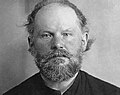
Archbishop of Kherson and Nikolaev, born in 1877, who died a martyr at Turtkul in 1937; canonized in 2000.
- Feast
- November 14old style November 27
- Reposed
- 193720th century
- Place
- Tortkul
- Order
- Martyrs
Life
Saint Prokopy Titov, Hieromartyr, was Archbishop of Kherson and Nikolaev and a confessor of the Russian Church in the years of Soviet persecution. Born in Siberia in 1877, he passed through the Solovki camp and long years of exile, and in 1937 he was shot at Turtkul in Karakalpakia. The Russian Church counted him among the New Martyrs and Confessors in the year 2000.
Youth and teaching
He was born on 25 December 1877 (Old Style) at Kuznetsk-Siberian in the Tomsk governorate, into a priest's family, and was baptized Peter. He graduated from the Tomsk ecclesiastical school (1892) and seminary (1897) and from the Kazan Theological Academy (1901) with the degree of candidate of theology. In 1901 he was tonsured a monk at Ufa by Bishop Anthony Khrapovitsky with the name Prokopy and ordained a hieromonk.
He then taught Russian and Church Slavonic at Tomsk, directed the church teachers' school there and sat on examining boards for candidates to the ranks of reader, deacon and priest. From 1906 he taught Holy Scripture at the Irkutsk seminary, where he was also censor of the diocesan publications. He became known as a gifted preacher and organized the charity section of the Brotherhood of Saint Innocent. In 1907 he published a book on the life and work of Saint Innocent. In 1909, raised to archimandrite, he became assistant head of the pastoral school at Zhitomir, where he taught asceticism and polemical and pastoral theology, and he sat on the commission that examined the relics of Saint Sophronius of Irkutsk. Those who knew him remembered his radiant gaze and his gentle, forgiving smile.
Bishop and the Alexander Nevsky Lavra
On 30 August 1914 he was consecrated Bishop of Elisavetgrad, second vicar of the Kherson diocese, in the cathedral at Odessa. In May 1917 he was appointed acting superior and then superior of the Alexander Nevsky Lavra in Petrograd. He was a member of the Local Council of 1917 to 1918, gave a report on Saint Sophronius of Irkutsk and signed the act of his glorification. On 14 December 1917 he was named abbot of the lavra.
He led the brotherhood that defended the lavra and, together with it, vowed before the shrine of Saint Alexander Nevsky to defend the monastery to his last breath. On 2 February 1918 (New Style) he was arrested together with Metropolitan Benjamin of Petrograd and the whole council of the lavra when Red Guards tried to seize the monastery, demanding the keys to the storerooms and wishing to set up a military hospital there. The alarm bells gathered a crowd of believers, the Red Guards withdrew, and the bishop was freed at the demand of the faithful. Soon he was named Bishop of Nikolaev, vicar of the Odessa diocese, remained at the head of the lavra until April 1918 and then left for Ukraine. On 6 July 1918 he headed the commission investigating the murder of Metropolitan Vladimir of Kiev. From 1921 he was Bishop of Odessa and Kherson.
Arrests and Solovki
On 16 February 1923 he was arrested and imprisoned at Kherson and then at Odessa, and sentenced to death for opposing the confiscation of church valuables. In reality the cause was his resistance to the Renovationist movement, whose clergy were not prosecuted. The sentence was commuted to exile from Ukraine, and on 12 January 1925 he was released and sent to Moscow.
There he was included in the provisional Synod which Patriarch Tikhon wished to legalize, served the memorial service at the patriarch's funeral and signed the document by which the duties of locum tenens passed to Metropolitan Peter of Krutitsy. In June 1925 he was raised to Archbishop of Odessa and Kherson, but could not return to his diocese. At Kherson a clandestine community of his spiritual children had formed, led by Fr John Skadovsky and Protodeacon Michael Zakharov, who commemorated him unfailingly at services and kept him in touch with his flock through letters and parcels. Even between prisons and transports the archbishop answered letters, giving the faithful comfort, advice and his blessing.
On 19 November 1925 he was arrested together with Metropolitan Peter as a supporter of the locum tenens and charged with belonging to a counter-revolutionary group of clergy and laity. In May 1926 he was sentenced to three years in a camp, which he served at Solovki until 3 December 1928. With Bishop Eugene Zernov and other bishops he took part in drafting the "Solovki Epistle" to the government, which called for state and Church not to interfere in each other's affairs. For a time he was the senior bishop in the camp. In September 1928 Metropolitan Sergius Stragorodsky removed him from the see of Kherson and placed him in retirement, which displeased many clergy of the diocese who disagreed with the Declaration of 1927.
Exile
In 1928 he was sent to Siberia, first to the Tyumen region, then to Tobolsk, where he spent a month and a half in an isolation cell, then to Obdorsk and Muzhi and, from 1929 to 1931, to the village of Novy Kievat. He did not accept Metropolitan Sergius's Declaration but did not break communion with him, and he corresponded with Metropolitan Peter until August 1930. On 30 July 1931 he was arrested in exile on a charge of anti-Soviet agitation and sentenced to three years of exile in Kazakhstan.
In April 1934, after his release, he went to his mother at Tomsk hoping to recover from the malaria he had caught in exile, but found no relief. In September 1934, at the invitation of Fr John Skadovsky, he went to Kamyshin, where the priest was in exile. On 2 October 1934 he was arrested again on suspicion of monarchist and anti-Soviet activity. He denied guilt and said he wanted a system ensuring the full separation of Church from state and the Church's freedom to govern itself. On 17 March 1935 he and Fr John were sentenced to five years of exile in Karakalpakia, at Turtkul, where they arrived on 7 May. In their house they set up a small church where Orthodox believers of the area came to confess and receive communion.
Martyrdom
On 24 August 1937 Archbishop Prokopy and Fr John Skadovsky were arrested on a charge of counter-revolutionary monarchist agitation and of organizing an illegal house of prayer. Neither admitted guilt. On 28 October an NKVD troika sentenced them to death and they were shot, the archbishop suffering on 23 November 1937.
Veneration
In 1996 the Holy Synod of the Orthodox Church in Ukraine glorified Prokopy and John as locally venerated saints. In August 2000 the Jubilee Council of Bishops of the Russian Church numbered them among the New Martyrs and Confessors of Russia for veneration throughout the Church. The saint is commemorated on 23 November, the day of his martyrdom, on 18 November together with the fathers of the Local Council of 1917 to 1918, and at the Synaxis of the New Martyrs and Confessors of the Russian Church and of the Saints of Saint Petersburg. In June 2025 a chapel with his icon was consecrated in the village of Novy Kievat in the Yamalo-Nenets region.
Commemorated the same day November 14
 Justinian the GreatRight-Believing · Byzantine EmperorNov 14
 PhilipApostle · The ApostleNov 14
 TheodoraRight-Believing · Byzantine EmpressNov 14
 Gregory PalamasSaint · Archbishop of ThessalonicaNov 14
 DubriciusSaint · Welsh bishopNov 14
- Alberic of UtrechtSaint · Bishop of UtrechtNov 14
 Dimitry BenevolenskyHieromartyr · ArchpriestNov 14
 Fantinus the YoungerVenerableNov 14
 Alexander BykovHieromartyr · PriestNov 14
- Anna ZertsalovaMartyr · Spiritual writerNov 14
 George IzvekovHieromartyr · Archpriest and composerNov 14
- Aristarchus Zaglodin-KokorevVenerable Martyr · HieromonkNov 14