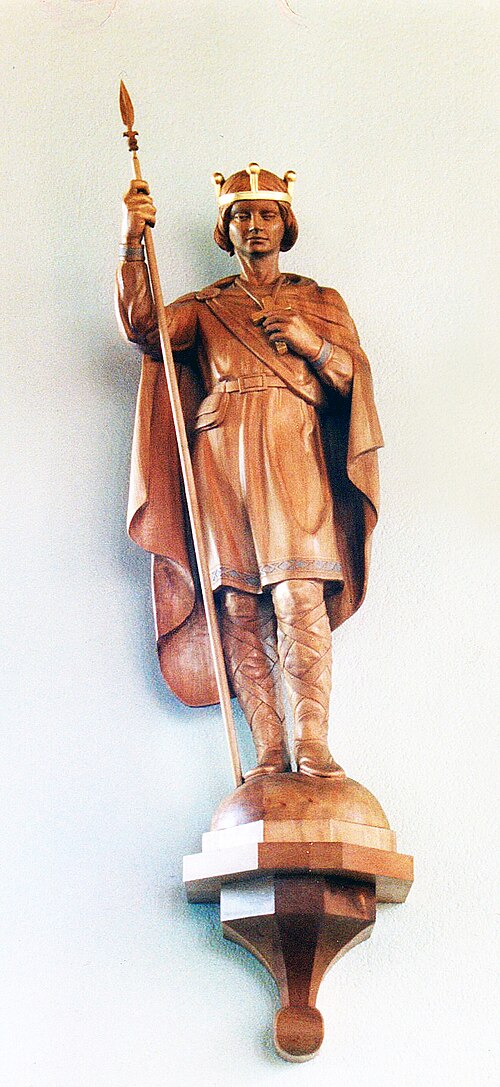
Right-Believing
Kenelm
Anglo-Saxon king of Mercia
Anglo-Saxon prince of Mercia, died around 821, venerated throughout medieval England.
- Feast
- July 17old style July 30
- Reposed
- 8219th century
- Place
- Clent Hills
Life
Saint Kenelm (Cynehelm) was a prince of Mercia, the Anglo-Saxon kingdom at the heart of England, the son of King Coenwulf, who lived at the end of the eighth and the beginning of the ninth century, in the time of the undivided Church. Medieval tradition honoured him as a boy king killed out of envy and as a martyr, and his tomb at Winchcombe became one of the most visited places of pilgrimage in England. The historian William of Malmesbury wrote in the twelfth century that no place in England drew more pilgrims than Winchcombe on Saint Kenelm's day.
His life as it was told in the Middle Ages differs greatly from what the documents of the time preserve. For this reason we set out first what history records and then what tradition relates.
What the records show
After the death of King Offa of Mercia, his son Ecgfrith reigned for only twenty weeks. He was succeeded by a distant kinsman, Coenwulf, of the house of the Iclingas, who reigned from 796 to 821. His son by his wife Ælfthryth was Cynehelm, that is, Kenelm. His date of birth is unknown; one view places it around 786.
Around 798 Coenwulf had his twelve-year-old son anointed as heir to the throne: a letter attributed to Pope Leo III from that year addresses “King Kenelm” and gives his age as twelve. In 799 his name appears as a witness to a gift of land to Christ Church, Canterbury, and from 803 he is regularly found beside his father in charters, perhaps as an associate in government.
After 811 his name disappears from the documents for a time, and many historians therefore believed that he died in his father's lifetime. Some sources, however, show him subscribing to Coenwulf's last charter, of 821, as “Kenelmus, son of the king”. On that evidence, if Kenelm died in 821 as tradition holds, he was then about thirty-five, not seven. Some historians think that in 821, after his father's death, he reigned for a few months and died either in battle, on a campaign in Wales, or at the hands of conspirators. The throne of Mercia then passed to his uncle, Ceolwulf I. The records also show that his sister Cwenthryth had entered monastic life by the time of their father's death and was abbess of Minster-in-Thanet.
The Winchcombe tradition
The earliest account of his life is found in a twelfth-century manuscript from Winchcombe Abbey, which claims to follow the account of a Worcester monk named Wilfin. The other chronicles follow this source.
According to this tradition, when King Coenwulf died, in 819 or 821, he left two daughters, Cwenthryth (Quendryda) and Burgenhilda, and a seven-year-old son, Kenelm, who was chosen to succeed him. Cwenthryth envied her brother and hoped to reign herself if he died. She therefore conspired with her lover Askobert, the boy's tutor and guardian, and paid him to kill the child. The opportunity came during a hunt in the forests of Worcestershire.
On the night before the hunt Kenelm dreamed that he climbed a tall tree adorned with flowers and lights, from which he saw all four quarters of his kingdom. Three bowed down to him, but the fourth began to cut down the tree until it fell. Then Kenelm became a white bird and flew away to safety. In the morning he told the dream to his nurse, a wise old woman skilled in interpreting dreams, who wept, understanding that the boy was to die.
On the first day of the hunt, tired from the heat, the boy lay down to rest under a tree, and Askobert began to dig a grave. The child woke, however, and told him that he sought in vain to kill him there, for he would be slain in another place, and as a sign he thrust his staff into the ground. The staff took root and blossomed at once; over the years it grew into a great ash tree, known as Saint Kenelm's Ash. Unmoved, the murderer took the boy up into the Clent Hills, and there, while the child was singing the Te Deum, he struck off his head and buried him where he fell.
The finding of the body
Tradition says that Kenelm's soul rose in the form of a dove carrying a scroll and flew to Rome, where it dropped the scroll at the feet of the pope. On it was written, in English verse, that at Clent, in a cow pasture under a thorn, lay Kenelm, born a king, with his head cut off. The pope wrote to the Archbishop of Canterbury, who sent men from Winchcombe, the Mercian capital, to search for the body. On their way they saw a pillar of light shining over a thicket, and beneath it lay the body of Kenelm. When they lifted it, a spring burst from the ground and became a stream that brought health to those who drank from it.
The collection of saints' lives in Middle English known as the South English Legendary, compiled in the thirteenth and fourteenth centuries, adds that after the body had been secretly buried, a cow came and sat all day beside the grave under the thorn, eating nothing, yet was full of milk in the evening and the morning. Cwenthryth had forbidden her brother's name ever to be spoken, and God arranged this wonder so that his memory would not perish. The valley came to be called Cowbach. When the dove carried the news to Rome and Archbishop Wulfred of Canterbury sent men to look for the body, the local people knew at once where it lay because of the cow.
The body was carried with honour towards Winchcombe. At the ford called Pyriford over the river Avon the bearers were met by an armed band from Worcester Abbey who also claimed the relics. They agreed that the relics would go to whichever party woke first the next morning, and this proved to be the monks of Winchcombe. Pursued by the men of Worcester, they stopped exhausted within sight of their abbey. When they struck their staffs into the ground a spring burst forth and refreshed them, and as they entered the royal abbey the bells began to ring of themselves.
Hearing the bells and learning that her brother's body was being brought in procession, Cwenthryth, who was reading the Psalter, is said to have declared that if this were true, her eyes should fall upon the book; and her eyes fell out onto the Psalter. Soon afterwards she and Askobert died wretchedly. Kenelm's relics were buried with honour at Winchcombe, and from then on he was venerated as a martyr. His feast, 17 July, is the day on which his relics were brought to Winchcombe.
Veneration
The cult of Saint Kenelm began in the mid-tenth century, and its centre was Winchcombe Abbey, where his relics remained for several hundred years. Two places are especially linked with his name: the Clent Hills south of Birmingham, held to be the place of his murder, and the small town of Winchcombe in Gloucestershire, near Cheltenham, where he was buried.
In the village of Kenelstowe, now part of the larger village of Romsley in the Clent Hills, stands the twelfth-century church of Saint Kenelm. For many years the villagers celebrated the saint's day, 17 July, with a fair and an old merry custom in which the parson was pelted with crab apples.
Kenelm was among the most popular saints of medieval England. Geoffrey Chaucer mentions him in the Canterbury Tales, where the cockerel Chauntecleer recalls the prophetic dream of the little king. Later his story inspired an elegy by William Shenstone, a ballad by Francis Brett Young, set to music by Andrew Downes, and lines by the poet Geoffrey Hill.
Today eight Anglican churches are dedicated to him, among them at Clent, Clifton-upon-Teme, Enstone, Minster Lovell, Upton Snodsbury and Alderley, as well as two Roman Catholic churches, at Halesowen and Stow-on-the-Wold. Two pilgrim routes, St Kenelm's Trail and St Kenelm's Way, link Clent with Winchcombe.
In the Orthodox Church Saint Kenelm is commemorated on 17 July and in the Synaxis of the Saints of Britain and Ireland, on the third Sunday after Pentecost.
Commemorated the same day July 17
 Leo IV of RomeSaint · Bishop of RomeJul 17
 MarinaGreat Martyr · of Antioch in PisidiaJul 17
- Ennodius of PaviaSaint · Bishop of PaviaJul 17
 Andrew ZorardVenerable · Hermit and Benedictine monkJul 17
 Ivan KharitonovPassion-Bearer · Head cook of the imperial courtJul 17
 Benedict of SkalkaVenerable · Hermit of SkalkaJul 17
 Irinarkh of SolovkiVenerable · Abbot of Solovki MonasteryJul 17
- Lazaros of GalesiosStylite · Stylite of Mount GalesiosJul 17
 Leonid of UstnedumskVenerable · HieromonkJul 17
 Justa of SevilleMartyrJul 17
 Rufina of SevilleMartyrJul 17
- Aquilinus of ScilliMartyrJul 17