Hieromartyr
Kirion II
Catholicos-Patriarch of Georgia
Catholicos-Patriarch of Georgia, murdered in the year 1918.
Life
Holy Hieromartyr Kirion II, born George Sadzaglishvili, was Catholicos-Patriarch of All Georgia and was murdered on 27 June 1918. He was born in 1855 in the village of Nikozi in the Gori district, the son of a priest.
Studies and work
He studied at the parochial school in Ananuri, the theological school in Gori and Tbilisi Seminary. In 1880 he graduated from the Kiev Theological Academy and was appointed assistant dean of the Odessa Theological Seminary. From 1883 to 1886 he worked in education in Gori, Telavi, Kutaisi and Tbilisi. In 1886 he was appointed supervisor of the Georgian monasteries and dean of the schools of the Society for the Renewal of Christianity in the Caucasus. He directed the parochial schools, set up libraries and collections of rare books, and published articles on Georgian Church history, folklore and literature under the pseudonyms Iverieli, Sadzagelov and Liakhveli. In 1886 he was tonsured a monk with the name Kirion and enthroned abbot of Kvabtakhevi Monastery. He collected folklore and ethnographic materials, studied artifacts of ancient Georgian churches, and gave reliquaries and rare manuscripts to the Church Museum of Tbilisi and the Society for the Propagation of Literacy among the Georgians. In 1898 he published a description of the historical monuments of the Liakhvi Gorge, an important resource since most of the monuments were later toppled.
In August 1898 Archimandrite Kirion was consecrated bishop of Alaverdi. He began at once to rebuild Alaverdi Church with his own resources and studied the ancient artifacts of Kakheti and Hereti. Among the manuscripts he gave to the museum was a Holy Gospel from 1098, unknown to scholars until then. He wrote more than forty monographs on the history of the Georgian Church and Christian culture in Georgia, compiled a short terminological dictionary of the ancient Georgian language and, with the linguist Grigol Qipshidze, a History of Georgian Philology. He fought the appropriation of Georgian churches by the Armenian Monophysites and sent the Russian exarch a detailed memorandum demanding that the confiscated Orthodox churches be returned.
For autocephaly
In 1901 he was installed bishop of Gori. The exarchate understood that educated clergy were backing Kirion in contesting the abolition of the autocephaly of the Georgian Church, so the government reassigned him often to other parts of the empire: in 1903 to Kherson, in 1904 to Orel, in 1906 to Sokhumi, where he strove to restore the historic Georgian churches and monasteries, and then to Kovno. In 1905, at the demand of the Georgian intelligentsia led by Saint Ilia the Righteous, the regime formed an extraordinary commission on the question of autocephaly. Kirion delivered two lectures: on the reasons for Georgia's struggle to restore an autocephalous Church, and on the role of nationality in the life of the Church. The commission rejected the Georgian claims and repressed the movement's leaders.
In 1907 Saint Ilia the Righteous was killed, and Kirion was forbidden to travel to Georgia; he could only send a letter of condolence. In 1908 he was accused of conspiring in the murder of Exarch Nikon, deprived of the rank of bishop and arrested. This deed roused indignation among the Georgian people and the faithful of Russia, and even democratic forces in Europe founded a society for the protection of his rights and gathered signatures for his release. He carried the cross of his persecution humbly and consoled his sympathizers with the words of the poet Shota Rustaveli: "Not a single rose is plucked from this world without thorns." By 1915 the regime had ceased to persecute him, restored him to his bishopric and raised him to archbishop of Polotsk and Vitebsk in western Russia, but he was not allowed to return home.
Catholicos-Patriarch
In March 1917 the Georgian Church declared its autocephaly restored. At the insistent demands of the people Kirion finally returned; one hundred and twenty cavalrymen met him in the Aragvi Gorge and escorted him with reverence to the capital. In September 1917 the Holy Synod enthroned him as Catholicos-Patriarch of All Georgia at Svetitskhoveli Cathedral. In his address he said that he had come not as a hired servant but as a faithful and obedient son, not to be ministered unto but to minister. Soon he sent an appeal to all the Orthodox patriarchs describing the history of the Georgian Church and asking recognition of its autocephaly.
On 26 May 1918 Georgia declared its independence, and the next day Catholicos-Patriarch Kirion presided at a service of thanksgiving. The shepherd and his flock rejoiced at the restored autocephaly and independence, though from the start they perceived the Bolshevik danger. On 27 June 1918 Kirion II was found murdered in the patriarchal residence at Martqopi Monastery. The investigation was a mere formality and the guilty were never found; a rumor was even spread that he had shot himself. The Holy Synod of the Georgian Church canonized him on 17 October 2002. He is commemorated on 12 March (new style; 25 March on the old calendar).
Commemorated the same day March 12
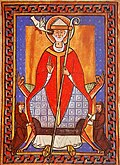 Gregory the DialogistSaint · Pope of RomeMar 12
 Innocent I of RomeSaint · Bishop of RomeMar 12
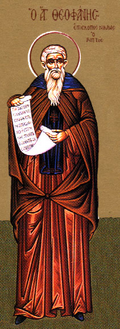 Theophanes the ConfessorVenerable · Chronicler and AbbotMar 12
 Symeon the New TheologianVenerable · Abbot of Saint Mamas MonasteryMar 12
 PhinehasProphet · Priest, grandson of AaronMar 12
 Demetrius II the Self-SacrificerRight-Believing · King of Eastern GeorgiaMar 12
- Maximilian of TebessaMartyr · Martyr of NumidiaMar 12
 Nicodemus of MammolaVenerable · Italo-Greek monk of CalabriaMar 12
 Alexander DerzhavinConfessor · PriestMar 12
- John PlekhanovHieromartyr · PriestMar 12
- Symeon the PiousVenerable · Monk of StoudiosMar 12
- Almut of WetterSaintMar 12