Hieromartyr
Lev Egorov
Archimandrite
Archimandrite born in 1889, brother of Metropolitan Gurius, who died on 20 September 1937; glorified in 2003.
- Feast
- September 7old style September 20
- Reposed
- 193720th century
- Place
- Temirtau
- Order
- Martyrs
Life
Saint Lev Egorov, the Hieromartyr (in the world Leonid Mikhailovich Egorov, 1889 to 1937), was an archimandrite of the Alexander Nevsky Lavra in Petrograd, brother of Metropolitan Gury and, with him, initiator of the Alexander Nevsky Brotherhood, which did missionary and charitable work among the workers and poor of the city. He was arrested several times, sentenced in 1932 to ten years in a camp and shot in 1937 in the Siblag camp. The Holy Synod of the Russian Church glorified him as a holy hieromartyr in July 2003.
Youth and monasticism
Leonid Egorov was born on 26 February 1889 at Opechensky Posad, in Novgorod province. He graduated from the faculty of history and philology of Saint Petersburg University, where he was a pupil of Professor Derzhavin, in the methodology of the Russian language. Then in 1915 he entered the Petrograd Theological Academy and studied three years. He could not finish his studies, because the Academy was closed in 1918. At the end of 1915 he was tonsured a monk of the Alexander Nevsky Lavra with the name Lev, and ordained hierodeacon, then hieromonk. In the same year his brother Vyacheslav was tonsured with the name Gury.
The Alexander Nevsky Brotherhood
Already in 1916 the Egorov brothers, as the people soon called Fathers Gury and Lev, developed, with the permission of the diocesan authorities, together with Hieromonk Innokenty (Tikhonov), intensive missionary work. They "went to the people", that is, they turned to the workers and poor in the area of Ligovsky Prospect. The work of the three young hieromonks took somewhat different forms than before the revolution. They did not "go to the people", but the people came to them. Metropolitan John (Wendland) wrote of the year 1918: "The fame of the 'Egorov brothers' spread through the city". Once Father Gury presented himself to Metropolitan Anthony Khrapovitsky, whom he had not known before. When he gave his surname, the metropolitan exclaimed: "Ah, the Egorov brothers, how could I not know you, all Russia knows the Egorov brothers".
At the beginning of 1919 the "Egorov brothers" organized the Alexander Nevsky Brotherhood at the Lavra, for which Metropolitan Benjamin (Kazansky) gave the Cross church of the Lavra's metropolitan house. The young hieromonk's pastoral work was interrupted by the start of the campaign of seizing church valuables and the so-called Renovationist schism organized by the Soviet authorities. On 16 June 1922 he was arrested and then exiled. He served almost two years of exile, first in Orenburg province, then in the West Kazakhstan region by Lake Elton. In his absence from Petrograd, despite repressions, the activity of the Brotherhood did not cease. In 1924 the term of exile ended. Then Hieromonk Lev was raised to archimandrite, and from March 1926 he fulfilled the duties of dean of the monastic town houses of Leningrad, teacher of Russian literature and member of the pedagogical council of the Theological and Pastoral School. In October 1926 he was named rector of the church of the Feodorovskaya Icon of the Mother of God in Leningrad. Gradually most of the Brotherhood moved there and, in 1930, two of its choirs.
Arrests and the camp
In spring 1927 he was arrested for the second time. At that time about 70 people were studying at the Theological and Pastoral School, and its popularity began to irritate the authorities, who had the GPU fabricate "the case of the Theological and Pastoral School". In the end the case collapsed. On 19 November 1927 all those arrested were released on recognizance not to leave, and a year later, on 10 November 1928, the case was dropped. Despite practically illegal existence, the Brotherhood continued under Archimandrite Lev the social and charitable activity strictly forbidden by Soviet laws.
In the night of 17 to 18 February 1932, 500 people were arrested, among them more than 40 members of the Brotherhood. The investigation was carried out in haste. On 22 March 1932 the visiting commission of the OGPU Collegium gave the sentence. Father Lev was sentenced to the maximum penalty, ten years in a camp. On 18 April 1932 he entered the Chernaya Rechka section of the Siberian camp (Sibirsky ITL, Siblag), in the West Siberian region. From the end of the month he worked in the mine at the settlement of Osinniki, near Novokuznetsk. The work was extremely hard. The camp authorities accused him of counter-revolutionary agitation among prisoners, and a special commission of the OGPU decided to move him to the punishment isolator for two years, and the troika increased the camp sentence by two years.
At the end of March 1936 he was moved from the isolator to the Akhpun section of Siblag (Akhpun station, today Temirtau). There he worked still in the mine, sometimes 14 hours a day hauling trolleys of rock. In 1937 a new criminal case was fabricated against him. On 13 September 1937 the NKVD troika sentenced him to the supreme penalty. He was shot on 20 September 1937. The file contains no data on the place of execution and burial. His relatives were officially informed that he had died in the camp in 1942. The Holy Synod of the Russian Church glorified him as a holy hieromartyr in July 2003.
Commemorated the same day September 7
 KassiaVenerable · Abbess and HymnographerSep 7
 ClodoaldVenerable · Merovingian prince and hermitSep 7
 Regina of AutunMartyrSep 7
 Alexander PeresvetVenerable · Warrior monk of the Trinity LavraSep 7
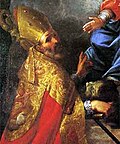 Gratus of AostaSaint · Bishop of AostaSep 7
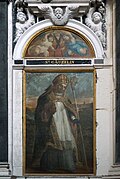 Gauzelin of ToulSaint · Bishop of ToulSep 7
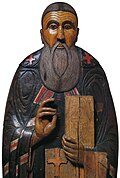 John of NovgorodSaint · Archbishop of NovgorodSep 7
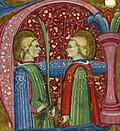 ChiaffredoMartyr · Patron of SaluzzoSep 7
 SozonMartyr · Shepherd of CiliciaSep 7
 Alpinus of ChâlonsSaint · Bishop of ChâlonsSep 7
 Andrew OslyabyaVenerable · Monk of the Trinity LavraSep 7
- Macarius of OptinaVenerable · Hieroschemamonk of OptinaSep 7