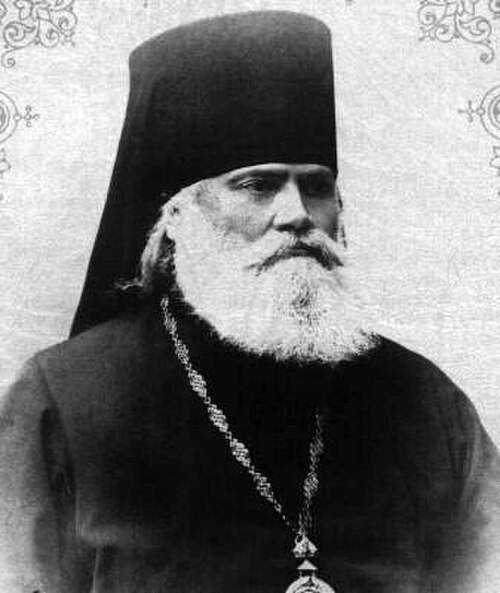
Hieromartyr
Macarius Gnevushev
Bishop of Vyazma
Bishop of Vyazma, vicar of the Smolensk diocese, who died a martyr at Smolensk in 1918; canonized in 2000.
- Feast
- January 29old style February 11
- Reposed
- 191820th century
- Place
- Smolensk
- Order
- Martyrs
Life
Saint Macarius Gnevushev, hieromartyr (born Mikhail Vasilievich Gnevushev, 1858 to 1918), was bishop of Vyazma, vicar of the diocese of Smolensk, shot at Smolensk on 4 September 1918. He was numbered among the new martyrs and confessors of Russia in August 2000 by the Jubilee Council of Bishops of the Russian Orthodox Church, for veneration in the whole Church. His figure remains controversial because of his involvement in the right-wing monarchist movement.
Youth and work as a teacher
He was born in September 1858 in the village of Repyovka, in the Simbirsk province. He studied at the church school at Ardatov and the seminary at Simbirsk (1878), and in 1882 graduated from the Theological Academy at Kyiv, with the title of candidate of theology, with a work on the Church of Alexandria. He was a teacher at the church school of Kyiv-Podil, at the teachers' seminary at Ostroh, at the girls' school in Kyiv and, from 1890, at the seminary in Kyiv, where he became known for fervent sermons and missionary work. In 1902 he initiated the founding of the "Kyiv Pedagogical Society of Mutual Aid".
Right-wing politics
He held right-wing political views. He took an active part in the monarchist movement in Kyiv, was one of the leaders of the movement called the "Black Hundred", in 1906 to 1908 was a member of the council of the Kyiv branch of the Russian Monarchist Party and, as the source records, made sharp antisemitic statements. In 1906 to 1907 he led the Kyiv Union of Russian Workers. In 1908, soon after the death of his wife, he became a monk with the name Macarius, was raised to archimandrite and appointed abbot of the Vysoko-Petrovsky monastery in Moscow. He was the close associate of Archpriest John Vostorgov, leader of the Russian Monarchist Union, took part in founding the Brotherhood of the Resurrection of Christ and in monarchist assemblies. In 1909 he was moved as abbot to the Novospassky monastery in Moscow, where he stressed congregational singing at services as a means of strengthening the interest of the faithful and of fighting the influence of sects. He carried out a major renovation of the monastery's church of Saint Nicholas, to which a large hall was added, which drew sharp criticism from the Imperial Moscow Archaeological Society; he replied that among archaeologists zeal for archaeological details often reaches a kind of idolatry toward every old brick. His work as abbot was several times criticized in newspapers and complaints were sent to the Synod, among them accusations of waste and financial manipulation, but without result. He was also among the organizers of the Congress of Russian People in 1909 and in 1912 chairman of the election committee of the right-wing parties for the Fourth Duma.
Bishop and martyrdom
On 11 July 1914 he was consecrated bishop of Balakhna, vicar of the diocese of Nizhny Novgorod. From January 1917 he was bishop of Oryol and Sevsk, and on 26 May he was retired, appointed to govern the Transfiguration monastery at Vyazma. On 12 August 1918 he was named bishop of Vyazma, vicar of Smolensk. On 22 August he was arrested and imprisoned at Smolensk, and on 4 September 1918, accused of having "organized a White Guard uprising", he was shot by the Cheka on the edge of the town. According to his daughter's recollection, fourteen condemned men were taken to a deserted place and stood with their backs to a freshly dug grave; the executioner went up to each and fired a bullet into the forehead. The bishop, at the end of the line, prayed fervently with his prayer rope for each of those killed. He was shot last.
Veneration
He was rehabilitated on 14 April 1993. His name had been put on a working list of Russian new martyrs when the canonization by the Russian Church Outside Russia in 1981 was being prepared, but that canonization was not by name. In 2000 he was canonized by the Jubilee Council of Bishops. In 2018, at Vyazma, part of Dokuchaev street was renamed Saint Macarius Square, but, because of the controversial character of the bishop, the decision caused a great stir and was annulled on 29 October 2018 by the prosecutor's office as illegal. His commemoration is on 29 January (Old Style).
Commemorated the same day January 29
 Gildas the WiseVenerable · British monk and writerJan 29
 AphrahatVenerable · Syriac writerJan 29
 Ashot I the GreatRight-Believing · Prince of IberiaJan 29
 Aquilinus of MilanMartyr · Missionary priestJan 29
 Constantius of PerugiaSaint · Bishop of PerugiaJan 29
 Martyrs of AlapayevskHoly New Martyrs · Members of the Romanov familyJan 29
 Lawrence of TurovSaint · Bishop of TurovJan 29
 Elijah GromoglasovHieromartyr · Archpriest and theologianJan 29
 Jonah of PermSaint · Bishop of PermJan 29
 Pitirim of PermHieromartyr · Bishop of PermJan 29
- Aphrahat the HermitVenerableJan 29
- Joannicius DmitrievVenerable Martyr · ArchimandriteJan 29