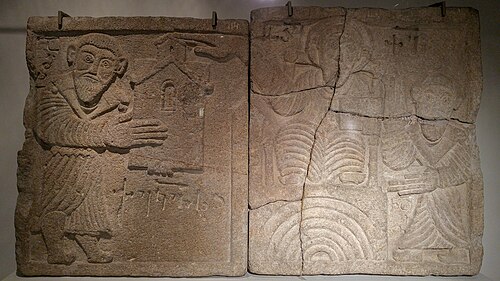
Right-Believing
Ashot I the Great
Prince of Iberia
Presiding prince of Iberia (modern Georgia) of the Bagratid dynasty, based in Tao-Klarjeti; died in 826.
- Feast
- January 29old style February 11
- Reposed
- 8269th century
- Place
- Nigali valley
Life
Saint Ashot I the Great, the right-believing, was a presiding prince of Iberia, that is modern Georgia, of the Bagrationi family, the first of it to attain that office, around 813. From his seat in Tao-Klarjeti he fought to enlarge the Bagrationi domains, sought Byzantine protection against Arab inroads and was murdered around 826. He is also called Ashot Kouropalates, after the Byzantine title he bore. He was a patron of Christian culture and a friend of the Church and was canonized by the Georgian Orthodox Church. He is commemorated on 29 January.
He was the son of the Iberian nobleman Adarnase, who had founded the hereditary Bagrationi fiefdom in Tao-Klarjeti, now in northeast Turkey, and of a daughter of Prince Nerse of Iberia. At first he failed to gain a foothold in central Iberia, Shida Kartli, because the Arabs held Tbilisi. He settled in his inherited duchy of Klarjeti, where he restored the castle of Artanuji, said to have been built by King Vakhtang Gorgasali in the fifth century, and received Byzantine protection, being recognized as prince and kouropalates of Iberia. To revive the land devastated by the Arabs and by cholera epidemics, he patronized the monastic communities founded by Grigol Khandzteli and encouraged the settlement of Georgians there, so that the political and religious centre of Iberia was moved to the southwest, to Tao-Klarjeti. From there he fought to win back Georgian lands from the Arabs and, though not always successful, took much of the neighbouring lands, from Tao in the southwest to Shida Kartli in the northeast, among them Kola, Artani, Javakheti, Samtskhe and Trialeti. Only Kakheti, in the east, eluded him.
When the Arab emirs in the Caucasus were growing ever more independent, the caliph recognized Ashot as prince of Iberia, around 818, to counter the rebellious emir of Tbilisi. With the Abkhazian king Theodosius II he defeated the emir at the Ksani and drove the Kakhetians from the lands of central Iberia. The Bagrationi's fortunes turned when, in 827 or 828, the caliph's viceroy in Arminiya moved to strengthen Arab authority in the Caucasus. Ashot was apparently still alive then, so the date of death in the chronicle of Sumbat, 826, is doubtful, and the murder more probably took place on 29 January 830. Driven by the Arabs from central Iberia, he withdrew to the Nigali valley, where he was killed by traitors at the altar of a church. His land was divided among his three sons: Bagrat I, Adarnase II and Guaram. He was married to Guaramavri, who died in 836, and had also a daughter, married to Theodosius II of Abkhazia.
Commemorated the same day January 29
 Gildas the WiseVenerable · British monk and writerJan 29
 AphrahatVenerable · Syriac writerJan 29
 Aquilinus of MilanMartyr · Missionary priestJan 29
 Constantius of PerugiaSaint · Bishop of PerugiaJan 29
 Martyrs of AlapayevskHoly New Martyrs · Members of the Romanov familyJan 29
 Lawrence of TurovSaint · Bishop of TurovJan 29
 Macarius GnevushevHieromartyr · Bishop of VyazmaJan 29
 Elijah GromoglasovHieromartyr · Archpriest and theologianJan 29
 Jonah of PermSaint · Bishop of PermJan 29
 Pitirim of PermHieromartyr · Bishop of PermJan 29
- Aphrahat the HermitVenerableJan 29
- Joannicius DmitrievVenerable Martyr · ArchimandriteJan 29