Holy New Martyrs
Martyrs of Alapayevsk
Members of the Romanov family
Members of the Romanov house and those close to them, killed by Soviet authorities on the night of July 18, 1918.
- Feast
- January 29old style February 11
- Reposed
- 191820th century
- Order
- Martyrs
Life
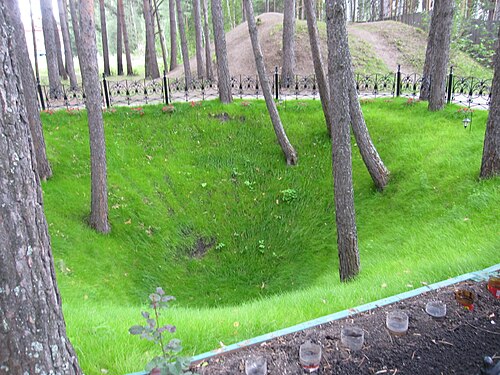
The Martyrs of Alapayevsk are the members of the House of Romanov and those close to them who were killed by the Soviet authorities on the night of 18 July 1918, the day after the murder of the family of Tsar Nicholas II. They were thrown into one of the abandoned shafts of the Nizhnyaya Selimskaya iron mine, 18 kilometres from the town of Alapayevsk in the Urals. The Church commemorates them among the New Martyrs of Russia and honours two of them, Grand Duchess Elizabeth and Sister Barbara, as venerable martyrs.
Those killed at Alapayevsk
Eight people died in the mine near Alapayevsk. Among them was Grand Duchess Elizabeth Feodorovna, foundress of the Convent of Saints Martha and Mary in Moscow and sister of Empress Alexandra. With her died Grand Duke Sergei Mikhailovich and three brothers, princes of the imperial blood and sons of Grand Duke Konstantin Konstantinovich: John, Konstantin the Younger and Igor. Prince Vladimir Pavlovich Paley, son of Grand Duke Paul Alexandrovich by his morganatic marriage to Olga Pistolkors, also died there.
Killed with them were Fyodor Semyonovich Remez, who managed the affairs of Grand Duke Sergei, and Sister Barbara Yakovleva of the Martha and Mary community, the Grand Duchess's cell attendant. In the summer of 1918 Elizabeth was 53, Sergei 48, John 32, Konstantin 27, Igor 24, Vladimir Paley 21, and Sister Barbara about 38.
Exile in the Urals
From their first days in power the Bolsheviks set out to erase every memory of the House of Romanov. At the end of February 1918, as the German offensive threatened Petrograd and the country sank into poverty and unrest, the Bolshevik leaders judged it dangerous for members of the imperial family to remain in the capital. According to the historian V. M. Khrustalev, it was then decided to gather all the Romanovs in the Urals, far from the Germans and the Entente but in a place where the Bolsheviks were strong and had everything under control.
On 9 March 1918 Grand Duke Michael Alexandrovich was exiled to Perm. On 26 March a decree of the Petrograd commune, signed by Zinoviev and Uritsky, sent Sergei Mikhailovich, the brothers John, Konstantin and Igor Konstantinovich and Vladimir Paley to Vyatka. A month later they were moved to Yekaterinburg and lodged at the Atamanovskie Nomera hotel.
On 7 May 1918 Grand Duchess Elizabeth was arrested in Moscow and sent to Perm, then to Yekaterinburg, where she was lodged at the Novo-Tikhvin Convent. She was accompanied by her cell attendant, Sister Barbara Yakovleva, and by Sister Catherine Yanysheva. After the tsar, the tsarina and their daughter Maria had been brought to Yekaterinburg on 30 April, and the other children in mid-May, the Ural Bolsheviks decided to disperse some of the Romanovs. By a resolution of the regional soviet of 18 May the prisoners were taken to Alapayevsk, where they arrived on 20 May.
Life in the school on the edge of town
At Alapayevsk they were held in the so-called Napolnaya School on the outskirts of the town. At first the regime was fairly mild. They had papers allowing them to move only within Alapayevsk, could go out by informing the guard, were permitted to write letters, attend church and walk in the field beside the school. Elizabeth prayed much, painted and embroidered. The prisoners made a small garden where they sometimes drank tea in the open air.
On the night of 12 to 13 June 1918 Grand Duke Michael was killed at Perm, and the authorities announced that he had escaped. This "escape" was used as a pretext to tighten the regime for all the Romanovs in the Urals, in agreement with Moscow and Petrograd.
On 21 June the order came to Alapayevsk. All their belongings were taken: shoes, linen, clothes, pillows, gold items and money, leaving them only the clothes they wore and two changes of underwear. Walks and letters were forbidden and their food was cut. Sister Catherine, two servants and the doctor Helmersen were sent away. A little later Helen of Serbia, wife of Prince John, who had given up her foreign citizenship in order to stay near her husband, also had to leave.
The night of 18 July
On the night of 18 July, on the pretext of moving the prisoners to the Verkhnyaya Sinyachikha works, a group of workers from the Nevyansk and Verkhnyaya Sinyachikha factories, led by Pyotr Startsev, arrived at the school. According to the testimony of one of the killers, the women were woken and told they were to be taken to a safe place because they were in danger of an armed raid. They obeyed without complaint. Their hands were tied behind their backs and they were blindfolded, then put into a cart.
The men were told the same. The young Konstantinovich princes and Prince Paley obeyed without argument. Only Grand Duke Sergei Mikhailovich tried to resist, and he was wounded by a bullet.
The prisoners were taken out of town to one of the abandoned shafts at Nizhnyaya Selimskaya. Grand Duke Sergei was shot and thrown into the shaft. The others were thrown in alive, according to some accounts after being struck on the head with the back of an axe. The killers then threw grenades into the shaft and covered it with poles, logs and earth.
The witness of the mine
When the bodies were later brought out of the mine, it was found that some had died almost at once, but others had survived the fall and died of hunger and their wounds. Prince John had fallen onto a ledge of the shaft beside the Grand Duchess, and his head wound was bound with a piece of her veil. The bodies of Prince Paley and Sister Barbara were found in a half-sitting position.
Peasants of the area said that for several days the sound of prayers being sung came from the mine. One of the killers recalled that after the first grenade was thrown, the troparion of the Cross rose from the depths: "O Lord, save Thy people and bless Thine inheritance." Other sources hold that death came almost at once for all and that the accounts of prayers in the mine belong to popular piety. The recollections of two local Bolshevik leaders, however, confirm that the prisoners were thrown into the mine alive and, stopping on a timber platform, remained alive, so that the killers then threw bombs down on them.
The staged abduction
Around three in the morning shots were fired and grenades exploded near the school, and a Red Army detachment was kept around the building for an hour. Commissar A. Smolnikov then came out and announced that White Guards had carried off the princes by aeroplane. The Alapayevsk executive committee telegraphed Yekaterinburg that an unknown band had attacked the school, that one bandit had been killed, and that the princes had escaped with their servants in an unknown direction. On the basis of this telegram the chairman of the regional soviet, A. G. Beloborodov, reported to Moscow and Petrograd, and on 26 July an official notice of the "abduction of the princes" was published.
On the morning of 18 July posters about the abduction were put up around the town. Nothing was said of the fate of the Grand Duchess and her attendant. The official inquiries led nowhere, and in August the princes' belongings were sold off as those of missing persons.
Émigré researchers, drawing on the investigation of N. A. Sokolov, showed that the abduction had been staged. The first to write of it was General Mikhail Diterikhs. While materials were being prepared for the canonisation of the New Martyrs, a transcript was found in the Yekaterinburg archives of a meeting held on 6 January 1933 by former Bolshevik activists of the Alapayevsk district. In it E. L. Seryodkin, chairman of the Verkhnyaya Sinyachikha soviet, and N. P. Govyrin, chairman of the extraordinary investigative commission, admitted that the prisoners had been killed and the abduction staged.
The investigation
At the end of September 1918 Alapayevsk came under the control of Admiral Kolchak's White forces, and an investigation was opened. Judge I. A. Sergeyev began it on 11 October 1918, and from 7 February 1919 it was taken over by N. A. Sokolov, who was also investigating the murder of the imperial family.
The 1933 transcript suggested that the killing had been decided by the Alapayevsk Bolshevik organisation without approval from the regional authorities. The Chekist Pyotr Startsev, who took part in the crime, stated however that it was done on orders from Yekaterinburg and that G. I. Safarov, one of the organisers of the murder of the imperial family, had come specially to direct it. From this Sokolov concluded that the two crimes were linked.
The journey of the bodies
In the autumn of 1918 the bodies were brought up from the mine, placed in coffins and taken to the Holy Trinity Cathedral in Alapayevsk. As the Red Army approached, the Whites carried them east through Chita to Harbin and then to Beijing, to the Russian Orthodox Mission. The bodies of Grand Duchess Elizabeth and Sister Barbara were taken on to Jerusalem and laid in the Church of Saint Mary Magdalene at Gethsemane, where they rest today.
Canonisation and veneration
The Russian Orthodox Church Outside of Russia numbered all those killed at Alapayevsk, except Fyodor Remez, among the martyrs. The Russian Orthodox Church canonised only Grand Duchess Elizabeth and Sister Barbara, as venerable martyrs. On 8 June 2009 the Prosecutor General of Russia posthumously rehabilitated all those killed near Alapayevsk.
In 1995 a men's monastery dedicated to the New Martyrs and Confessors of the Russian Church was founded beside the Nizhnyaya Selimskaya mine, and it has become a place of pilgrimage for believers from the Urals and all of Russia. The Martyrs of Alapayevsk are commemorated on 5 July, the day of their death according to the Old Style calendar.
Commemorated the same day January 29
 Gildas the WiseVenerable · British monk and writerJan 29
 AphrahatVenerable · Syriac writerJan 29
 Ashot I the GreatRight-Believing · Prince of IberiaJan 29
 Aquilinus of MilanMartyr · Missionary priestJan 29
 Constantius of PerugiaSaint · Bishop of PerugiaJan 29
 Lawrence of TurovSaint · Bishop of TurovJan 29
 Macarius GnevushevHieromartyr · Bishop of VyazmaJan 29
 Elijah GromoglasovHieromartyr · Archpriest and theologianJan 29
 Jonah of PermSaint · Bishop of PermJan 29
 Pitirim of PermHieromartyr · Bishop of PermJan 29
- Aphrahat the HermitVenerableJan 29
- Joannicius DmitrievVenerable Martyr · ArchimandriteJan 29