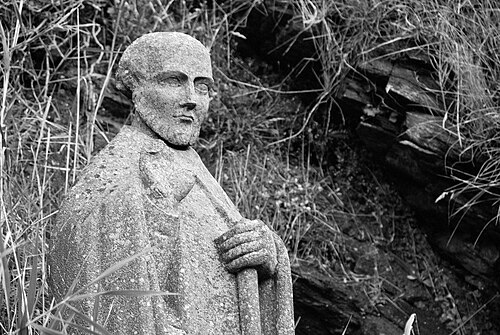
Venerable
Gildas the Wise
British monk and writer
British monk of the sixth century, author of a work on the ruin of Britain.
- Feast
- January 29old style February 11
- Reposed
- 5706th century
- Place
- Rhuys Peninsula
- Order
- Venerables
Life
Venerable Gildas the Wise was a British monk of the sixth century, the author of On the Ruin and Conquest of Britain, the only extensive account of the history of the Britons written close to the events. He is honoured as a saint of the undivided Church in Wales, in Brittany and in the Orthodox Church. He is commemorated on 29 January.
His life
Few certain things are known about him. The two lives of him are late and contradict each other: the first was written in the eleventh century by a monk of the monastery he founded in Brittany, and the second by Caradoc of Llancarfan, a largely invented account meant to link him to Glastonbury and King Arthur. Gildas himself says that he was born in the year of the battle of Mons Badonicus, in which the Britons halted the advance of the Saxons.
The first life names him the son of Caunus, a king of Alt Clud in the north of Britain, and says he was born at Arecluta on the River Clyde. Some historians think he came from the south of the island, since his writing shows better knowledge of the south and a fine Latin education. According to his lives he studied at the monastery of Saint Illtud in Glamorgan, forsook his noble birth for the monastic life, was ordained priest in Ireland and preached in the north of Britain. The high king of Ireland is said to have called on him to restore the Church there. He is said to have travelled to Rome and Ravenna, then settled as a hermit on the island of Houat in Brittany. Pupils sought him out and begged to be taught, and he founded the monastery of Saint-Gildas-de-Rhuys.
On the Ruin and Conquest of Britain
The work, in Latin, is a sermon in three parts. The first is a short history of Britain from the Romans to his own day. The second rebukes five British kings, among them Constantine, Aurelius Conanus, Vortiporius, Cuneglasus and Maelgwn. The third rebukes the clergy. Gildas holds that the Saxon invasion is a punishment from God for the sins of the people and its leaders. The tone is severe, in the manner of the Old Testament prophets. He says he was forty-four when he wrote it; the date of the work is debated, the older view placing it in the 540s and some scholars earlier. It names for the first time Ambrosius Aurelianus as a leader of resistance to the Saxons. The hymn called the Lorica, a prayer for deliverance from evil, is also attributed to him.
His end and veneration
He is thought to have died around 570 at Rhuys and to have been buried there. His relics were venerated at Rhuys until the tenth century, when they were taken to Berry, and in modern times they returned to Saint-Gildas-de-Rhuys, where a skull reliquary, an arm and other parts are kept in a treasury. He is patron of several churches and monasteries in Brittany.
Commemorated the same day January 29
 AphrahatVenerable · Syriac writerJan 29
 Ashot I the GreatRight-Believing · Prince of IberiaJan 29
 Aquilinus of MilanMartyr · Missionary priestJan 29
 Constantius of PerugiaSaint · Bishop of PerugiaJan 29
 Martyrs of AlapayevskHoly New Martyrs · Members of the Romanov familyJan 29
 Lawrence of TurovSaint · Bishop of TurovJan 29
 Macarius GnevushevHieromartyr · Bishop of VyazmaJan 29
 Elijah GromoglasovHieromartyr · Archpriest and theologianJan 29
 Jonah of PermSaint · Bishop of PermJan 29
 Pitirim of PermHieromartyr · Bishop of PermJan 29
- Aphrahat the HermitVenerableJan 29
- Joannicius DmitrievVenerable Martyr · ArchimandriteJan 29