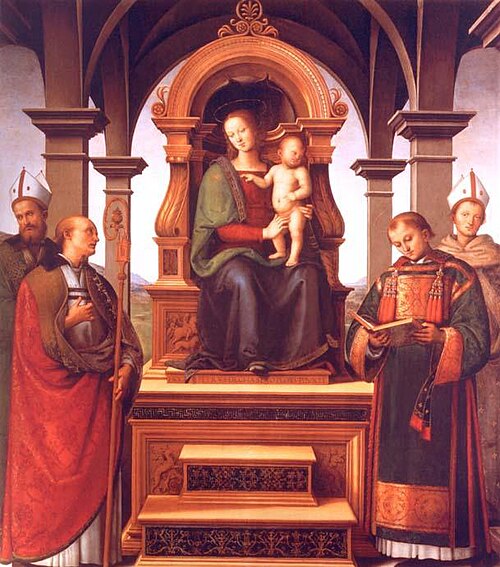
Saint
Constantius of Perugia
Bishop of Perugia
Bishop and one of the patrons of Perugia in Italy, who died around 170.
- Feast
- January 29old style February 11
- Reposed
- 1702nd century
- Place
- Foligno
- Order
- Hierarchs
Life
Saint Constantius was a bishop and martyr in Umbria, in Italy, in the second century, when Christians were persecuted by the Roman emperors. Local tradition counts him as the first bishop of Perugia, and the city still honours him as one of its patron saints. He departed to the Lord around the year 170, through martyrdom, near Foligno.
According to tradition, Constantius took up the care of the city at the age of thirty. It is said that he preached the Gospel with zeal and looked after the poor. The legend of his life survives in four versions, which differ in details but agree on the place where he suffered.
Martyrdom
In these accounts Constantius was arrested during the persecution under the emperor Antoninus (some sources name Marcus Aurelius) and was scourged. He was then thrown, together with his companions, into a blazing furnace, from which all came out unharmed. He was imprisoned and was set free by his guards, whom he had brought to the Christian faith.
The saint took refuge in the house of a Christian named Anastasius, but both were arrested again. After torments in the prisons of Assisi and Spello, they were beheaded near Foligno.
Veneration
His cult spread beyond Umbria, and the Martyrologium Hieronymianum commemorates him on 29 January. According to the accounts of his martyrdom, his body was carried to Perugia and buried near the site of the present cathedral. The church dedicated to him in the city was pulled down in 1527, and in 1825 his relics were solemnly moved to a new altar in the church of San Costanzo.
In iconography Saint Constantius is shown as a bishop with mitre and crozier, often beside another patron of Perugia, Saint Herculanus. On his feast the people of Perugia keep an old custom of baking the "torcolo", a ring-shaped cake made with pine nuts, raisins and dried fruit.
Commemorated the same day January 29
 Gildas the WiseVenerable · British monk and writerJan 29
 AphrahatVenerable · Syriac writerJan 29
 Ashot I the GreatRight-Believing · Prince of IberiaJan 29
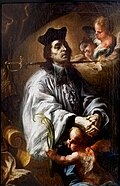 Aquilinus of MilanMartyr · Missionary priestJan 29
 Martyrs of AlapayevskHoly New Martyrs · Members of the Romanov familyJan 29
 Lawrence of TurovSaint · Bishop of TurovJan 29
 Macarius GnevushevHieromartyr · Bishop of VyazmaJan 29
 Elijah GromoglasovHieromartyr · Archpriest and theologianJan 29
 Jonah of PermSaint · Bishop of PermJan 29
 Pitirim of PermHieromartyr · Bishop of PermJan 29
- Aphrahat the HermitVenerableJan 29
- Joannicius DmitrievVenerable Martyr · ArchimandriteJan 29