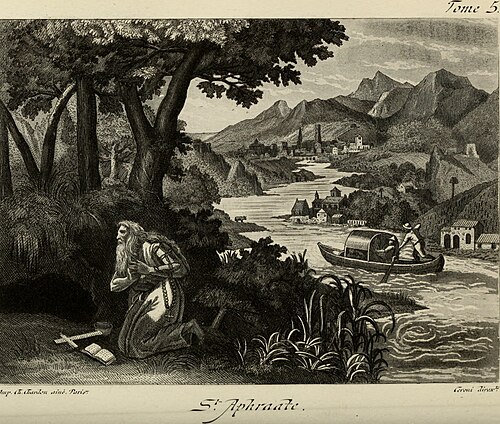
Venerable
Aphrahat
Syriac writer
Syriac Christian writer of the Persian Empire, author of theological Demonstrations in the fourth century.
- Feast
- January 29old style February 11
- Reposed
- 3454th century
- Place
- Adiabene
- Order
- Venerables
Life
Venerable Aphrahat, called the "Persian Sage," was a Christian writer in Syriac from the Persian Empire in the fourth century, the author of the twenty-three Demonstrations, the oldest Christian writings preserved from Persia. He lived as an ascetic. The Church's calendar remembers an "Aphraates the Persian" on 29 January, but the Byzantine synaxarion describes there a Persian ascetic who lived near Antioch and died around 370, and not all scholars take him to be the same man as the writer.
His life
Little is known about him. He was born around 280, near the border between Roman Syria and Persia, in the time of Shapur II. The name Aphrahat is the Syriac form of the Persian name Frahat. A manuscript of 510 gives him the name Jacob, perhaps his baptismal name, and so he was later confused with Saint James of Nisibis. The two are different men: James of Nisibis died in 338, while Aphrahat wrote between 337 and 345.
He lived as an ascetic, by every sign among the "sons of the covenant," an early form of celibate life in the Syriac Church. Later tradition says that he was a bishop and the head of the monastery of Mar Mattai near Mosul, but this is uncertain. In his writings he does not call himself a bishop, but he speaks with authority about pastors and faithful. In 344 he drew up, in the name of a synod, a letter to the Churches of Ctesiphon and Seleucia, which became his fourteenth Demonstration.
The Demonstrations
The twenty-three Demonstrations are treatises on faith and Christian life. The first ten were written in 337 and speak of faith, love, fasting, prayer, wars, the sons of the covenant, repentance, the resurrection of the dead, humility and pastors. The next twelve, written in 344, treat circumcision, Passover, the Sabbath, foods, the call of the Gentiles, Christ, virginity, the dispersion of Israel, almsgiving, persecution, and death and the last days. The twenty-third, written in the winter of 344-345, takes as its theme the cluster of grapes from Isaiah 65:8 and follows the fulfilment of the messianic promise from Adam to Christ. The first twenty-two begin with the successive letters of the Syriac alphabet. The persecution of Shapur II, in the time of many of these works, grew out of the tension between Rome and Persia, since Persian Christians were suspected of favouring Rome.
Aphrahat reads Scripture in Syriac and quotes the Gospels from Tatian's Diatessaron. He does not philosophize, but stays close to the Bible. He laid a foundation for Syriac Christian literature and prepared the way for Saint Ephrem the Syrian. His writings were translated into Armenian, Georgian and Ethiopic.
His end
He died around 345, in a time still troubled for the Church of Persia. Nothing is recorded about his last days. His writings are valued as an early witness to the Christian faith in the East.
Commemorated the same day January 29
 Gildas the WiseVenerable · British monk and writerJan 29
 Ashot I the GreatRight-Believing · Prince of IberiaJan 29
 Aquilinus of MilanMartyr · Missionary priestJan 29
 Constantius of PerugiaSaint · Bishop of PerugiaJan 29
 Martyrs of AlapayevskHoly New Martyrs · Members of the Romanov familyJan 29
 Lawrence of TurovSaint · Bishop of TurovJan 29
 Macarius GnevushevHieromartyr · Bishop of VyazmaJan 29
 Elijah GromoglasovHieromartyr · Archpriest and theologianJan 29
 Jonah of PermSaint · Bishop of PermJan 29
 Pitirim of PermHieromartyr · Bishop of PermJan 29
- Aphrahat the HermitVenerableJan 29
- Joannicius DmitrievVenerable Martyr · ArchimandriteJan 29