Venerable
Martyrius Kirichenko
Venerable of Glinsk Hermitage
A venerable father of Glinsk Hermitage, who died in 1865.
- Feast
- September 9old style September 22
- Reposed
- 186519th century
- Order
- Venerables
Life
The Venerable Martyrius Kirichenko of Glinsk (died 1865), in the world Matthew, was a monk of the Glinsk Hermitage known for his fasting, silence and self-denial. Born around 1800 in a devout family of the Kursk region, he entered the hermitage in 1831, in the time of Abbot Philaret, was received as a novice in 1835 and tonsured in 1840 with the name Martyrius. His first obedience was in the kitchen, beside the blessed elder Theodotus, who was for him an example of self-denial.
His labours
Martyrius lived in perfect poverty: he had no spare garment, would not see money and accepted nothing from his well-off brother except wax candles for prayer; he asked him to give his alms elsewhere, so that the monk might stay unknown. He rejected the priesthood altogether. He kept his eyes closed and his head bowed at services, spoke no idle words and knew the Psalter by heart, reciting it in his mind at any work. He slept sitting on a sheepskin, between an icon and a board of books, and never counted his prostrations, lest he be tempted to pride.
The longest part of his life he spent as miller, at a distant mill, where he moved his services and vigils to the night. One winter a novice noticed that, instead of mending his hut, the elder let the cold in; invited to his prayer, the novice laboured so in prostrations that he undressed from sweat, and the elder told him with a smile to do the same whenever he was cold. He fasted severely: a day or two without food was usual, in Great Lent he lived weeks on bread and water, and once he stayed fifteen days without food, then said that more was not possible. To the steward who asked why he no longer came for provisions he answered only: "It is far." Sometimes he feasted the brethren with pancakes baked at the mill.
In the summer of 1863, in the tower where he lived, he was attacked at night by demons, who left bruises on his body and wounded his right arm. He told his confessor, Porphyrius, simply, puzzled that the enemy should attack him. The same year the hieroschemamonk Macarius moved into the same tower, and the two elders exchanged spiritual words.
His end
As he weakened he did not change his rule; in his last Great Lent he allowed himself only warm water and a spoon of honey on Wednesday. On Paschal night he listened to the service from the cathedral porch, leaning on the wall, and on the second day of Pascha he received Communion and died with prayer on his lips, on 5 April 1865. His face became bright, and the schema-archimandrite Heliodorus said that such an end bore witness to a God-pleasing life. He was buried at Glinsk. He is commemorated on 22 September, in the new style, in the Synaxis of the Venerable Fathers of Glinsk.
Commemorated the same day September 9
 JoachimRighteous · Father of the TheotokosSep 9
 Ciarán of ClonmacnoiseVenerable · Abbot of ClonmacnoiseSep 9
 Joseph of VolotskVenerable · Abbot of Volokolamsk MonasterySep 9
 Gorgonius of NicomediaMartyr · Martyr of NicomediaSep 9
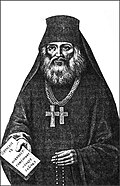 Philaret of GlinskVenerable · Abbot of Glinsk HermitageSep 9
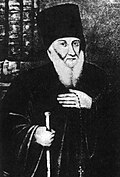 Basil KishkinVenerable · Hieromonk of PloshchanskSep 9
- Zenobius MazhugaSaint · Metropolitan of the Georgian ChurchSep 9
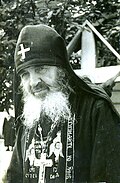 Andronik LukashVenerable · Schema-archimandrite and elderSep 9
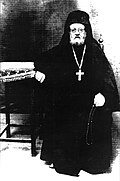 Joanicius of RakotinciVenerableSep 9
 Zacharias LobovHieromartyr · Archbishop of VoronezhSep 9
- Joachim of OpochkaVenerable · Disciple of St. Euphrosynus of PskovSep 9
- Nikita of ConstantinopleFool-for-Christ · Clerk of ConstantinopleSep 9