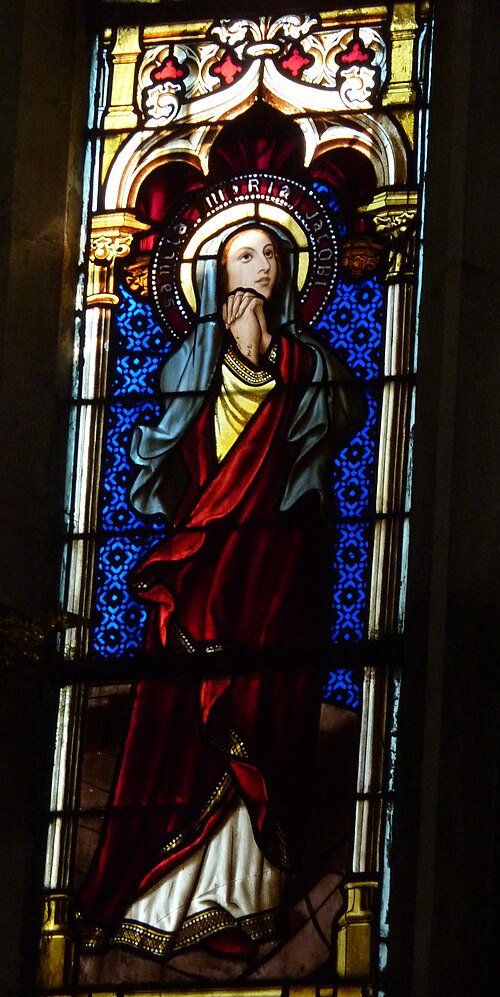
Saint
Mary of Clopas
Myrrhbearer
One of the women who stood by the cross of the Lord and came to the tomb with spices.
- Feast
- May 23old style June 5
- Reposed
- 11st century
Life
Saint Mary of Clopas, called in the Orthodox tradition Mary the wife of Cleopas, was one of the women who followed the Lord, stood by His cross and came to the tomb with spices. The Orthodox Church honours her among the holy myrrh-bearing women. Her own day is 23 May, and she is remembered again on the third Sunday after Pascha.
In the Gospels
Her name is given only in John 19:25, where she is among the women standing by the cross of Jesus with His mother and Mary Magdalene. The Greek wording says "Mary of Clopas" without stating the relation, and the usual reading is that she was the wife of Clopas. The second-century writer Hegesippus, quoted by Eusebius, says that Clopas was a brother of Joseph.
Matthew and Mark name a "Mary the mother of James and Joses" among the women at the Crucifixion, and the Church has generally taken this to be the same woman. On the morning after the Sabbath she went with the other myrrh-bearers to anoint the body of the Lord, and with them heard from the angel that He is risen. Matthew calls her "the other Mary," to tell her apart from Mary Magdalene.
Tradition about her family
The Orthodox Church in America gives the Church's tradition in this form: Mary was a daughter of Saint Joseph the Betrothed by his first wife, and so grew up as a friend of the Mother of God. After the return from Egypt Joseph gave her in marriage to his younger brother Cleopas. Their son was the Hieromartyr Symeon, one of the seventy apostles and the second bishop of Jerusalem, a kinsman of the Lord (27 April).
The Greek synaxarion names her sons as Joses and James, called the Less. It adds that she was present at Pentecost in the upper room and went on serving the first Church at Jerusalem.
Saint Jerome argued in the West that the "brothers of the Lord" were sons of Mary of Clopas, the sister of the Mother of God, and so cousins of the Lord. This is a Western reading and not the tradition quoted above. A later Western legend about three Marys sailing to Provence, to Saintes-Maries-de-la-Mer, is not part of the Orthodox synaxarion.
Veneration
Nothing certain is known of her last years or of her repose. A portion of her relics is kept at the monastery of Panagia Tourliani on Mykonos.
Commemorated the same day May 23
 Euphrosyne of PolotskVenerable · Abbess of PolotskMay 23
 Demetrius I of GeorgiaRight-Believing · King of GeorgiaMay 23
 Michael of SynnadaSaint · Metropolitan of SynnadaMay 23
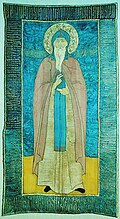 Nicetas the Stylite of PereslavlStylite · Founder of Saint Nicetas MonasteryMay 23
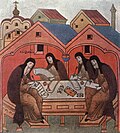 Epiphanius the WiseVenerable · Monk and hagiographerMay 23
 Desiderius of LangresHieromartyr · Bishop of LangresMay 23
 Euphebius of NaplesSaint · Bishop of NaplesMay 23
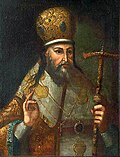 Arsenius MatsievichHieromartyr · Metropolitan of RostovMay 23
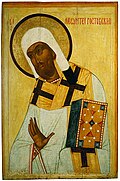 Leontius of RostovSaint · Bishop of RostovMay 23
 Cyril II of RostovSaint · Bishop of RostovMay 23
 Dimitry of UglichRight-Believing · Prince of UglichMay 23
 Simeon of VladimirSaint · Bishop of VladimirMay 23